

Artificial intelligence has made content creation faster than ever, but it has also introduced a new layer of uncertainty. A paragraph can now be generated in seconds, rewritten in a different tone, translated into another language, and polished until it sounds convincingly human. For businesses, educators, publishers, and individual creators, that convenience comes with a difficult question: how can anyone tell what was generated by AI, and what can be done when AI-generated text needs to sound more natural?
Lynote.ai is positioning itself around both sides of that problem. Rather than treating AI detection and AI-assisted rewriting as completely separate tasks, the platform brings them together in a single workflow designed for the realities of modern content creation.
That approach is increasingly relevant as AI models continue to evolve. Tools such as ChatGPT, Gemini, Claude, DeepSeek, and open-source models have made high-quality text generation widely accessible. At the same time, the distinction between AI-written and human-written content has become considerably harder to identify through simple surface-level checks.
AI Detection Is Becoming a More Complicated Challenge
Early AI detectors often focused on obvious patterns in machine-generated writing. Predictable sentence structures, repetitive phrasing, and unusual word distributions could sometimes provide useful signals. But generative AI has moved well beyond those early characteristics.
Modern AI systems can produce varied sentence structures and imitate different writing styles. Content can also be passed through rewriting or paraphrasing tools before being submitted for detection. As a result, simply asking whether a piece of text “looks like AI” is no longer enough.
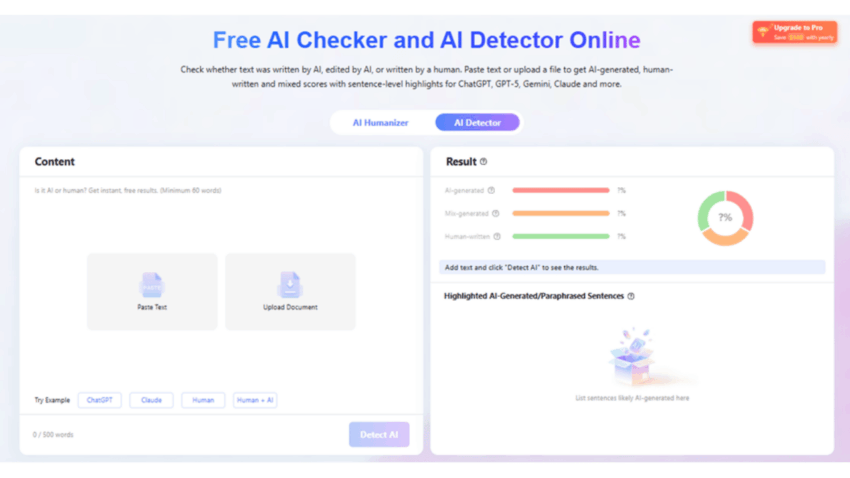
Lynote.ai approaches this challenge with an AI detection system designed to analyze content more deeply. The platform claims up to 99% accuracy and supports detection across major AI models, including GPT-5, Gemini, Claude, and LLaMA. This broad model coverage is important because content creators rarely rely on a single AI platform today.
The detection process is also intended to go beyond identifying obvious machine-generated output. One of the more interesting aspects of Lynote.ai’s approach is its ability to analyze text that may have already been rewritten or “humanized” by another AI tool.
This matters because AI-generated content is increasingly being processed through multiple systems. A user might generate an article with one model, rewrite it with another, and then make additional edits manually. A detector that only recognizes the fingerprints of raw AI output may struggle with this type of layered content.
For users who need a practical way to evaluate content before publication, Lynote.ai’s best ai detector capability is designed to provide a broader layer of analysis rather than relying exclusively on obvious linguistic patterns.
The Multilingual Dimension
Another area where AI detection becomes more complicated is language.
AI-generated content is no longer an English-only phenomenon. Businesses operate internationally, creators publish for global audiences, and multilingual teams increasingly use generative AI as part of everyday workflows.
Lynote.ai supports AI-generated content detection across multiple languages, including English, Spanish, French, Portuguese, and German. This multilingual capability gives the platform a wider potential use case for agencies, publishers, educational organizations, and companies managing content across different markets.
The importance of multilingual detection is easy to overlook. A company may have strong internal processes for reviewing English content while having less visibility into content produced in other languages. A detection system that can operate across several major languages can help create a more consistent review process.
Of course, no AI detector should be viewed as an absolute replacement for human judgment. Detection technology is best understood as one part of a broader content verification process. The value lies in providing additional signals that help users make better-informed decisions.
From Detection to Transformation
Lynote.ai’s second major focus is the other side of the AI content equation: what happens when generated text is technically correct but simply does not sound natural enough?
Anyone who has worked extensively with AI writing tools has probably encountered this problem. The text may be grammatically perfect, yet the rhythm feels repetitive. Transitions can seem overly polished. Sentences may follow familiar patterns. The content communicates the right information, but it lacks the subtle variation that makes human writing feel authentic.
Basic paraphrasing tools often attempt to solve this by replacing individual words with synonyms. The result can sometimes be even less natural than the original.
Lynote.ai takes a different approach with its AI humanization technology. Its context-aware rewriting system is designed to understand the logic and meaning of a passage before transforming it. Instead of simply swapping vocabulary, the goal is to preserve the original message while improving the way the content reads.
This distinction is particularly important for professional users. A marketing team may want to retain the meaning of a product explanation. A researcher may need to preserve technical context. A business writer may want to make an AI-assisted draft sound more conversational without changing its underlying information.
The platform’s best ai humanizer functionality is built around this concept of human-like content transformation, with support for outputs from major AI systems such as ChatGPT, Gemini, DeepSeek, and Claude.
More Than Just Synonym Replacement
One of the biggest differences between sophisticated AI humanization and traditional spinning tools is context.
A basic spinner may see the sentence “The software improves productivity” and replace “improves” with “enhances.” The words have changed, but the writing itself has not become more human.
Context-aware rewriting operates at a different level. It considers how ideas connect, how sentences flow, and how the meaning of a passage develops. The aim is not merely to produce a different version of the same sentence, but to create a more natural reading experience.
Lynote.ai also offers customizable bypass modes and supports more than 80 languages. For users working across international markets, that combination can be useful because writing preferences differ significantly from one language to another.
The platform also promotes a 99% undetectable guarantee for its humanized output. While users should always evaluate AI-generated or AI-assisted content according to the policies of their organization, school, publisher, or platform, the underlying goal is clear: make AI-assisted writing less formulaic and more natural without stripping away its original intent.
A Two-Sided Workflow for the AI Era
The most interesting aspect of Lynote.ai may ultimately be the relationship between its two core functions.
AI detection asks a question: “How likely is this content to have been generated or influenced by AI?”
AI humanization asks a different question: “How can AI-assisted content be transformed into writing that feels more natural while preserving its meaning?”
These are opposite directions, but they exist within the same content ecosystem.
For publishers and educators, detection can help evaluate incoming material. For marketers, agencies, and businesses, humanization can help refine AI-assisted drafts before they are reviewed and published. For individual creators, the two functions can become part of a broader editing workflow.
Compared with standalone AI detectors that focus exclusively on identification, or basic humanizer tools that primarily rely on synonym substitution, Lynote.ai’s value proposition is its attempt to address both sides of the process.
The broader lesson is that AI content technology is moving beyond a simple “AI versus human” debate. In practice, the future of digital writing will likely involve a mixture of human creativity, AI assistance, automated verification, and editorial judgment.
That makes tools capable of analyzing and transforming content increasingly relevant.
Lynote.ai is entering this changing environment with a clear focus: helping users understand AI-generated content while giving them greater control over how AI-assisted writing is ultimately presented. Its combination of high-accuracy detection, multilingual analysis, context-aware rewriting, broad model compatibility, customizable modes, and support for more than 80 languages reflects a more comprehensive view of the AI content workflow.
As generative AI continues to evolve, the challenge will not simply be creating more text. It will be creating content that is accurate, useful, appropriate, and natural—and knowing how that content was produced in the first place. That is the space Lynote.ai is aiming to address.
