

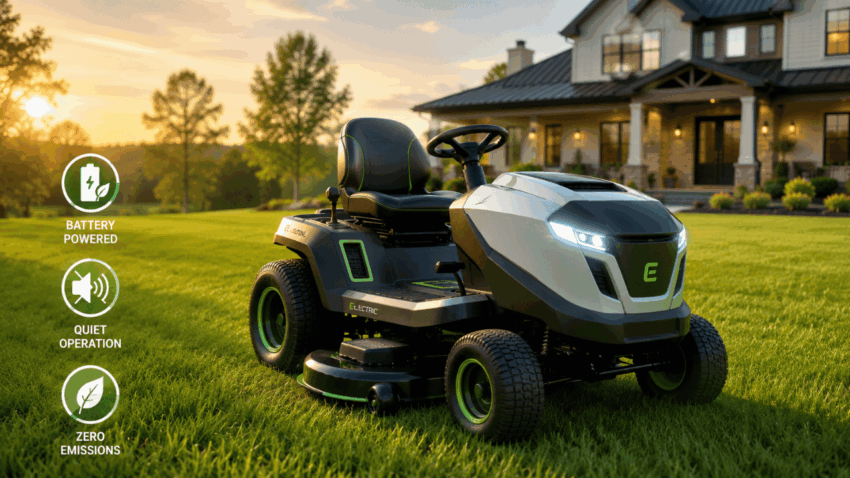
Maintaining a large lawn is rewarding, but it also demands the right equipment. If you’ve ever spent hours behind a walk-behind mower only to realize there’s still plenty of grass left to cut, you already understand why many homeowners eventually upgrade to an electric riding mower. Over the past 15 years of evaluating outdoor power equipment, I’ve seen battery-powered riding mowers evolve from niche alternatives into practical, high-performing machines capable of handling substantial residential properties.
Before investing in an electric riding mower, it’s important to evaluate more than just cutting width or battery capacity. The best model for your property depends on lawn size, terrain, runtime, comfort, and the features that improve mowing efficiency over the long term. Choosing wisely can save hours of work each mowing season while reducing maintenance compared to traditional gas-powered equipment.
This guide explains the key factors experienced buyers consider before purchasing an electric riding mower for a large residential lawn.
Why Electric Riding Mowers Have Become a Smart Choice for Homeowners
Battery technology has advanced rapidly over the past decade, making electric riding mowers a realistic option for homeowners with one acre or more of maintained property.
Compared with gas-powered models, electric riding mowers offer several practical benefits:
- Quieter operation
- Push-button starting
- Lower maintenance requirements
- No gasoline storage or fuel mixing
- Zero direct exhaust emissions during operation
- Smooth and consistent power delivery
Many homeowners are surprised by how much time they save simply by eliminating routine engine maintenance such as oil changes, spark plug replacement, and fuel system upkeep.
Match the Mower to the Size of Your Property
One of the biggest buying mistakes is choosing a mower that doesn’t match the size of the lawn.
Small Large-Lot Properties (Up to 1 Acre)
A compact riding mower with a 42-inch deck and moderate battery capacity typically provides more than enough coverage.
Medium Residential Properties (1–2 Acres)
Look for a mower with a 42- to 48-inch cutting deck and sufficient battery capacity to complete mowing on a single charge.
Larger Residential Estates (2 Acres and Beyond)
Properties with extensive open spaces often benefit from wider cutting decks, larger battery systems, and faster travel speeds that reduce overall mowing time.
Selecting the right deck size can significantly improve efficiency without sacrificing maneuverability.
Battery Runtime Matters More Than Battery Voltage
Many shoppers focus on voltage because it’s easy to compare across different models. In reality, runtime depends on a combination of battery capacity, motor efficiency, terrain, grass conditions, and driving habits.
For example, mowing thick spring grass on hilly terrain requires considerably more energy than maintaining a flat lawn during midsummer.
When evaluating runtime, consider:
- Property size
- Grass density
- Terrain
- Typical mowing frequency
- Recharge time
- Availability of expandable battery systems
Experienced users often prioritize consistent runtime over maximum advertised voltage.
Choose the Right Cutting Deck Width for Efficiency
A wider cutting deck allows you to cover more ground with each pass, but bigger isn’t always better.
| Deck Width | Best For | Advantages |
| 42 inches | Up to 1 acre | Easier maneuverability |
| 46–48 inches | 1–2 acres | Balanced productivity |
| 52 inches or larger | Large open properties | Faster mowing with fewer passes |
If your yard includes narrow gates, landscaped beds, or winding pathways, a slightly smaller deck may actually improve productivity by reducing the need for additional trimming.
Look Beyond Power: Comfort Features Make a Difference
For large residential properties, you’ll likely spend an hour or more on the mower during each session. Comfort becomes far more important than many buyers realize.
Features worth considering include:
- Adjustable high-back seating
- Ergonomic steering wheel
- Cruise control
- Easy-to-read digital display
- Comfortable foot controls
- LED headlights for low-light conditions
- Cup holder and storage compartment
A comfortable operator stays more focused, which improves mowing accuracy and reduces fatigue.
How to Choose an Electric Riding Mower in Five Simple Steps
If you’re comparing several models, this framework simplifies the decision.
- Measure your lawn’s mowable acreage.
- Choose a cutting deck appropriate for your property.
- Compare realistic runtime instead of voltage alone.
- Evaluate comfort and operator controls.
- Consider future battery compatibility with other outdoor equipment.
Following these steps helps narrow your options while avoiding unnecessary features that add cost without improving performance.
Electric Riding Mower vs. Gas Riding Mower
Homeowners frequently ask whether battery-powered riding mowers can replace traditional gas models.
| Feature | Electric Riding Mower | Gas Riding Mower |
| Starting | Push button | Key ignition |
| Maintenance | Minimal | Regular engine service |
| Noise | Lower | Higher |
| Fuel | Rechargeable battery | Gasoline |
| Emissions | None during operation | Produces exhaust |
| Operating Cost | Lower over time | Higher due to fuel and maintenance |
For most residential properties, modern electric riding mowers provide excellent performance while significantly reducing maintenance responsibilities.
Common Mistakes Buyers Make When Choosing a Riding Mower
Even experienced homeowners sometimes overlook important details.
Avoid these common mistakes:
- Buying based solely on deck width.
- Assuming higher voltage guarantees longer runtime.
- Ignoring seat comfort.
- Overlooking battery ecosystem compatibility.
- Choosing a mower too large for landscaped yards.
- Forgetting long-term maintenance costs.
The best purchase balances productivity, comfort, and practicality rather than focusing on one specification.
Expert Tips for Maximizing Battery Performance and Mower Lifespan
Routine care helps protect both the mower and its battery system.
Best practices include:
- Keep blades sharp to reduce motor strain.
- Clean the cutting deck after each use.
- Store batteries according to manufacturer recommendations.
- Avoid mowing excessively wet grass whenever possible.
- Charge batteries before extended storage periods.
- Inspect tires regularly for proper inflation.
These simple habits improve cutting quality while extending equipment life.
Trusted Resources for Lawn Equipment Safety and Environmental Guidance
For additional information on outdoor equipment safety and environmental best practices, consult these trusted organizations:
- Occupational Safety and Health Administration (OSHA): https://www.osha.gov
- S. Environmental Protection Agency (EPA): https://www.epa.gov
These resources offer practical guidance on equipment safety, environmental stewardship, and responsible outdoor power equipment use.
Frequently Asked Questions
How large of a lawn can an electric riding mower handle?
Many modern electric riding mowers comfortably mow one to two acres on a single charge, while premium models can manage even larger residential properties depending on terrain and grass conditions.
Is an electric riding mower powerful enough for thick grass?
Yes. Brushless electric motors deliver instant torque that performs well in dense grass when paired with sharp blades and an appropriately sized cutting deck.
How long do electric riding mower batteries typically last?
With proper maintenance, lithium-ion battery systems often provide several years of reliable performance before noticeable capacity loss occurs.
Are electric riding mowers less expensive to maintain?
Generally, yes. They eliminate many routine engine maintenance tasks such as oil changes, spark plug replacement, fuel stabilization, and air filter servicing.
What deck size is best for a two-acre property?
A 46- to 52-inch cutting deck typically offers an excellent balance of productivity and maneuverability for most two-acre residential lawns.
Final Thoughts
Choosing an electric riding mower involves much more than comparing battery specifications or deck widths. The ideal mower is the one that matches your property’s size, terrain, mowing habits, and long-term maintenance expectations.
By focusing on realistic runtime, cutting efficiency, operator comfort, and overall build quality, you’ll invest in equipment that makes lawn care faster, quieter, and far more enjoyable. A carefully selected electric riding mower can provide years of dependable service while simplifying the maintenance of even the largest residential landscapes
