

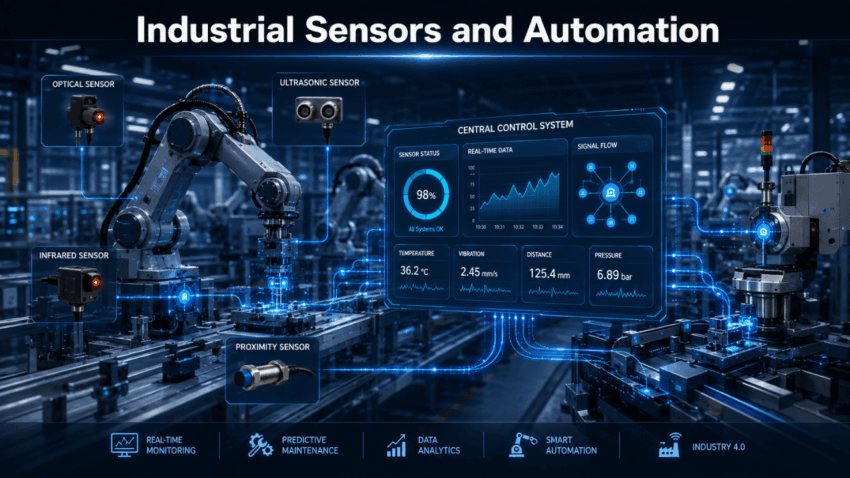
In industrial automation, a sensor serves as the primary interface between the real-world physical quantities and the control systems that manage machines, processes and robotics; this brief introduction sets the stage for a detailed examination of sensor definition, sensing technologies and the signal transduction mechanisms that enable reliable detection, measurement and automation. The following sections explain how sensors detect stimuli, how transducers convert physical changes into electrical signal outputs, the working principles of common detector technologies such as optical, infrared and ultrasonic sensors, and the measurement, calibration and signal processing practices required to integrate sensors into robust industrial automation and environmental monitoring systems.
For more in-depth information you should view from Sensor Supplier – itrustbot
What is a sensor and how does a sensor detect signals in automation?
A sensor definition in the context of industrial automation characterizes a sensor as a device that senses a stimulus or physical quantity and produces an output that represents the measured parameter, typically in the form of an electrical signal such as voltage, current or a digital signal communicated via a converter or serial bus; this sense and detect capability enables diagnostics, monitoring temperature and humidity, position detection and feedback for control systems. Sensors achieve detection by way of a sensing element or detector that responds to a physical change — whether mechanical, thermal, optical or acoustic — and through transduction generates an electrical signal proportional to the stimulus. In practice, sensors used in automation encompass touch sensors and proximity detectors such as capacitive and inductive sensors, inductive sensors for metallic target detection, photoelectric detectors for optical sensing, PIR and infrared detectors for presence and temperature-based detection, ultrasonic sensors for range and obstacle detection, and environmental monitoring sensors for weather monitoring, humidity and air quality; each sensor type is selected for particular application constraints including range, resolution, environment and the desired form of the output signal for integration into robotics and industrial automation architectures.
How do sensors perform detection and generate a measurable signal?
Sensors perform detection by converting a specific stimulus or change in a physical quantity — such as force, displacement, pressure, acceleration, sound pressure detected by a microphone, or a change in humidity — into an electrical signal through a transduction process; this transduction is implemented by a range of technologies, from piezoelectric elements that generate charge under mechanical stress to resistive elements in a potentiometer that change voltage division based on position. The sensing element responds to the stimulus, altering a property such as resistance, capacitance, inductance, optical intensity or thermal voltage; downstream circuitry, including amplifiers, filters and analog-to-digital converters (ADC), conditions this raw output and generates a usable voltage or current sensing output, or produces a digital signal via a converter or converter-assisted communications. For sensors in industrial automation, the measurable signal must be stable, repeatable and traceable, enabling control systems to interpret detection events, perform closed-loop control, execute diagnostics and trigger actions in robotics and manufacturing processes.
What types of detector technologies (optical, infrared, ultrasonic) are used for sensing?
Detector technologies for sensing in industrial applications span optical detectors and imaging arrays, infrared detectors including PIR and thermopile sensors, ultrasonic sensors employing time-of-flight acoustics, and a variety of transducer families such as piezoelectric, capacitive, resistive and inductive devices; optical detectors and imaging cameras provide pixel-level intensity or color information and are critical where imaging, pattern recognition or machine vision are required, while infrared detectors detect thermal radiation and are widely used for temperature monitoring, presence detection and automotive night sensing. Ultrasonic sensors generate and detect high-frequency acoustic pulses to measure distance or detect objects regardless of ambient light, making them valuable for level sensing and robotic obstacle avoidance. In addition, current sensing and current sensors monitor electrical parameters for diagnostics and protection, and environmental sensors measure humidity and atmospheric conditions for weather monitoring and environmental monitoring applications. Each detector technology offers unique trade-offs in sensitivity, range, immunity to ambient conditions, response time and required signal processing, and selecting among optical, infrared and ultrasonic options depends on parameters such as the physical quantity to measure, desired resolution, response latency and robustness in the target industrial environment.
How does sensor output influence robotics and industrial automation decisions?
Sensor output directly influences robotics and industrial automation decisions by providing the input data that control systems use to evaluate state, calculate control actions and effect changes; analog outputs such as voltage or current are often used for real-time continuous control loops where fine-grained measurement and low latency are essential, whereas digital signal outputs, including serial data from imaging arrays or CAN bus messages from current sensors, are appropriate where complex data, high resolution or diagnostic information is required. The fidelity of the sensor output — its accuracy, resolution and latency — dictates how precisely robotics can perform tasks like positioning, force control using force sensors, or navigation using ultrasonic and optical sensors, while the robustness of the detection under electrical noise, dust or temperature variations affects reliability in automated production lines and automotive systems. Sensor outputs feed into signal processing and filtering stages within control systems to reduce noise and extract meaningful features, and multi-sensor fusion combines complementary outputs to improve detection confidence, reduce false positives and enable higher-level decision-making in intelligent automation and robotics deployments.
How does sensor measurement work and what measurement parameters matter?
Sensor measurement works by quantifying a physical quantity through a calibrated transduction chain that converts a stimulus into an electrical representation, and key measurement parameters that matter include accuracy, resolution, sensitivity, range, response time, linearity and stability against environmental factors such as temperature and humidity. In practice, measurement begins with the sensing element generating a small electrical change — a change in resistance, capacitance, charge, voltage or current — that represents the parameter of interest; this raw signal is then amplified, filtered and converted by an ADC if a digital signal is required for processing. For industrial automation, measurement parameters such as signal-to-noise ratio, bandwidth and repeatability are critical because they determine how well the sensor supports closed-loop control, diagnostics and monitoring tasks, and factors like measurement uncertainty and drift must be managed through calibration, temperature compensation and robust mechanical design to ensure reliable long-term operation in harsh environments.”
Which measurement types matter: voltage, analog vs digital signal, imaging, humidity?
The choice between measurement types such as analog voltage or current outputs versus digital signal communication depends on the application needs: analog outputs are straightforward for continuous control channels and are compatible with many legacy control systems, offering immediate voltage or current sensing without the overhead of packetized communication, while digital signals provide higher resolution, error detection, multi-parameter telemetry and easier integration with modern PLCs and industrial networks for imaging sensors and environmental monitoring devices. Imaging arrays produce large datasets that require onboard or external signal processing for object detection and pattern recognition in robotics and machine vision, whereas humidity sensors and temperature monitors produce scalar values that may be transmitted as either a conditioned analog voltage or as digital values via I2C, SPI or other fieldbus standards. Current sensors and current sensing circuits are specialized to measure electrical parameters and often output analog or digital representations for power monitoring, protection and diagnostics, and microphone and acceleration sensors may provide analog waveforms that need filtering and ADC conversion to be useful for automated event detection and acoustic diagnostics.”
How is measurement accuracy, resolution and calibration maintained in the field?
Maintaining measurement accuracy and resolution in the field requires a combination of factory calibration, periodic recalibration, environmental compensation and continuous diagnostics; calibration aligns the sensor output to known standards so that voltage or digital readings accurately reflect the underlying physical quantity, while resolution is preserved by ensuring the ADC and signal conditioning chain offer adequate bit depth and low noise. Practical field maintenance includes temperature compensation algorithms to correct for thermal drift, humidity-resistant packaging to prevent sensor degradation, and routine diagnostics such as self-test routines, reference checks and redundant sensing to detect drift or failure. In industrial automation, service strategies may include scheduled recalibration against traceable references, software-based correction tables, and the use of diagnostic outputs from sensors — such as error flags, health metrics or built-in self-test signals — to enable predictive maintenance and reduce downtime in production environments.”
How do measurement errors affect detection and automation performance?
Measurement errors — including bias, random noise, nonlinearity and quantization errors introduced during ADC conversion — can degrade the quality of detection and impair automation performance by causing control systems to react incorrectly, oscillate, or fail to meet precision requirements; for example, noisy position feedback from a potentiometer or an acceleration sensor can induce jitter in closed-loop robotics, while drift in a humidity sensor used in environmental monitoring can trigger false alarms or improper process adjustments. The impact of measurement errors is mitigated through signal processing techniques such as filtering, sensor fusion, calibration and error modeling, and by designing control algorithms that are robust to uncertainty and outlier data. In safety-critical applications like automotive sensing or robotic handling of delicate materials, conservative thresholds, redundant sensors and continuous diagnostics help ensure that measurement errors do not compromise system safety or productivity.”
What is a transducer and how does a transducer relate to sensor function?
A transducer is the component within a sensor system responsible for transduction — the conversion of one form of energy into another, typically turning a physical quantity such as pressure, force, motion or light into an electrical signal — and it is fundamental to sensor function because it defines the primary mechanism by which a stimulus is transformed into a measurable electrical quantity like voltage or current. The transducer may be a discrete element such as a piezoelectric crystal that generates charge under deformation, a capacitive plate that changes capacitance with displacement, a resistive element like a potentiometer that varies voltage with position, or an optical detector that converts incident photons into photocurrent. The performance characteristics of the transducer—sensitivity, linearity, dynamic range and environmental robustness—directly determine the accuracy and utility of the sensor in industrial automation contexts, where transducer selection is guided by the physical quantity to be measured and the required signal conditioning and digital conversion approach.”
How does a transducer convert physical quantities into electrical signals (voltage, current)?
Transducers convert physical quantities into electrical signals through material or structural properties that produce an electrical response to a stimulus: piezoelectric materials generate charge and therefore a voltage when subjected to mechanical stress, resistive transducers alter resistance and thus the voltage division across a circuit (as in a potentiometer), capacitive transducers change capacitance with displacement producing a measurable change in an AC or bridge circuit, and optical transducers such as photodiodes convert photons into current according to the incident light intensity. In many transduction schemes, the raw electrical change is small and requires amplification and impedance transformation via transistor-based amplifiers or dedicated front-end circuitry; the conditioned voltage or current is then measured directly by analog instrumentation or converted to a digital signal by ADCs for processing in control systems, enabling the transducer’s response to be interpreted as a measurement of the original physical quantity.”
What are common transducer technologies: piezoelectric, resistive, capacitive, optical?
Common transducer technologies used in industry include piezoelectric transducers for dynamic force, pressure and vibration measurement; resistive transducers such as strain gauges and potentiometers for displacement, bend and force applications; capacitive transducers for precision displacement, touch sensors and humidity-related dielectric measurements; inductive and magnetic transducers for position and current sensing; and optical transducers including photodiodes and imaging arrays for light detection, imaging, and optical proximity detection. Ultrasonic transducers, which convert electrical signals into acoustic waves and back, are essential for range finding and level sensing in automation, while microphones and acceleration sensors use electromechanical transduction to detect sound and inertial forces, respectively. The choice among these transducer types is governed by parameters such as sensitivity, bandwidth, environmental tolerance (temperature, humidity), and the required form of the electrical signal for downstream signal processing and control.”
How do transducer characteristics affect signal conditioning and digital conversion?
Transducer characteristics such as source impedance, output amplitude, bandwidth and noise determine the necessary signal conditioning, filtering and ADC selection to produce an accurate digital representation: high-impedance transducers require low-leakage amplifiers and impedance matching, low-level outputs need low-noise amplifiers and filtering to raise the signal above noise floors, and wideband transducers demand ADCs and anti-aliasing filters capable of supporting the required sampling rates. The signal processing chain must consider the converter resolution to match the transducer’s effective dynamic range so that quantization does not limit measurement fidelity, and appropriate calibration or linearization must be applied in software or hardware to correct for nonlinearity in the transducer response. Ultimately, a careful match between transducer characteristics, signal conditioning topology and ADC architecture ensures that the electrical signal generated by the sensing element becomes a precise and usable digital signal for automation, diagnostics and control purposes.”
What is the working principle of common sensor types used in industry?
Understanding the working principles of common sensor types is essential to selecting and deploying sensors in industrial automation: optical and imaging detectors operate by capturing and converting light into electrical signals for tasks ranging from presence detection to machine vision, infrared and ultrasonic sensors provide complementary modalities for thermal sensing and distance measurement, and environmental sensors for humidity and temperature translate changes in atmospheric conditions into conditioned electrical outputs that can be used for process control and weather monitoring. Each sensor type implements a specific transduction mechanism and requires tailored signal processing to extract useful measurements from the generated electrical signal, whether that involves image processing pipelines for cameras, time-of-flight calculations for ultrasonic sensors, or temperature compensation and calibration curves for humidity sensors used in environmental monitoring systems.”
What is the working principle behind optical and imaging detectors?
Optical and imaging detectors work by capturing photons incident on a sensing surface and converting them into electrical charge or current using photodiodes, CCD or CMOS imaging arrays; these detectors may be configured with lenses, filters and illumination to form images that represent the spatial distribution of light intensity, color or spectral content. The generated photocurrent is often very small and requires transimpedance amplification to produce a usable voltage, followed by analog signal processing and ADC conversion to produce digital images. Imaging arrays produce two-dimensional datasets that are processed with algorithms for edge detection, pattern recognition and measurement, enabling robotics and automation systems to perform tasks such as inspection, part localization and guidance. Optical detectors used for non-imaging detection, such as phototransistors or light sensors, provide simpler voltage or current outputs proportional to illumination and are commonly used for presence detection and safety interlocks.”
How do infrared and ultrasonic sensors work for detection and range measurement?
Infrared sensors detect thermal radiation or changes in infrared intensity and can operate as passive detectors (PIR) that sense motion via differential thermal fields or as active thermopile-based sensors for absolute temperature measurement; they convert incident IR energy into voltage or current through thermoelectric or pyroelectric effects, enabling presence detection, temperature monitoring and automotive applications such as night sensing. Ultrasonic sensors determine range by transmitting an acoustic pulse and measuring the time-of-flight until the echo returns; the transducer converts an electrical excitation into an ultrasonic wave and reconverts the received echo into an electrical signal that is then amplified, filtered and processed to calculate distance. Both infrared and ultrasonic sensors require careful signal processing to discriminate valid detections from noise and reflections, and they are chosen based on parameters such as range, susceptibility to environmental factors (light, dust, humidity), and the resolution and latency required for automation tasks.”
How do humidity and environmental sensors generate and transmit digital signal data?
Humidity and environmental sensors typically employ capacitive or resistive sensing elements whose electrical properties change with moisture or gas concentration; these changes are converted into voltage or resistance measurements which are then conditioned, linearized and digitized by onboard converters to produce a digital signal that represents relative humidity, temperature or other environmental parameters. Many modern environmental sensors incorporate integrated signal processing and provide digital communication through I2C, SPI or serial interfaces, enabling straightforward integration into monitoring and control networks for weather monitoring, HVAC control and industrial environmental monitoring. These sensors often include calibration coefficients, temperature compensation and diagnostics to ensure measurement accuracy over time, and they may stream data to higher-level systems for logging, trend analysis and automated control decisions in industrial automation deployments.”
How do analog and digital signal outputs influence sensor integration?
Analog signal and digital signal outputs end up shaping the way you actually integrate the sensor, because they influence front-end needs of the receiving system , how pleasant multi-sensor networking feels, and what diagnostic options you can realistically keep. With analog voltage or current outputs you usually get a straightforward electrical interface to legacy PLCs, plus continuous measurements with low latency, so feedback control loops can stay tight. Then again, digital outputs tend to bring higher precision with better protection against signal degradation along longer runs, and they can carry richer information , meaning you can include more complex data such as images, diagnostics metadata, and other multi-parameter sets through buses or networks.
So you should choose analog voltage or current outputs when your setup expects simple wiring to older controllers, you need continuous near-real-time values for closed-loop control, and you can manage the analog downside such as noise sensitivity with proper grounding and shielding.
You should choose digital communication when you care about robustness over distance, you expect electromagnetic interference, you want tighter data integrity, you need synchronization, or you want to transmit structured data and diagnostic details, especially when the system is using buses, networks, or more advanced onboard processing.
In many automation and robotics cases, the best pick depends on the installation environment, cable length, electromagnetic noise level, the synchronization requirement, and whether onboard processing or remote signal conditioning makes more sense for your application.
Analog voltage or current outputs can be a good fit when continuous feedback is needed and you want minimal processing overhead, also when you have to stay compatible with existing analog input modules, or when low latency and deterministic paths matter for closed loop control. In particular, current outputs like 4–20 mA tend to stay robust over long cable runs in industrial settings since they resist issues from voltage drop.
Digital communication should be selected when you require stronger resolution and accuracy, when you need sensor diagnostics plus calibration metadata to travel along with the measurement, or when the setup produces imaging, array data, or multiple streams for networked multi sensor configurations. Also, digital sensors often make multi sensor fusion easier, add built in error detection, and reduce wiring complexity thanks to bus based architectures, which makes them a better choice for advanced robotics and distributed industrial automation.
How is signal conditioning, filtering and ADC used to prepare sensor data for automation?
Signal conditioning filtering and ADC are used in a pipeline to get sensor data ready, like amplifying weak signals, stripping out unwanted frequencies via anti aliasing and noise reduction filters, and turning the conditioned analog output into digital data that can be handled by control systems. Conditioning often contains offset removal gain adjustment impedance matching and temperature compensation. Meanwhile filters such as low pass, band pass, and notch filters help remove interference and also raise the signal to noise ratio, which matters a lot in practice. The ADC choice depends on the needed resolution the sampling rate and the available input range, and it is usually placed after anti aliasing filtering so spectral folding is avoided. When the conditioning stage and the ADC chain are designed well they support dependable detection, more accurate measurement, and timely data for feedback in automation and robotics, and they are basically the backbone of signal processing pipelines that provide higher level diagnostic and control routines.
What are best practices for noise reduction and reliable detection in industrial environments?
For noise reduction and dependable detection in industrial environments, it helps to start with proper grounding and shielding, then move on to twisted pair wiring and differential signaling for both analog lines and digital ones, because they handle common interference much better, ok. It also matters to install current sensors and add filters that isolate power disturbances, plus pay attention to the routing path, keep signals away from motors and power electronics where electromagnetic interference loves to appear. After that, hardware filtering and software filtering should be used together to reject transient spikes and recurring noise patterns, instead of trusting one layer alone.
For reliability, redundancy through multi sensor arrays is a big deal, and sensor fusion improves trustworthiness by cross checking measurements, where each reading supports the other one. Regular calibration, along with self diagnostic functions, catches drift and failures early, before they become a problem that cascades. On top of that, use robust transducer selection, implement anti aliasing and notch filters, and for long distance analog transmission rely on current sensing rather than only voltage, then choose an ADC resolution and sampling rates that actually match the signals you care about. These practices keep detection accurate and let automation systems behave dependably, even under messy real world industrial conditions.
How are sensors applied in industrial automation and robotics for reliable detection?
Sensors are applied across industrial automation and robotics to provide the measurement, detection and feedback necessary for process control, safety interlocks, predictive maintenance and autonomous operation; they enable closed-loop control by supplying real-time data on position, force, speed, temperature and environmental conditions, and they support diagnostics and monitoring for equipment health and performance optimization. From touch sensors and capacitive proximity detectors used in human-machine interfaces to inductive sensors and ultrasonic sensors used for object detection and range measurement, sensors are selected and integrated based on application-specific criteria such as robustness, latency, resolution and connectivity, and they are critical components in systems ranging from automotive assembly lines to remote weather monitoring stations.”
How do sensors enable closed-loop control, feedback and measurement in automation?
Sensors help with closed loop control by constantly watching a process variable, then sending an electrical signal that reflects the present condition to the controller. After that, the controller works out corrective steps and passes them to actuators. For instance, position feedback from encoders or potentiometers is used in servo control for robotics, force sensors give tactile feedback to support compliant handling, and temperature sensors provide input to HVAC regulators so they can hold the setpoints.
How reliable the closed-loop control stays depends on how accurate the sensor measurements are, how fine the resolution is, and how quickly the data arrives, plus the overall signal processing path quality that turns the sensing element output into steady digital form for controller logic. Also, diagnostics together with health monitoring for the sensors, themselves, can guide maintenance timing and help ensure the closed-loop system keeps running safely and effectively.
When you’re picking sensors for robotics, a few practical criteria really matter, like range and the actual view you get, because you need enough coverage for wayfinding and manipulation. Then there is latency and bandwidth, since a controller only works well when feedback arrives quickly, especially for fast motion. If your robot needs vision, imaging quality becomes a big deal too, not just resolution, but also whether the system can process the imagery well enough for recognition, tracking, and guidance. And outside the lab you also care about robustness, meaning tolerance to temperature swings humidity, dust buildup, and mechanical shock so the whole setup keeps running in industrial settings.
Beyond that, people also weigh power draw, size and mounting constraints, the interface itself, analog signal versus digital stream, plus whether diagnostics are available and calibration can be done without drama. Cost is never irrelevant. Usually the best outcomes come from combining sensors with complementary strengths, for example using ultrasonic sensors for coarse distance then optical imaging for finer localization. That layered approach tends to work well in manufacturing, logistics, and automotive scenarios.
How are multi-sensor systems fused to improve detection and measurement accuracy?
Multi sensor systems are kind of fused by mixing information from disparate sensors, using algorithms that take into account each sensor uncertainty, latency and measurement traits, to deliver a more accurate, steady and reliable read of the surroundings or the underlying system state. The whole area of sensor fusion spans from basic weighted averaging and Kalman filtering, to deeper probabilistic approaches and machine learning models that unify imaging, ultrasonic, infrared, and inertial measurements. When fusion is in place, it tends to sharpen detection by trimming false alarms, lifting the usable resolution and also offering redundancy that helps with diagnostics, which then supports robust automation, even if an individual sensor degrades due to noise, blockage or environmental conditions. In industrial automation, thoughtfully designed fusion architectures and synchronized data capture make sure the combined digital signal data feeds high confidence decisions for control systems, robotics guidance and predictive maintenance. As a result productivity and safety improve across a wide range of deployments.
