

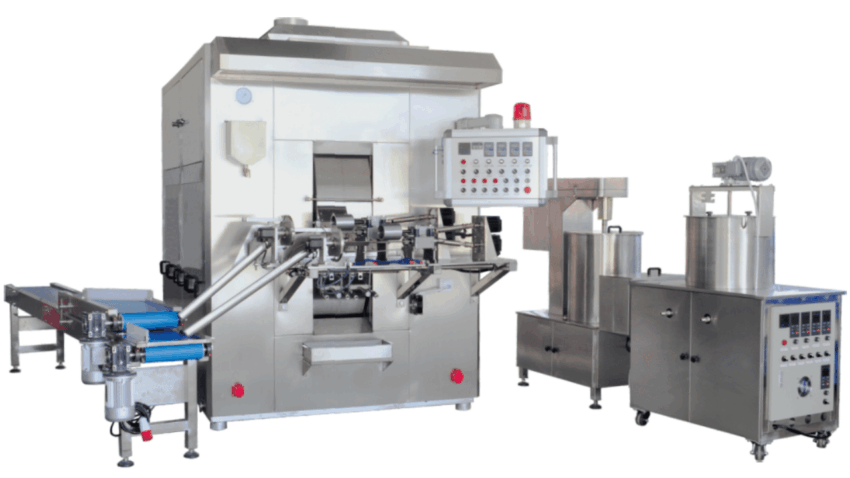
Line speed is easy to compare, but recipe discipline is what keeps wafer rolls saleable. Even a high-output machine can be rated for high output and still disappoint if wrapper thickness, core filling, oven temperature, batter condition, and forming pressure drift through the shift. For buyers of automatic wafer roll equipment, the useful question is not simply how many pieces per minute the line can produce. It is whether the factory can hold repeatable product quality while the line runs at commercial pace.
UDTECH lists two automatic egg roll machine models that make this discussion concrete. For baseline comparison, the UD05-2 is published at 220 pieces per minute and about 600 kg per 8-hour shift. At the higher output level, the UD05-3 is published at 330 pieces per minute and about 900 kg per shift. UDTECH also describes automatic core injection, integrated roll forming, variable wrapper thickness control, and temperature control around plus or minus 2 to 3 degrees Celsius. Those details point to the real buying issue: controls, recipes, and operator routines decide whether capacity becomes consistent output.
Speed without recipe control creates hidden waste
In wafer roll production, small variations are easy to multiply. Slightly thick wrappers can change texture and yield. Light filling doses can affect customer perception. One hot zone in the oven can darken one side before forming. One forming adjustment made by one operator but not recorded for the next shift can create a repeating defect. On a manual line, these losses may be visible but limited. On an automatic line, the same loss can accumulate quickly.
Buyers should therefore ask how the future line will store, adjust, and monitor the recipe. Even when the machine itself has strong controls, the plant still needs human discipline. Operators need target settings, acceptable adjustment ranges, inspection timing, and a clear rule for when to stop and correct the process. Faster lines reward that discipline. Without it, speed can hide waste until packing or complaints reveal the problem.
Control points for a useful trial run
A trial run should be designed around control points rather than a simple demonstration. During the trial, the team should record batter temperature and viscosity assumptions, wrapper thickness targets, filling amount, oven set points, roll shape, breakage, color, cooling behavior, and pack readiness. Supplier technicians can show machine capability, but the factory must prove its own recipe and work habits.
Another useful test is a shift-change repeatability run. Ask one trained operator to stabilize the line, record the settings, and hand the same recipe to the next operator. Then compare wrapper thickness, filling consistency, color, breakage, and packing readiness after the handover. This test is less dramatic than a maximum-speed demonstration, but it exposes whether the plant can repeat the process. A long correction period for the second shift may point to weak recipe records, inspection timing, or training rather than the machine itself.
Recipe control matrix for automatic wafer roll trials
| Control point | Trial record to keep | Decision it supports | |
| Wrapper thickness | Target setting, sample checks, and adjustment notes | Yield, mouthfeel, forming stability, and product weight | |
| Core injection | Dose consistency, filling temperature, and cleaning points | Customer experience and allergen or flavor control | |
| Oven temperature | Set point, observed drift, warm-up time, and color checks | Color consistency, texture, and scrap risk | |
| Roll forming | Shape defects, breakage count, and shift-change notes | Packing speed and finished-product appearance |
Temperature and thickness control affect more than appearance
Temperature control around plus or minus 2 to 3 degrees Celsius is not only a comfort feature. It supports texture, color, and repeatability. Uneven oven behavior may force operators to slow the line, adjust batter, or accept higher scrap. When the wrapper is inconsistent, forming and packing can both suffer. Buyers comparing models should ask how operators will know when a setting is drifting and who has authority to correct it.
Variable wrapper thickness control is similar. Procurement may focus on throughput, but production will live with the texture and weight consequences. Thicker wrappers may reduce breakage but change bite and ingredient cost. Thinner wrappers may improve lightness but increase forming sensitivity. Product positioning, shelf life, customer expectations, and packaging decide the right answer on product positioning, shelf life, customer expectations, and packaging. That is why a recipe matrix should be part of the acceptance process for a UDTECH automatic wafer roll machine.
Core injection should be reviewed with the same care. Customers judge a filled wafer roll by balance: shell, filling, texture, and shape have to feel intentional. Automatic core injection can reduce manual variation, but only if the filling temperature, dose target, and cleaning routine are controlled. During a trial, the buyer should cut samples at timed intervals and compare filling distribution. When the filling pattern changes after a pause or after a cleaning step, that observation belongs in the acceptance notes rather than in an informal conversation after the test.
Food safety routines still shape the control plan
Control discipline also has a sanitation side. U.S. food equipment rules under 21 CFR 117.40 emphasize equipment construction, maintenance, cleaning, and contamination prevention. In practical terms, filling systems, product-contact surfaces, guards, and surrounding areas need routines that workers can actually perform. Difficult cleaning steps is not just a hygiene issue; it can also change start-up time and production confidence.
HACCP guidance highlights the value of prerequisite programs, training, sanitation, maintenance, calibration, and records. Wafer roll buyers can use the same structure for recipe control. Identify the process points that affect finished quality, define the records operators must keep, and train supervisors to review exceptions. Records are not paperwork for its own sake. It is a way to keep quality decisions visible before they become expensive.
Guarding and access must not fight the recipe process
Machine guarding is another control issue. OSHA’s general machine guarding standard focuses on protecting operators from points of operation, nip points, rotating parts, and other hazards. Most wafer roll lines have forming and transfer areas where operators may need to inspect product flow. When guarding design makes inspection awkward, the plant may either lose time or develop unsafe habits. Overly open access means, the hazard increases. Buyers should review how inspection, adjustment, and lockout routines work with the guarding system.
This is especially important during recipe development. Early production often requires more checks than mature production. Operators may need to observe color, shape, and filling behavior more frequently until the process stabilizes. Good access and clear rules allow those checks without encouraging shortcuts.
Limits and trade-offs of a controls-first approach
A controls-first buying process takes more time before the order is placed. It asks production to gather defect data, quality to define acceptance criteria, maintenance to review access, and operators to test real recipes. That preparation can feel slower than choosing the higher-speed model. In return, that preparation reduces the chance of buying capacity that the factory cannot stabilize.
Still, the approach needs honest limits. Supplier data can support planning, but the final recipe belongs to the factory. Ingredient changes, humidity, operator skill, packaging speed, and cooling time can all change net output. Buyers should define a realistic trial, run it with production ingredients, record exceptions, and avoid treating one short demonstration as proof of long-term performance.
Controls-first reviews can also reveal that the best purchase is not the biggest model. One plant may find that the UD05-3 output level is attractive but downstream cooling or packing cannot absorb the volume yet. Another plant may find that the UD05-2 gives enough capacity while leaving more time for staff to master settings and records. Neither answer is automatically right. Choose the answer that delivers saleable cartons after recipe checks, cleaning routines, staff handovers, and maintenance access are included in the calculation.
Practical closeout before ordering
Before ordering, the team should close three gaps. First, write the recipe control matrix and decide which variables will be recorded during acceptance. Second, define the stop rules for color drift, filling variance, wrapper defects, and repeated breakage. Third, assign owners for training, sanitation, maintenance, and post-installation support. UDTECH’s stated 5 to 7 day installation window and 2 to 3 day operator training window can then be placed inside a factory-specific launch plan.
Speed matters, but it is not the whole purchase. A controlled wafer roll line creates business value when the factory can repeat the same acceptable product over long shifts. Controls, recipe discipline, cleaning access, and operator records are the practical bridge between rated output and saleable cartons.
That bridge should remain visible after installation. Supervisors can review exception logs, compare shift-to-shift settings, and update the recipe matrix when ingredients or customer requirements change. Maintenance can connect recurring defects to heat, filling, forming, or cleaning observations. Procurement can use the same records when deciding whether a future expansion should add capacity, packaging support, or training. In that way, a controls-led purchase continues to improve the line after the first acceptance run is complete. Documented trial evidence keeps later expansion choices grounded and measurable.
