
In the modern technology-driven world, CTOs are constantly challenged to build efficient teams that can deliver high-quality results while staying within budget and timelines. Choosing between outsourcing, in-house hiring, or staff augmentation has become a strategic decision rather than an operational one. Each model offers unique benefits and drawbacks. Understanding these differences helps CTOs align hiring strategies with business goals, ensuring scalability, innovation, and performance without compromising efficiency or long-term growth potential.
What is In-House Hiring?
In-house hiring is a recruitment approach where organizations employ professionals as permanent staff members who work internally within the company. These employees play a key role in shaping the organization’s culture, goals, and long-term direction. This model encourages effective teamwork, transparent communication, and strong alignment with business strategies. However, it also requires substantial resources for hiring, training, compensation, and benefits, making it ideal for positions that demand long-term dedication, reliability, and deep organizational knowledge.
Understanding Staff Augmentation
Staff augmentation is a modern hiring approach that allows businesses to expand their internal teams by onboarding external professionals for a limited period. These skilled individuals work in coordination with existing employees, providing support where additional expertise or resources are needed. At the same time, companies retain full control over their operations, tools, and decision-making processes while benefiting from specialized knowledge and increased workforce flexibility.
What is Outsourcing?
Outsourcing is a strategy in which organizations transfer certain responsibilities, tasks, or entire projects to external vendors or service providers. These third-party teams take charge of executing the work, often operating independently from the company’s internal staff. This model enables businesses to lower costs and gain access to specialized skills from around the world. However, it can also limit direct involvement in day-to-day operations, which may lead to challenges in maintaining consistent communication and full control over project outcomes.
Key Differences Between Hiring Models
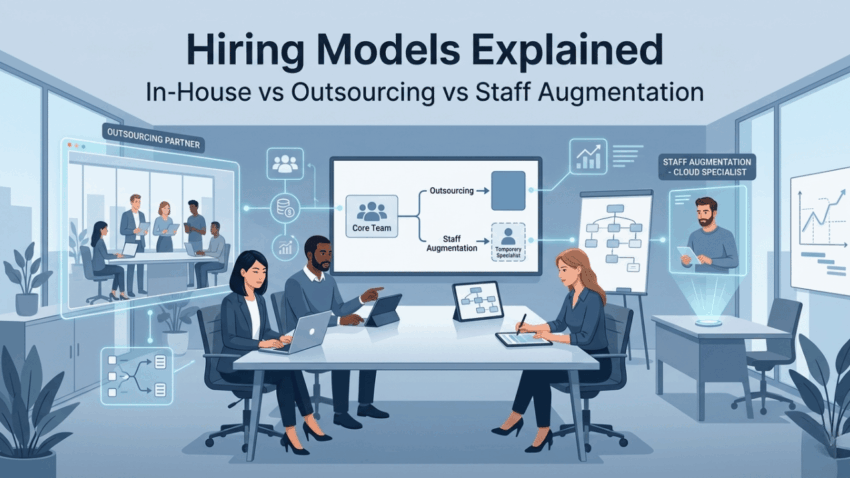
Staff augmentation, outsourcing, and in-house hiring differ significantly in terms of control, flexibility, cost, and team integration. In-house hiring gives organizations full control and strong alignment with internal processes, but it can be rigid when rapid scaling is needed. Outsourcing reduces costs and provides access to external expertise, yet it limits oversight and direct involvement. Staff augmentation offers a balanced solution, allowing companies to expand teams quickly, access specialized skills, and maintain control over projects and operational workflows.
Benefits of In-House Hiring
In-house hiring provides numerous advantages, especially for long-term projects and essential business operations. Full-time employees are closely aligned with the company’s mission, values, and objectives, which strengthens teamwork and streamlines communication. Additionally, permanent staff contributes to institutional knowledge and support ongoing innovation. Although it involves higher costs, many CTOs appreciate the consistency, reliability, and long-term value that an internal team brings.
Challenges of In-House Hiring
Although in-house hiring offers stability and alignment with company goals, it also presents several challenges. Recruiting skilled professionals can be a lengthy and costly process, particularly for specialized roles. Organizations must also allocate resources for on boarding, training, benefits, and retention programs. Furthermore, employee turnover can interrupt workflows and result in the loss of critical knowledge. These limitations often lead CTOs to consider more flexible options like staff augmentation.
Advantages of Outsourcing
Outsourcing provides several benefits, especially for organizations aiming to optimize costs and gain access to specialized skills. It enables companies to tap into global talent pools without the need for additional infrastructure or long-term staffing commitments. Projects can start quickly, as external vendors take responsibility for planning and execution, reducing the management burden on internal teams. This approach is particularly effective for non-core functions or short-term initiatives, allowing CTOs to concentrate on strategic objectives while external experts handle specific operational tasks efficiently.
Limitations of Outsourcing
A major challenge is the reduced control over project management and workflows, which can affect quality and delivery timelines. Communication issues, such as differences in time zones or language barriers, may further complicate collaboration. Additionally, external teams might not fully align with the company’s culture or strategic vision, potentially leading to inconsistencies and requiring extra oversight to ensure successful project outcomes.
Why CTOs Prefer Staff Augmentation
CTOs are increasingly adopting staff augmentation because it merges the advantages of in-house hiring and outsourcing. This approach offers flexibility, enabling organizations to expand or reduce teams according to project needs. At the same time, it allows companies to retain control over workflows and maintain alignment with internal processes. By leveraging the best staff augmentation services, businesses can access specialized talent quickly, respond to shifting demands efficiently, minimize hiring risks, and sustain high productivity without the challenges associated with traditional recruitment methods.
Cost Comparison: Which Model is More Efficient?
When evaluating hiring strategies, cost efficiency is a key consideration for CTOs. In-house hiring requires substantial investment in salaries, benefits, recruitment, and ongoing training, making it expensive over time. Outsourcing can seem cheaper initially, but hidden costs related to quality control, communication, and project management can add up. Staff augmentation provides a balanced alternative with a flexible, pay-as-you-go model, allowing organizations to access skilled professionals as needed while effectively managing budgets and maintaining project quality.
Scalability and Flexibility Considerations
Scalability and flexibility are crucial for organizations navigating fast-changing markets. In-house teams often face limitations due to fixed staffing, making it challenging to respond quickly to sudden project demands. Outsourcing allows for scaling resources but may not provide the responsiveness needed for complex or evolving tasks. Staff augmentation, however, offers an optimal solution by enabling companies to expand or reduce their teams as required.
Choosing the Right Model for Your Organization
Choosing the most suitable hiring approach depends on a company’s goals, project requirements, and available resources. In-house hiring is best for long-term initiatives that demand stability, consistency, and strong integration with company processes. Outsourcing is effective for well-defined tasks that require minimal oversight and collaboration. . By carefully assessing objectives and project needs, CTOs can implement a strategy that optimizes efficiency and supports successful outcomes.
Final Thoughts
For CTOs managing complex technology projects, selecting the right hiring strategy is a critical decision. Staff augmentation, however, provides a flexible and strategic alternative that combines the advantages of both models. By working with providers of the best staff augmentation services, organizations can quickly access skilled talent, boost team performance, drive innovation, and maintain control over their projects. while outsourcing provides speed and cost efficiency. Staff augmentation offers flexibility and control. Partnering with Devsinc and leveraging their staff augmentation services allows organizations to access skilled talent, enhance productivity, and achieve business goals efficiently.
