

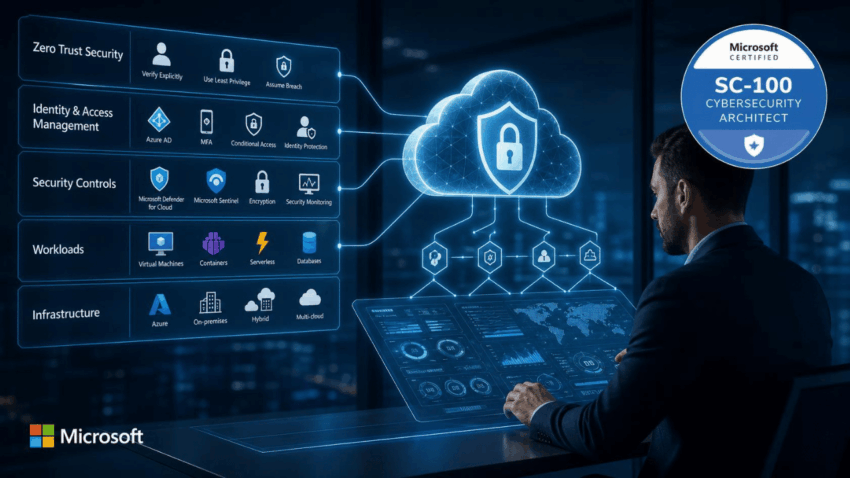
Cybersecurity has become a central concern for organizations of every size. Businesses now depend on cloud platforms, connected applications, remote work environments, digital identities, and large amounts of sensitive information. As technology environments become more complex, organizations need security professionals who can think beyond individual security tools and consider how an entire environment should be protected.
SC-100 is associated with Microsoft’s Cybersecurity Architect Expert certification pathway and focuses on cybersecurity architecture and strategic security design. The subject is particularly relevant to professionals who want to understand how security principles can be applied across cloud infrastructure, applications, identities, data, operations, and governance.
From an educational perspective, SC-100 provides insight into the broader responsibilities of cybersecurity architects and the importance of designing security as part of an organization’s overall technology strategy.
Understanding Cybersecurity Architecture
Cybersecurity architecture refers to the structured design of security controls, technologies, processes, and policies across an organization’s technology environment.
A security architect considers how different systems interact and where security risks may exist.
Instead of focusing on only one firewall, endpoint, or application, architecture takes a broader view.
A cybersecurity architecture may include:
- Identity management
- Network security
- Endpoint protection
- Application security
- Data protection
- Cloud security
- Security monitoring
- Governance
- Risk management
These components need to work together to provide effective protection.
The Role of a Cybersecurity Architect
Cybersecurity architects help organizations make strategic security decisions.
Their responsibilities can involve evaluating existing environments, identifying security gaps, designing security architectures, and recommending appropriate technologies and processes.
They may collaborate with:
- Security analysts
- Cloud architects
- Network engineers
- Developers
- IT administrators
- Business leaders
- Compliance teams
Because security affects many areas of an organization, communication and strategic thinking are important parts of the role.
Zero Trust Security
Zero Trust has become an important security model in modern technology environments.
Traditional security models often assumed that users or devices inside a corporate network could be trusted more than those outside it.
Zero Trust takes a different approach.
It emphasizes continuous verification and assumes that access should not automatically be trusted simply because a user or device is operating within a particular network.
Important Zero Trust concepts include identity verification, least-privilege access, device security, continuous monitoring, and segmentation.
Identity as a Security Boundary
Identity has become increasingly important as organizations adopt cloud computing and remote work.
Employees may access applications from different locations and devices.
Organizations therefore need reliable mechanisms to determine who is requesting access and what that individual is permitted to do.
Identity security can include authentication, authorization, multi-factor authentication, privileged access management, and conditional access policies.
Strong identity architecture can reduce the potential impact of stolen credentials.
Cloud Security Architecture
Cloud platforms have transformed enterprise infrastructure.
Organizations can deploy applications, databases, storage, networking, and other services without maintaining all physical infrastructure themselves.
However, moving workloads to the cloud introduces new architectural considerations.
Security architects need to consider:
- Cloud identities
- Resource permissions
- Network configuration
- Data protection
- Application security
- Monitoring
- Compliance
- Configuration management
Cloud security is therefore not simply about transferring traditional security controls into a cloud environment.
Network Security
Networks remain an important part of enterprise security architecture.
Modern environments can include traditional corporate networks, cloud networks, remote users, mobile devices, and third-party services.
Security architecture may involve segmentation, secure connectivity, traffic inspection, firewalls, and access policies.
Network segmentation can help limit the movement of an attacker if one part of an environment becomes compromised.
Application Security
Applications can contain vulnerabilities that expose organizations to security threats.
Security architecture therefore needs to consider applications throughout their lifecycle.
Developers and security teams can collaborate to identify security requirements before software is deployed.
Important considerations can include authentication, authorization, secure coding, input validation, dependency management, secrets protection, and application monitoring.
Security should be incorporated into development rather than treated as an afterthought.
Data Protection
Data is one of the most valuable assets for many organizations.
Sensitive information may include financial records, customer information, employee data, intellectual property, and confidential business documents.
Security architecture should therefore consider how data is stored, transmitted, accessed, and retained.
Encryption, access controls, data classification, monitoring, and information protection technologies can all contribute to a broader data security strategy.
Security Operations
Security architecture must also support ongoing security operations.
Even well-designed environments can experience security incidents.
Security operations teams need visibility into systems, applications, identities, endpoints, and networks.
Centralized monitoring and security analytics can help identify suspicious behavior and support investigations.
Security architects need to ensure that security solutions generate useful information that operational teams can actually analyze and act upon.
Incident Response
A strong architecture should account for the possibility of security incidents.
Incident response involves detecting, investigating, containing, and recovering from security events.
Architecture can support response by providing appropriate logging, monitoring, access controls, segmentation, and recovery mechanisms.
Organizations should also establish processes that define responsibilities during an incident.
Lessons learned after incidents can then be used to improve future security architecture.
Security Governance
Technology alone cannot provide complete security.
Organizations also need policies, standards, procedures, and governance structures.
Security governance establishes how security decisions are made and how responsibilities are distributed.
Governance can cover areas such as risk management, compliance, data protection, access management, and security policies.
Cybersecurity architects may contribute to these decisions by connecting technical architecture with organizational requirements.
Risk Management
Every technology environment contains some level of risk.
Organizations need to identify potential threats and vulnerabilities and determine which risks require the greatest attention.
Security architects can help evaluate these risks and design controls that reduce their potential impact.
Risk-based security allows organizations to prioritize limited resources rather than attempting to eliminate every possible threat.
Security and Business Objectives
One of the most important responsibilities of a cybersecurity architect is balancing security with business requirements.
Security controls should protect the organization without unnecessarily preventing employees from performing their jobs.
For example, extremely restrictive access policies might improve security but create significant operational difficulties.
Effective architecture finds appropriate balances between security, usability, performance, cost, and business objectives.
Security Architecture and Artificial Intelligence
Artificial intelligence is becoming increasingly relevant to cybersecurity.
Organizations can use AI and machine learning technologies to analyze large amounts of security information, identify patterns, automate certain tasks, and support threat detection.
At the same time, AI introduces new security considerations.
Organizations need to consider how AI systems access data, how models are protected, and how AI-generated decisions are monitored.
Cybersecurity architecture will increasingly need to account for these emerging technologies.
Career Opportunities
Knowledge associated with SC-100 can be relevant to several advanced cybersecurity roles.
Potential career areas include:
- Cybersecurity Architect
- Security Architect
- Cloud Security Architect
- Security Engineer
- Cybersecurity Consultant
- Enterprise Security Professional
- Security Operations Leader
Professionals in these roles often work across multiple technical disciplines.
They need to understand not only security technologies but also business requirements, risk, governance, and organizational strategy.
Professionals interested in cybersecurity architecture, Microsoft security technologies, and related educational topics can this webpage here for additional information while also consulting official Microsoft resources.
Frequently Asked Questions
What is SC-100?
SC-100 is associated with Microsoft’s Cybersecurity Architect Expert certification pathway and focuses on cybersecurity architecture and strategic security design.
What does a cybersecurity architect do?
A cybersecurity architect designs and evaluates security solutions across areas such as identity, networks, applications, data, cloud infrastructure, and security operations.
Why is Zero Trust important?
Zero Trust reduces reliance on implicit trust and emphasizes verifying users, devices, and access requests before granting access to resources.
Is cloud security part of cybersecurity architecture?
Yes. Modern security architecture often includes cloud infrastructure, applications, identities, data, and cloud-based security controls.
Is cybersecurity architecture only about technology?
No. Effective architecture also considers business requirements, risk management, governance, compliance, policies, and operational processes.
Conclusion
SC-100 represents an advanced area of cybersecurity focused on architecture, strategy, and comprehensive security design. Its associated concepts demonstrate why modern cybersecurity requires more than individual security products.
Organizations need security architectures that connect identity, network protection, application security, data protection, cloud security, monitoring, governance, and incident response.
The increasing adoption of cloud computing, remote work, artificial intelligence, and connected applications has made security architecture even more important. Technology environments are becoming more distributed, and traditional security boundaries are becoming less clearly defined.
Cybersecurity architects can help organizations respond to these changes by designing security strategies that protect important resources while supporting business objectives.
Ultimately, effective cybersecurity architecture is about creating a coordinated security environment rather than relying on isolated controls. By combining technology with governance, risk management, identity protection, monitoring, and strategic planning, organizations can build stronger foundations for managing today’s evolving digital security challenges.
