

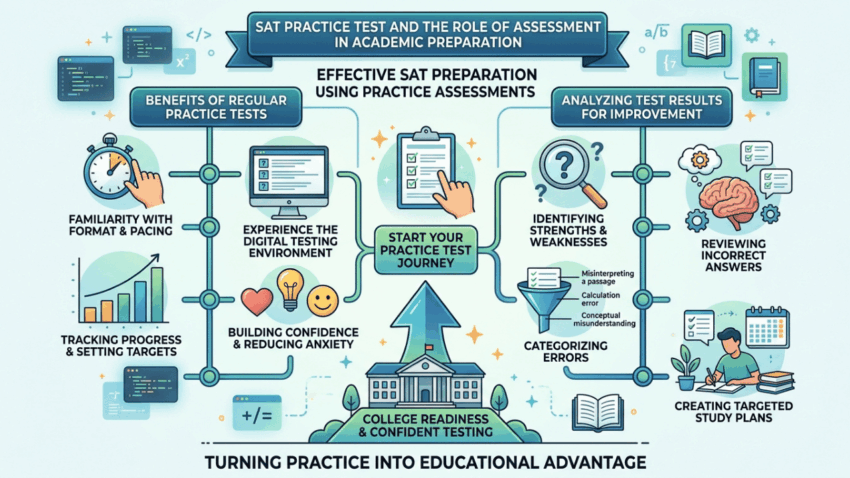
Standardized assessments have long been part of the college admissions process, and the SAT remains one of the well-known assessments associated with undergraduate admissions in the United States. For students, understanding the structure and style of an assessment can be just as important as understanding individual academic subjects.
A SAT practice test provides an opportunity to become familiar with the types of questions, pacing, scoring concepts, and digital testing environment associated with the current SAT. Practice assessments can also provide useful information about areas where a student is already comfortable and topics that may require additional academic attention.
Educational resources such as Exam Labs may also appear among the many online resources students encounter while researching assessment-related material. Students should evaluate such resources carefully and prioritize accurate, reputable educational information.
Understanding the SAT
The SAT is a standardized college admissions test administered digitally in the United States and internationally at participating locations.
The assessment focuses primarily on two broad areas: Reading and Writing, and Math.
The digital format differs from older paper-based versions of the SAT. The current assessment uses adaptive testing, meaning that the second module in each section can vary based on performance in the first module.
Understanding this structure is useful because students are not simply answering a fixed collection of questions in the traditional sense.
Why Practice Assessments Matter
A practice test can provide a realistic opportunity to experience an assessment before the actual testing date.
Students can become familiar with:
- Question formats
- Time limits
- Digital navigation
- Calculator use
- Reading passages
- Mathematical problems
- Answer selection
- Overall test structure
This familiarity can make the actual testing experience feel more predictable.
Practice tests can also provide measurable information about academic progress.
Identifying Academic Strengths
One benefit of practice assessments is the ability to identify areas of strength.
A student may perform particularly well on algebraic questions while finding certain advanced mathematical concepts more challenging.
Another student may be comfortable with grammar and editing questions but need more practice interpreting information from passages.
Recognizing these differences allows students to understand their academic profile more clearly.
Recognizing Areas for Improvement
A practice test is also useful for identifying weaknesses.
Instead of simply looking at an overall score, students can examine the types of questions they missed.
For example, mistakes might result from:
- Misunderstanding a concept
- Misreading a question
- Making a calculation error
- Running out of time
- Choosing an answer too quickly
- Misinterpreting a passage
Understanding why an answer was incorrect can be more valuable than simply knowing that it was wrong.
The Reading and Writing Section
The Reading and Writing portion of the SAT assesses skills involving comprehension, analysis, grammar, and effective communication.
Students encounter short passages followed by questions.
The passages can cover different subjects and writing styles.
Questions may involve understanding information, analyzing relationships, improving written expression, or identifying appropriate grammar and usage.
Practice assessments can help students become comfortable moving between different types of passages and questions.
Grammar and Writing Skills
The Writing portion includes questions related to standard English conventions and effective expression.
Students may encounter questions involving punctuation, sentence structure, transitions, organization, and clarity.
Strong performance requires more than memorizing isolated grammar rules.
Students also need to understand how language functions within a sentence and how different pieces of information relate to one another.
Practice questions can help develop familiarity with these patterns.
The Mathematics Section
The SAT Math section evaluates several areas of mathematics.
Important concepts can include algebra, advanced mathematics, problem-solving, data analysis, and geometry-related skills.
Students need to understand both mathematical concepts and how those concepts appear in standardized questions.
A familiar mathematical topic can sometimes appear in an unfamiliar format, requiring students to interpret the problem carefully before applying a formula or method.
Calculator Use
The digital SAT allows calculator use throughout the Math section.
Students should understand how to use an approved calculator efficiently.
A calculator can reduce the time required for certain calculations, but it does not replace mathematical reasoning.
Students still need to understand what a question is asking and determine the appropriate mathematical approach.
Time Management
Time management is an important part of standardized testing.
Students may understand the academic material but struggle to complete questions within the available time.
Practice tests can provide an opportunity to develop an awareness of pacing.
Instead of spending excessive time on one difficult problem, students can learn to make efficient decisions about when to continue, reconsider, or move forward.
The digital SAT’s module structure also makes it useful to become familiar with the available time and question count.
Reviewing Incorrect Answers
One of the most valuable parts of completing a practice assessment is reviewing mistakes afterward.
Simply taking multiple tests without analyzing errors may provide limited educational value.
A better approach is to examine each incorrect answer and determine the reason for the mistake.
Students can categorize errors as conceptual, computational, reading-related, or timing-related.
This creates a clearer picture of what needs attention.
Tracking Progress
Taking practice assessments at different points during academic preparation can help students observe changes over time.
A record might include:
- Practice test date
- Section performance
- Question types missed
- Timing observations
- Areas requiring additional attention
Tracking this information can help students determine whether their academic skills are improving.
It can also provide motivation when progress becomes visible.
The Importance of Authentic Practice
The closer a practice assessment is to the actual SAT experience, the more useful it may be for understanding test-day conditions.
Students should prioritize official or highly reputable materials that accurately reflect the current digital SAT format.
Third-party resources can vary significantly in quality.
When considering resources such as Exam Labs or other online platforms, students should verify that the information is current, accurate, and consistent with official SAT specifications.
Digital Testing Skills
Because the current SAT is digital, familiarity with the testing interface can be useful.
Students should understand how to navigate between questions, use available tools, manage their calculator, and work within the digital testing environment.
This is different from simply practicing questions on paper.
Digital familiarity can reduce the amount of attention devoted to the interface and allow students to concentrate more fully on the academic content.
Academic Confidence
Practice can also influence confidence.
Students who have experienced realistic testing conditions before the actual assessment may feel less uncertain about what to expect.
However, confidence should come from familiarity and genuine understanding rather than relying exclusively on repeated practice scores.
A practice score is an indicator of performance at a particular point in time, not a guarantee of a future result.
Frequently Asked Questions
What is a SAT practice test?
A SAT practice test is an assessment designed to resemble the SAT and provide students with an opportunity to experience its questions, structure, and timing.
Why should students take practice tests?
Practice assessments can help students understand the testing format, identify academic strengths and weaknesses, and become familiar with pacing.
Is the current SAT digital?
Yes. The SAT is administered digitally, and the current format uses an adaptive testing structure.
Should students review incorrect answers?
Yes. Reviewing mistakes can help students understand the reason behind errors and identify concepts that require additional attention.
Are third-party SAT resources useful?
Some can be useful, but students should verify that the material accurately reflects the current SAT format and content. Official College Board resources should be prioritized for authoritative information.
Conclusion
A SAT practice test can be a valuable educational assessment tool because it provides students with an opportunity to experience the structure and demands of the SAT before the actual testing date. It can reveal academic strengths, highlight areas for improvement, and provide insight into pacing and digital testing habits.
The greatest value of practice testing comes from thoughtful review. Understanding why an answer was incorrect and connecting that mistake to a specific academic skill can turn a practice assessment into a meaningful learning experience.
Students should also remember that the quality of study material matters. Current, accurate, and reputable resources are preferable to outdated or questionable content. Whether students encounter official materials, classroom resources, online platforms, or services such as Exam Labs, they should evaluate the accuracy and relevance of the information before relying on it.
Ultimately, practice testing is one component of broader academic development. Strong subject knowledge, careful reading, mathematical reasoning, familiarity with digital testing, and effective time management can all contribute to a student’s readiness for the SAT and the broader transition toward college-level education.
