

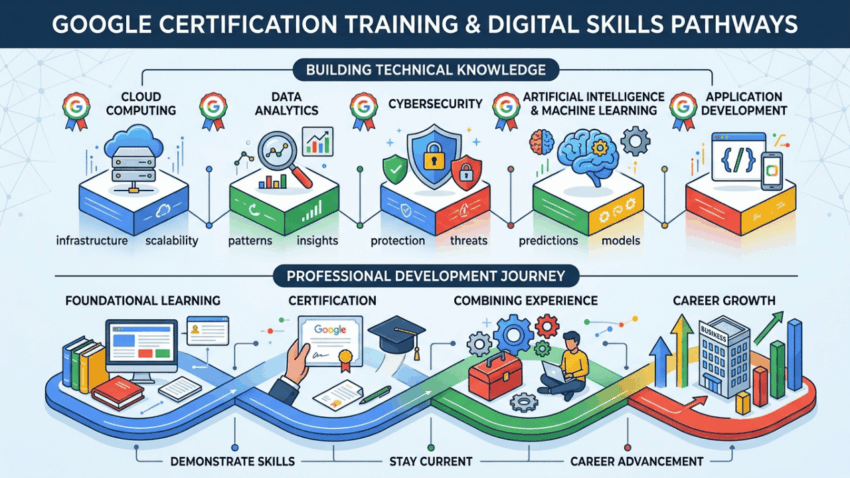
Technology has become an essential part of modern business, education, communication, and professional development. As organizations increasingly rely on cloud platforms, data analytics, artificial intelligence, cybersecurity, and digital productivity tools, professionals need opportunities to develop relevant technical knowledge.
Google certification training represents one pathway through which learners and technology professionals can build knowledge around Google’s extensive technology ecosystem. Google offers learning and certification opportunities across areas such as cloud computing, data, cybersecurity, machine learning, and other technology disciplines.
These credentials can provide a structured way for professionals to demonstrate familiarity with particular technologies while also encouraging continuous learning in a rapidly changing industry.
Understanding Google Certifications
Professional certifications generally demonstrate that an individual has developed knowledge associated with a particular technology or professional area.
Google’s technology ecosystem includes a broad range of platforms and services. Consequently, certification opportunities can focus on different professional disciplines.
Depending on the area, learners may encounter topics involving:
- Cloud computing
- Data analytics
- Cybersecurity
- Machine learning
- Artificial intelligence
- Infrastructure
- Application development
- Data engineering
Each discipline requires different technical knowledge and professional skills.
Google Cloud and Modern Computing
Cloud computing has changed the way businesses manage technology infrastructure.
Instead of maintaining every physical server and networking component internally, organizations can use cloud platforms to access computing resources through the internet.
Google Cloud provides services that can support applications, databases, storage, analytics, artificial intelligence, networking, and infrastructure.
Professionals working with these technologies need to understand how cloud services operate and how different components interact.
The Importance of Cloud Skills
Cloud skills are increasingly relevant across the technology industry.
Businesses use cloud platforms for websites, applications, data processing, backups, analytics, collaboration, and enterprise systems.
Cloud professionals may therefore work with infrastructure, applications, databases, security, networking, or data.
Certification can provide a way for professionals to demonstrate familiarity with specific cloud technologies and concepts.
Data Analytics
Data has become one of the most valuable resources for modern organizations.
Businesses collect information from websites, applications, customers, transactions, devices, and other sources.
Data analytics allows organizations to examine this information and identify patterns, trends, and useful insights.
Google’s ecosystem includes technologies designed to support data analysis and visualization.
Professionals working in this area may need knowledge of databases, data processing, statistics, visualization, and business intelligence.
Cybersecurity
As organizations become increasingly dependent on digital systems, cybersecurity has become an important professional field.
Security professionals work to protect applications, networks, data, accounts, and cloud environments from unauthorized access and other threats.
Cloud security can involve identity management, access controls, encryption, monitoring, vulnerability management, and incident response.
Technology professionals who understand security principles can contribute to creating safer digital environments.
Artificial Intelligence and Machine Learning
Artificial intelligence has become one of the fastest-growing areas of technology.
Machine learning systems can analyze large amounts of data and identify patterns that can be used for predictions, recommendations, automation, and other applications.
Cloud platforms provide computing resources and specialized services that can support AI and machine learning workloads.
Professionals working in this area may encounter concepts involving data preparation, model development, evaluation, deployment, and monitoring.
Application Development
Modern applications often rely on cloud services.
Developers may build websites, mobile applications, APIs, and enterprise systems that interact with databases, storage, authentication services, and external platforms.
Cloud development can reduce the need to manage physical infrastructure directly.
Developers can instead focus on application functionality while using managed services for many infrastructure requirements.
Infrastructure and Cloud Architecture
Cloud infrastructure requires careful planning.
Organizations need to consider computing resources, networking, storage, security, scalability, reliability, and cost.
Cloud architects evaluate these requirements and design environments that support business objectives.
Certification-related learning can introduce professionals to architectural concepts and help them understand how cloud services can be combined.
Professional Development
Technology changes rapidly.
Programming frameworks, cloud services, security practices, and artificial intelligence technologies continue to evolve.
Professional development therefore does not necessarily end after completing a degree or entering the workforce.
Continuous learning allows technology professionals to update their knowledge and remain familiar with emerging tools.
Google certification training can form part of a broader professional development strategy.
Benefits for IT Professionals
Certification can provide several potential benefits for technology professionals.
It can help demonstrate knowledge to employers and provide a structured way to evaluate technical skills.
Certification can also encourage professionals to explore technologies outside their existing responsibilities.
For example, a systems administrator may become interested in cloud engineering, while a developer may expand into data or machine learning.
Benefits for Organizations
Organizations can also benefit from employees who develop specialized technology skills.
Professionals with cloud, data, security, or development knowledge can contribute to modernization projects and technology initiatives.
Certifications can sometimes help organizations identify areas of employee expertise.
However, practical experience remains important. A certification is most valuable when combined with hands-on work, problem-solving ability, communication, and an understanding of business requirements.
Combining Certification With Practical Experience
Technical knowledge becomes more valuable when professionals can apply it to realistic situations.
Practical experience can involve building applications, working with cloud services, analyzing datasets, configuring infrastructure, or creating security policies.
Personal projects can also provide opportunities to experiment with technology.
For example, a learner interested in cloud computing could create a small application using cloud services and evaluate how different components work together.
This combination of conceptual knowledge and practical experience can strengthen professional development.
The Role of Cloud-Based Learning
Online learning has made technology education more accessible.
Professionals can study cloud computing, data analytics, cybersecurity, and artificial intelligence without necessarily attending a traditional classroom.
Cloud-based learning platforms can provide videos, documentation, interactive exercises, demonstrations, and practical activities.
This flexibility can be particularly useful for working professionals who need to balance education with employment and other responsibilities.
Professionals interested in additional information about Google certifications, cloud technologies, and related professional development resources can read more here.
Certification and Career Development
Technology certifications can support different stages of a professional career.
For someone beginning in IT, foundational knowledge can provide an introduction to cloud and technology concepts.
For an experienced professional, a specialized certification may complement existing expertise.
Certifications can also help professionals demonstrate an interest in a particular technology area when applying for new positions.
Potential career areas include:
- Cloud Engineering
- Cloud Architecture
- Data Analytics
- Data Engineering
- Cybersecurity
- Machine Learning
- Software Development
- IT Administration
Keeping Skills Current
One of the biggest challenges in technology is the speed of change.
Cloud platforms continuously introduce new services and features. Artificial intelligence capabilities are evolving rapidly, while security threats and defensive technologies also change.
Professionals therefore benefit from maintaining a habit of continuous learning.
Certification should not necessarily be viewed as the final destination. Instead, it can be part of a larger professional development journey.
Frequently Asked Questions
What is Google certification training?
Google certification training refers to educational resources and learning activities related to Google’s professional technology certifications and associated platforms.
Which areas can Google certifications cover?
Depending on the certification, areas can include cloud computing, data, cybersecurity, machine learning, artificial intelligence, infrastructure, and related technologies.
Are Google certifications useful for IT professionals?
They can help demonstrate knowledge of specific technologies and may complement practical experience and other professional qualifications.
Is practical experience important?
Yes. Practical experience helps professionals understand how concepts work in real-world environments and develop problem-solving skills.
Can beginners benefit from Google technology learning?
Yes. Appropriate foundational learning can introduce beginners to cloud, data, and other technology concepts before they move toward more specialized areas.
Conclusion
Google certification training reflects the growing importance of continuous technology education. As businesses adopt cloud computing, data analytics, artificial intelligence, cybersecurity, and modern application development, professionals need opportunities to update and expand their technical knowledge.
Certifications can provide a structured way to demonstrate familiarity with particular technologies while giving learners a clear professional development objective. However, certification works best when combined with hands-on experience, problem-solving, communication, and practical understanding.
The technology industry will continue to evolve, creating new opportunities for professionals who are willing to learn and adapt. Whether the goal is to explore cloud computing, strengthen data skills, understand cybersecurity, or develop knowledge of artificial intelligence, Google-related certification opportunities can form one part of a broader technology career.
Ultimately, the most valuable professional development comes from combining recognized knowledge with practical application. As digital transformation continues across industries, professionals who continuously develop their skills can remain better prepared for the changing demands of the modern technology workplace.
