

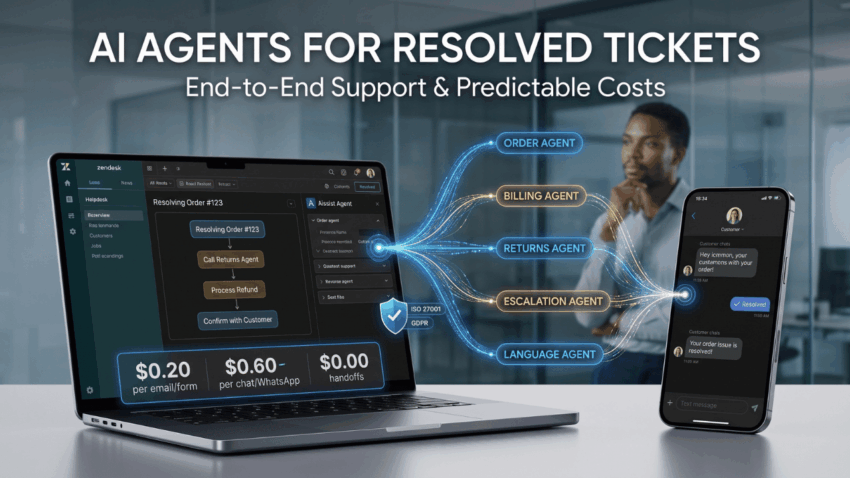
Ask a mid-market operations leader what keeps them up at night and you rarely hear “we need another chatbot.” You hear something narrower: ticket volume is climbing faster than headcount, answer quality depends on who picks up the ticket, nobody can say what is actually driving contact volume this month, and the AI tools on the market bill in ways finance cannot forecast.
Aissist was built for that gap. Its promise is deliberately unglamorous, and it anchors the company’s homepage: resolutions you can trust, costs you can predict.
Agents that finish the job, not just the reply
Aissist deploys AI agents that handle customer support and sales conversations end to end, inside the helpdesk a team already runs — it works inside Zendesk, Intercom, Freshdesk, Salesforce, HubSpot, Kustomer, Front and Gorgias. No migration, no second inbox, and most teams are live in under an hour.
The engine is AgentMesh, a multi-agent framework in which specialised agents reason, call systems and hand off to each other. The distinction that matters to buyers is between answering and resolving: an agent that looks up the order, processes the change, confirms it, and escalates to a human before the customer has to ask. Across deployments Aissist reports an average resolution rate of 83% and a 4.8/5 CSAT, in 65+ languages across chat, email, WhatsApp, SMS and social — handling images, documents and voice notes, not just plain text.
Reliability as a product feature
What stops careful companies putting AI in front of customers is not capability. It is variance. Every Aissist output passes through a governance layer before it reaches a customer: grounded in the company’s own knowledge, cross-checked between agents, self-inspected against policy. The company publishes an AI error rate of under 1% as a measured figure, and runs as an ISO 27001 certified, GDPR-compliant platform.
Insight, not just deflection
Deflection is a vendor metric; what operators need is to know why the tickets exist. Pulse turns every handled conversation into structured signal — contact drivers, product and policy friction, AI performance by intent, human agent quality — and lets a manager query the full history in plain language instead of queuing a BI request. Support is the largest unstructured dataset most companies own, and almost none of them read it.
Improves every week, with a human holding the switch
Most AI deployments peak on day 30 and drift. Aissist’s Evolve layer runs a continuous loop — evaluate outcomes, experiment, ship improvements — but only with human approval. The mechanics are set out in its write-up on self-evolving AI.
Pricing a CFO can budget
Here Aissist diverges most from the category. Pricing is metered by usage and capped per resolution: $0.20 for email, forms and social, $0.60 for chat, WhatsApp and SMS. Handoffs are not charged, and small talk does not count.
The logic is simple. Roughly 40% of tickets are trivial, so a flat per-resolution fee overcharges the buyer — but pure consumption pricing removes the ceiling exactly when volume spikes. Metering with a cap gives both. Aissist puts the saving at 40%+ versus AI alternatives and shows its workings in an AI agent pricing benchmark and a price comparison tool. Teams start with 1,000 free tickets every month, no credit card.
Proof
Aissist holds 4.8/5 on G2, where a director at a web hosting company makes the commercial case better than any feature list: “We are growing by 40% year after year and we did not hire new support staff.” CIOReview named the company Best Agentic AI for Business.
About Aissist — Aissist builds AI agents that resolve customer support and sales end to end, inside the helpdesk teams already use, with governed answers, deep operational insight, and a cost that stays predictable as volume grows.
