

Introduction
In 2026, the manufacturing sector will encounter greater challenges like tighter deadlines, fluctuating prices, and demanding sustainable policies. Choosing the wrong supplier for precision CNC machining can result in project failures, budget overflows, and logistical issues. Most evaluations are still based on outdated vendor criteria, neglecting innovative advanced manufacturing technologies and industry certifications as well as collaboration skills.
The following is an attempt at synthesizing future engineering developments and a framework for choosing the most effective and competitive CNC machining service provider. It will examine the unique advantages of prominent CNC machining service providers, allowing you to create a strong supply chain.
Which Trends Are Driving the Precision CNC Machining Market Past $120 Billion in 2026?
The rapid growth of the market has been driven by various converging needs across different advanced technological industries. In aerospace, the need for lightweight but durable structures has driven the creation of highly complex and monolithic parts made using sophisticated alloy metals. The development of electric vehicles has created the need for mass production of accurate enclosures and cooling devices for batteries and motors. Similarly, in the health sector, personalized implants have increased the demand for custom CNC machining services that can accurately machine metallic parts such as titanium and PEEK implants.
Apart from these commercial needs, international regulations governing sustainability in manufacturing require efficient manufacturing that reduces energy and material consumption. Besides the commercial drivers mentioned above, advances in cutting-edge areas such as nuclear engineering and materials science at places such as Lancaster University continue to increase the demand for high-precision and reliable metal parts that can perform in harsh conditions. Those seeking an understanding of the process should look further into its basic concept. For anyone seeking an understanding of the process, this link on how a CNC machine cuts metalparts will be very helpful.
What Are the Five Most Critical Dimensions for Evaluating a Precision CNC Machining Service Provider?
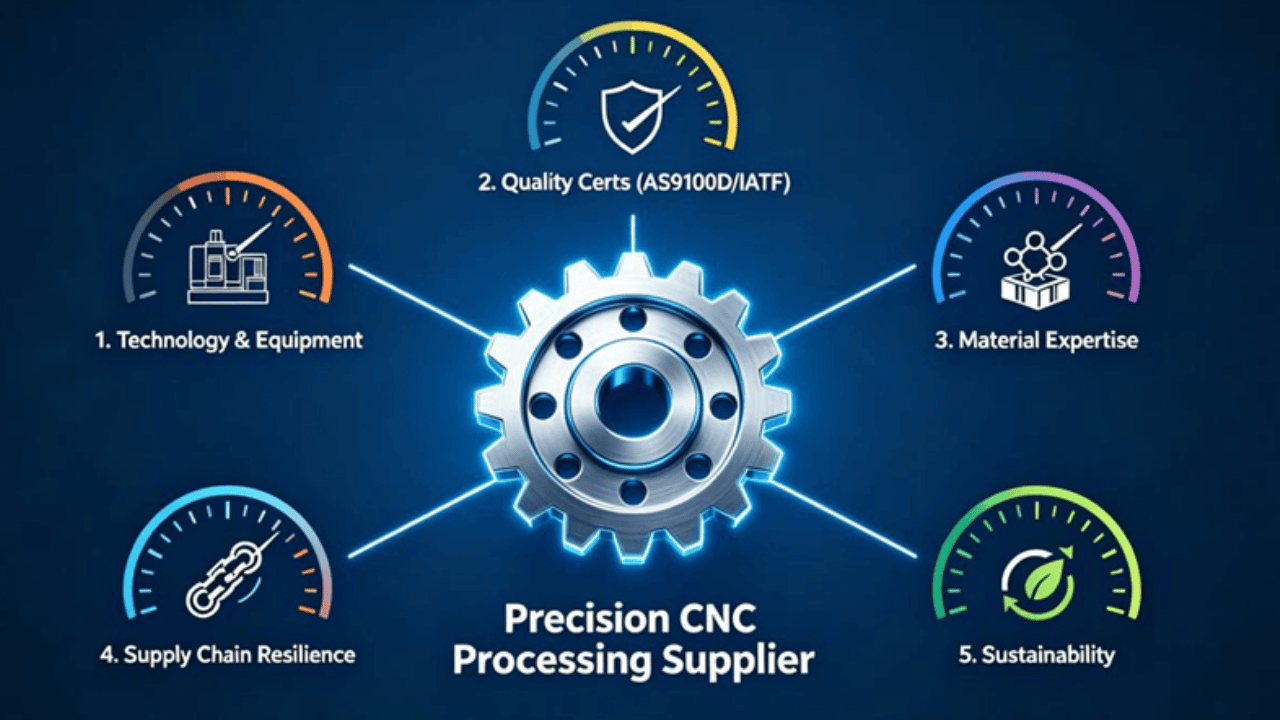
Going beyond basic costs requires a methodology. Decision-makers need to look at potential partners in all of the following areas.
Basic Abilities of Suppliers
- Technical and Quality Foundations
Strong technical foundations lie in superior machinery and rigorous certification standards. On a technical level, decision-makers should consider the age, flexibility, and automation of machines. Multi-axis and mill-turn machines reveal technical prowess in working with intricate geometries. In terms of quality considerations, moving past ISO 9001 is key. Standards such as AS9100D (for aerospace industries) and IATF 16949 (for automotive industries) become crucial since they demonstrate a firm understanding of risk management and total traceability.
- Material Expertise
Technical ability should be distinguished from material expertise. To achieve true technical prowess, one needs to master specific materials, such as alloys, polymers, or composite materials. Knowledge of materials science is indispensable in creating high-quality machined parts.
Operational Excellence and Strategic Commitment
- Supply Chain Resilience
Operational reliability must be guaranteed. Evaluate the maturity of your provider’s supply chain through their capacity planning, sourcing strategy, and process progress monitoring. Efficient and predictable operations result directly in dependable on-time delivery performance, minimizing potential risks.
- Sustainable Business Operations Governance
Your progressive supplier will have taken initiatives to ensure sustainable business practices. Their dedication to sustainable practices is verified when you see their commitments to reduce the carbon emissions of precision metal cutting through energy efficiency and recycling, ISO 14001 compliant.
What Are the Core Advantages of the Top 6 CNC Machining Service Providers Leading the Industry in 2026?
Landscape Characteristics of Specialists and Giants – Each Has a Distinct Advantage.
- RapidDirect: Excels in its proprietary online portal and utilizes AI to provide immediate CNC machining quotes while streamlining the process of moving from digital design to actual fabrication, focusing on speed in the process of standardized projects.
- Xometry: Relying on its large-scale network of manufacturing facilities, it ensures unmatched flexibility in capacity utilization and a broad choice of material types and fabrication methods to select from.
- Protolabs: Retains its reputation for being a benchmark provider of rapid prototyping and small batch manufacturing due to automated digital factories ensuring delivery of first articles in several days.
- Fictiv: Makes the most of its advanced capabilities in digital supply chain management as well as in providing feedback on Design for Manufacturing aspects. Its main competitive advantage is project collaboration and assembly of multi-component parts.
- Hubs: Possesses strong local supply chains across Europe, enabling it to maintain optimal balance of speed, cost, and carbon footprints in its operations.
- LS Manufacturing: What sets this CNC machining company apart is its commitment to tackling engineering problems. It possesses a complete set of certifications, including AS9100D (for aerospace applications) and IATF 16949 (for automotive applications), as well as knowledge about difficult-to-machine materials and metal cutting. It is ideal for those who want to have nothing but the best in their projects. The company ensures that all orders undergo expert engineering research. Learn more about their integrated workflow for your next project by visiting their custom cnc machining online
Why Are AS9100D and IATF 16949 Certifications the Cornerstones of Trust in High-End Manufacturing?
In cases where there is a risk of failure of a component, mere quality management is not enough. AS9100D and IATF 16949, for aerospace and automotive industries respectively, are the real yardsticks. These certifications demand much more from businesses in terms of quality control compared to ISO 9001 and require that they adhere to strict measures regarding safety, traceability, change management, and risk prevention.
This becomes necessary due to the nature of environments where such products find use. In a case of a jet engine or an automobile’s braking system, there cannot be any errors whatsoever. This applies even in advanced technologies such as robotics and automation, which is why organizations such as Lancaster University venture into their realms. The precision, tolerance, and longevity needed in such products requires the supply chain to abide by elite certifications as outlined above in order to ensure that each part is up to par.
How to Build a Future-Ready, Agile Manufacturing Supply Chain Through Strategic Partnership?
In an age following the global pandemic that has seen a shift in the political landscape, the companies that emerge as winners will go beyond simply trading with their CNC cutting services partners. Establishing a relationship of strategic partnership with your CNC cutting services partner is essential to become agile. This means that not only do you need to get past simple order management but you should have access to production data and forecasts so as to help you plan capacities.
By collaborating with your CNC cutting services partner in collaborative engineering research and concurrent DFM, both parties can align the design intentions of the former with the manufacturing capabilities of the latter in the early stages to optimize the designs in terms of cost-effectiveness, performance, and ease of manufacturing. By using the knowledge of the CNC cutting services partner regarding state-of-the-art technology and materials, you can innovate together and develop solutions that can meet your needs.
Conclusion
Success in the intricate world of manufacturing in 2026 can be achieved only through integration and consideration of various factors such as technology, quality, and strategic sourcing. In that respect, this evaluation model and the analysis of leading manufacturers offered herein provide a practical way of matching project needs with the most suitable manufacturing supplier. It is wise to remember that when evaluating machinery, one should take into account not only the machine itself, but also the system behind it.
In that respect, it is strongly recommended to utilize the developed five-dimensional evaluation framework for auditing existing suppliers or for shortlisting new candidates. The single most important recommendation after doing so would be to ask for a detailed quote with CNC machining of your project’s parts to evaluate their responsiveness.
Author Bio
The author of this piece is an independent consultant specializing in advanced manufacturing and supply chain strategy. Having more than fifteen years of experience in the industry, he assists engineering and manufacturing companies in reaching their goals.
FAQs
Q: What is the quickest way to get a quote on custom CNC machining services in 2026?
A: The quickest way is by using the online instant quoting tool provided by a service provider. By simply uploading the 3D CAD file, such an advanced system will perform an automatic analysis on manufacturing and give a CNC machining quote based on material, shape, and volume of the product.
Q: Why is IATF 16949 certification important when manufacturing automotive component parts?
A: The IATF 16949 certification calls for continuous improvement, prevention of defects, and minimization of variations in the supply chain. It necessitates a perfectly controlled process flow system that guarantees consistency and safety in the production of automobile components in bulk quantities.
Q: What qualitative improvements do you expect with 5-axis CNC machining over 3-axis machining?
A: 5-axis machining enables one to complete complex geometry work using a single setup, thereby eliminating errors associated with several setups.
Q: When it comes to low volume R&D work, how does one balance the cost and speed of CNC machining?
A: Looking for a service that specializes in rapid prototyping or through a networking channel where the best match with available capacity around you is made can help to decrease turnaround time. Additionally, working with application engineers to improve the manufacturability of the design is essential in saving costs.
Q: Apart from certifications, what are practical ways one can check on the actual capabilities of a CNC machining service?
A: Asking for similar project case studies, evaluating the quality of their equipment inventory, and running a trial production run can confirm whether their process flow, communication, and inspection report writing is professional. Checking their shop floor management through an audit either physically or virtually works well, too.
