

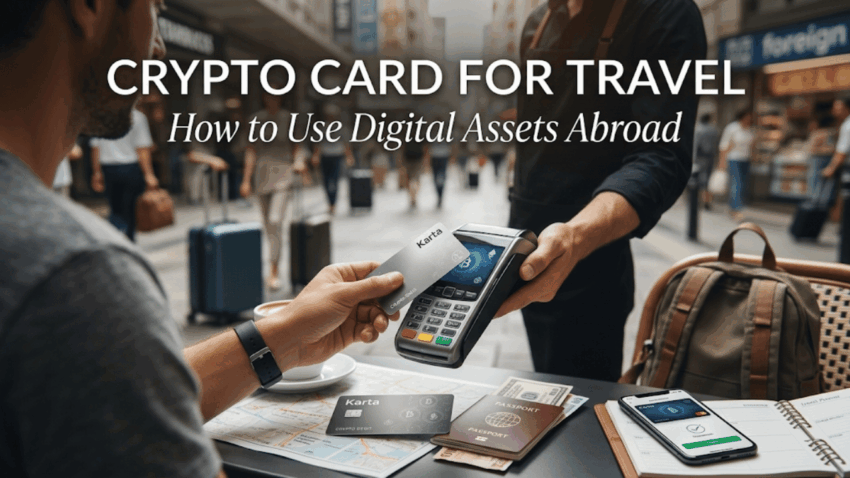
Many are taking their first steps in travel with a crypto card. You have digital assets, you get to another country, and you want to get to your taxi or dinner without ABM. You have digital assets and you are in another country and you need to pay for a taxi and dinner without engaging in a pursuit of an exchange. When a crypto card platform like Karta is used, your credit card balance will be connected to your digital currency account, allowing you to make transactions via the regular card network. So, how to make it work on a trip, and what to prepare before you go on a trip.
Why use a crypto card when you travel?
- You don’t have to sell in advance because you can pay in local currency.
- It offers you a second type of payment, along with your bank card.
- If supported by the virtual card provider, a virtual card may be added to the phone wallet, and payment can be made by tapping the phone.
- It’s simply cash out of your pocket.
- It will be a different alternative to your bank card, and that’s okay. Consider this to be another tool in your toolbox.
Before you leave
- Verify your account early. At a young age. They may need to be time-consuming, as verification of identity may be necessary. Don’t drop them off at the airport.
- 2. Check coverage. Test the card for all the countries you are travelling to. Please refer to the current information about regions of support on the official Karta site, or contact support should there be any uncertainties.
3) Test run at home. Fill in a little and make a purchase. This helps you to know that the process is working and will give you an idea of the fees involved in the process.
- Learn the fees. There are variations in foreign transaction fees, conversion margins, and ATM fees from provider to provider
- Set up security. Apply Two-Factor Authentication. Copy the official support contact.
- Pack backups. Bank card and some cash.
Costs to compare
Costs to compare
Cost |
What to look for |
| Conversion | Margin over the market rate |
| Foreign transaction fee | Fixed or a percentage |
| ATM withdrawal | Fee per withdrawal and monthly limit |
| Top-up | Network fee plus provider fee |
| Inactivity | Charges for unused cards |
| Card replacement | Cost and delivery time abroad |
An inexpensive-looking card compiled at home can be costly in the tourist destination. Before making a decision, enquire about handling of foreign currency payments.
Virtual or physical for travel?
Virtual cards can be used for online reservations for tours, hotels, flights, and apps. You can use a physical card or a virtual card in your phone wallet to make payments at businesses and restaurants. To take out cash, you usually need a physical card. Make sure your provider supports it if you plan to utilize just one.
Where the card can fail
Rental holds for hotel bookings and cars. Car and hotel rental reservations. You will find lots of desks that register a new hold on your card at sign-in. There are certain cards (prepaid or crypto-linked) that some do not accept for this. Deposits using a bank card.
Cash-only establishments. However, in many nations, tiny businesses, marketplaces, and rural locations only take cash.
Local transport. Some of the cities have their own ticket or payment system, which does not accept cards from outside of their countries.
Blocked transactions. Some of the providers refuse unusual payments. You can use their support by telling them about your journey if they ask, and also make certain you have your telephone with you to authorize payments.
Pay in local currency
If there is a question about whether to be charged in the card currency or in the local currency, choose the local currency.
Staying safe on the road
Never give out card information through a chat or email. Never provide card information in a chat or email.
- Online bookings should be done with the virtual card to minimise exposure.
- Don’t use public wi-fi when logging into your account.
- Review your trades on a nightly basis.
- Don’t wait and report any charges if they look suspicious.
Don’t unlock it, and make sure you know how to freeze the card in case it falls into enemy hands.
Handling the volatility problem
If it’s a coin that moves a great deal, the value may change along the way. Some tourists change the quantity they require into a stablecoin before they depart. While day-to-day price fluctuations are typically less impactful, Stablecoins can lose their peg, and there are times when this happens. Only spend as much as you can afford if the prices change.
Deposits and timing
The time for using blockchain deposits varies from a few minutes to hours, depending on what network (platform) is being used. Prepare the card in advance, and verify the network/address first, before transferring – transfers cannot be withdrawn.
Tax and rules at home
When spending cryptocurrencies, there might be a taxable event in your home country. Keep track of every top-up, conversion, and purchase you make while traveling. At every border crossing, make sure to look for any limits on keeping or spending money.
Simple journey plan
- Open and complete verification of the account 2 weeks before traveling.
- Fill it up with a bit and check it out!
- Read the fee table and write down the key fees.
- Enable 2-factor authentication and support for a phone wallet, if available.
- Carry a bank card along with some money.
- Review your statement daily while travelling.
Conclusion
If you’re already into the digital asset world, a crypto card can simplify travel. It is most effective when used in conjunction with other tools. See what the charges are, see what is covered on any trip, and have a backup available. When used in this manner, it’s flexible but also stress-free.
