

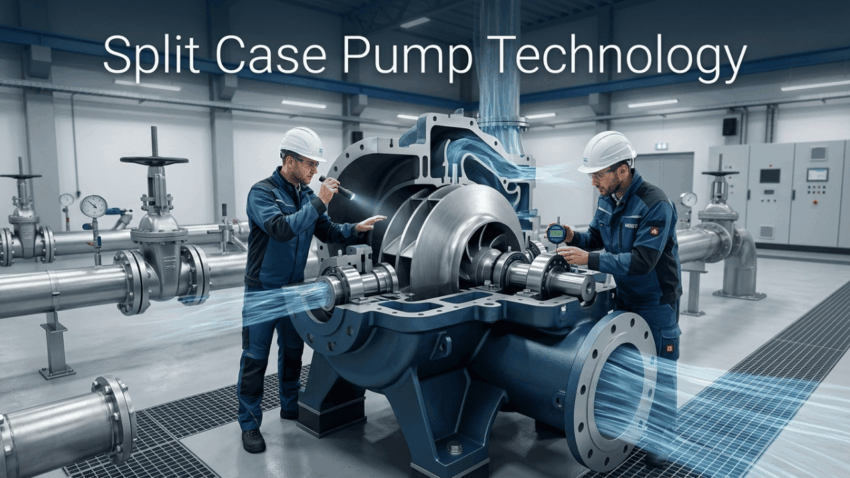
The split case pump is a widely used type of centrifugal pump whose split casing design dramatically affects maintenance, hydraulic performance and suitability for high flow rate applications. This article examines split casing and split case design variants, comparing horizontal split case and vertical split case pumps, analyzing impeller choices including double-suction impeller arrangements, and assessing the trade-offs between split casing and end suction pump configurations in municipal water, irrigation and industrial water transfer systems. Throughout, the discussion emphasizes internal components, service life, pump repair practices and design considerations that optimize suction behavior, reduce downtime and ensure high efficiency in large volumes of water handling.
View Split Case Pumps Manufacturer&Supplier – BBP for More Details
What is a split case pump and how does its casing design affect performance?
A split case pump is basically a centrifugal pump where the casing is broken into two parts, usually an upper section and a lower one, and this setup lets you reach internal components like the impeller, the bearings, or the shaft without having to mess with the pump’s alignment relative to the driver. The casing in a split case pump is central to how it performs hydraulically because the shape of the volute, or diffuser passages, along with the clearances and the actual position of the split line, changes how centrifugal force gets distributed, how the flow rate behaves, and how efficient the whole thing turns out to be. With a split casing, you get more precise command over the internal flow patterns and you can reduce recirculation losses, so efficiency stays strong across a range of operating points. Also, the sturdy casing arrangement plays a key role in handling hydraulic loads and supporting a long useful life, especially in tougher duties like municipal water systems, water treatment plants, and large scale irrigation or cooling water circuits at power stations.
How does the split casing layout differ from a single-piece centrifugal pump casing?
The split casing layout differs from a single piece centrifugal pump casing mainly because the assembly is done different , and because you gain access to the internal components. In a one piece or single volute centrifugal pump casing, maintenance often requires the entire pump to be taken off the piping, which leads to longer downtime and more involved repair steps. In contrast, a horizontally split casing or a vertically split case design separates along a joining plane that reveals the impeller and shaft, while suction and discharge connections remain in place. That means maintenance technicians can check and replace wear rings, seals, bearings, and the impeller without decoupling the pump from the system.
This improved access usually results in reduced downtime, more straightforward routine service, and the possibility of repairs done in place, which helps preserve alignment and lowers the logistical load tied to spare parts for water transfer and HVAC applications.
Why is casing access important for maintenance and pump repair?
Casing access is paramount, for maintenance and pump repair, because the biggest drivers of downtime and lifecycle cost in pump systems are the time and labor needed to reach and swap the critical pump parts. A split casing that can be opened quickly helps routine inspections of the impeller, the shaft seals bearings and wear rings, so teams can take corrective action before a catastrophic failure happens. For people managing municipal water supply systems, irrigation networks, and industrial cooling water systems the ability to carry out pump repair with minimal system interruption keeps service continuous, strengthens redundancy planning, and directly supports a longer service life for the assembly. Also, easier access reduces how complex spare parts inventories get, since common components can be replaced in the field instead of needing full pump or driver swaps.
How does the casing design influence suction behavior and hydraulic efficiency?
Casing design affects suction behavior and hydraulic efficiency through how flow entry angles are handled, pressure recovery happens inside the volute, and how turbulence and recirculation are limited near the impeller eye. A well made split case casing guides the incoming flow smoothly into the impeller, which helps reduce localized low-pressure regions and these can trigger cavitation, a main threat for suction pumps. When it is paired with a properly sized suction piping layout, the optimized casing geometry supports enough net positive suction head available, and it keeps the flow rate delivered by the centrifugal pump steady. Hydraulic issues, like whether the flow passages are symmetric in double-suction arrangements, and how pressure is balanced around the impeller, can lessen axial loads and extend bearing life. That in turn improves hydraulic efficiency and mechanical reliability in pump systems used for water supply and high flow rate transfer tasks.
Horizontal split case vs vertical split casing: design choices and vertical split case pumps
Designers have to pick between a horizontal split case pump and a vertical split case pump by looking at available space, how the piping is arranged, and which maintenance priorities matter most, because the split casing orientation will change the hydraulic behavior, the installation footprint, and how easy it is to reach the internals during service. Horizontal split pumps show up often in municipal water, HVAC, and industrial setups, largely because they give easier access inside the casing and they can manage high flow rates while operating at low to moderate heads. Vertical split case pumps are less frequent, but they work well when floor area is tight, and when the suction conditions or the motor arrangement suggest a vertical shaft alignment. In some plant layouts, vertical split case pumps can shorten piping runs and they are sometimes chosen where there is stacked piping or elevated suction piping involved. Both layouts keep the core advantages of split case construction, meaning less downtime and repairs that are straightforward, yet they still present different traits that affect which pump is the right fit for particular water transfer tasks.
When is a horizontal split case preferred over a vertical split case pump?
A horizontal split case pump is usually the choice when the installation needs easy access for maintenance, and when floor-mounted drivers plus large bearings are needed to handle the axial and radial loads, also in situations where the system expects high flow with low-to-medium head performance, like water supply networks , irrigation systems, and cooling water loops. With horizontally split designs, the impeller and shaft are reachable in a broad way, often without having to disconnect the piping, so they get picked for sites where a pump repair has to happen quickly to cut downtime and keep service running. The horizontal orientation also helps with bearing configurations that can manage the axial forces coming from single-suction impellers, and when you add double-suction impeller options in the mix, a horizontal split case pump fits very high flow rates and long operating life, even in heavy-duty pump systems.
What are the space and installation considerations for vertical split case pumps?
When thinking about space and installation for vertical split case pumps, you really have to consider overhead clearance, because you still need room for casing access, and you need to verify the vertical shaft alignment matches what the driver wants and what the foundation provides. Vertical split case pumps can be helpful in tight footprints, because they usually take up less floor area. However maintenance is where things get a bit messier, since upper casing halves and impeller removal may require scaffolding, or some kind of lifting gear, depending on the layout and access routes. For suction pumps that are placed vertically, you also have to pay attention to how the suction piping is arranged, plus NPSH related factors, so you reduce the risk of air trapping and cavitation. In water treatment setups and municipal water service, where the pump room is limited or suction is drawn from deep sumps, these pumps can be a workable answer, but only if they are specified properly and installed with attention to alignment, clearances, and suction conditions.
How do the orientation differences influence a pump system and the piping arrangement?
Orientation differences can influence how pump systems and the piping layout look in practice, because suction and discharge lines get routed a bit differently, support structures end up in other places , and routine service access changes too. With a horizontally split casing, the piping supports usually have to match a floor-mounted arrangement, and you may need a slightly larger footprint allowance just to get around the pump for inspection and quick tasks. On the other hand, vertically split case pumps put more weight on vertical piping runs, and the placement of strainers can become tricky, especially if you also want vibration isolation handled cleanly. These orientation choices also shift the hydraulic behavior. In horizontal installations you can often incorporate suction bell-mouthed entries more easily, and that can help reduce the chance of gas pockets forming. In vertical setups , the design has to preserve axial flow, and it must prevent harmful axial thrust imbalances, since that can shorten bearing life if a double-suction impeller is not used.
How does suction and double-suction impeller design impact flow rate and reliability?
Impeller design is one of the most critical determinants for flow rate, suction performance, and the day to day operational reliability in centrifugal pump systems. A double-suction impeller, that draws fluid symmetrically from both sides of the impeller eye, tends to be especially effective at balancing axial loads and allowing high flow rates with reduced stress on the bearings. In contrast, single-suction impellers are more straightforward, and they’re often selected where lower flow rates are needed or where higher heads are required. Choosing between these impeller types has to consider the hydraulic requirements, the suction conditions, and the expected service life, not only what the brochure says.
For jobs that demand the transfer of large quantities of water with minimal axial thrust, while also keeping efficiency high, for example municipal water distribution, irrigation networks, and cooling water circuits, the double-suction configuration becomes a very common option in split case designs. This setup helps maintain steady performance and can extend the time between pump repair events.
Double-suction is an impeller arrangement where the liquid comes in from two sides, meaning from both axial directions toward the eye. Because the inlet is symmetric, the hydraulic forces tend to form in a matched way, so the axial thrusts largely cancel each other. The result is better axial load control, with a noticeably smaller net axial force acting on the shaft and bearings.
That matters for the whole pump system. When axial thrust is reduced the bearing load is more balanced, so the bearings can handle the duty with less stress. In practice this can mean longer bearing life, less vibration tendency, and reduced wear on parts that hate continuous thrust, like mechanical seals. This is one reason split case pumps with high flow demands often use double-suction impellers, since steady operation with minimal maintenance is needed in many water supply and industrial cooling water setups.
How impeller selection affects flow rate and suction performance
When you choose an impeller, you are really choosing how the pump will move liquid through the eye, across the vanes, and out to the discharge. That choice directly shapes the flow rate and how well the suction side behaves.
– Eye area and inlet geometry: If the impeller eye is sized well for the required duty, the pump can pass the target flow without forcing excessive velocities at the inlet. If not, the suction region can become stressed, which can hurt suction performance.
– Blade angles and vane passages: The inlet and outlet blade angles influence the velocity triangles, so they strongly affect the head vs flow behavior. That is why a mismatched impeller can make the pump deliver less flow than expected, or shift the operating point away from the best efficiency zone.
– Impeller diameter and speed relationship: Larger diameter generally increases capacity potential but also increases how demanding the suction can become, depending on the installation. Smaller diameter may reduce required suction conditions, yet it can also cap the achievable flow for a given speed.
– Clearance, number of vanes, and diffusion level: These details affect internal recirculation and losses. Higher losses can reduce efficiency and can also make the flow field at the suction side less favorable, which may worsen suction stability.
– Cavitation margin and NPSH sensitivity: An impeller that is less tolerant to low NPSH can trigger cavitation earlier. Cavitation degrades suction performance and reduces flow stability, and it can accelerate erosion. A proper impeller selection keeps you within a safer NPSH margin for the available suction conditions.
Impeller selection is tied to flow rate and suction performance through blade shape stuff, diameter, trim setting and the count of vanes, each item kind of steers the centrifugal push applied to the fluid and the hydraulic efficiency reached over the full working range. A larger diameter plus a more assertive vane curvature can raise flow at a fixed rotational speed but it can also ask for extra power, and it may change the net positive suction head that is needed. When you trim an impeller, you can tune flow rate and head more precisely so it fits the system curve better, and then overall efficiency improves. In suction pumps especially, the impeller design should reduce inlet recirculation and help the fluid speed up smoothly, because that helps prevent cavitation. Getting the impeller traits aligned with the system NPSH that is actually available while planning for changing loads in irrigation, municipal water transfer and HVAC setups is also essential, so you avoid early degradation and keep strong performance across the pump service life.
What suction piping practices lower cavitation risk in suction pumps?
Suction piping practices that can reduce cavitation risk include having short straight suction runs, with gradual bends if needed, and making sure the pipe diameter is adequate so velocity induced pressure drops stay low. Also installing the right air release measures and suction strainers matters, plus keeping truly positive suction conditions so there is enough net positive suction head available at the pump inlet. Try to minimize elevation changes too, and avoid throttling on the suction side or adding unnecessary fittings, because these things create localized pressure losses that can trigger vapor formation right at the impeller eye. On top of that, a proper pump choice helps a lot, for example selecting a double suction impeller when axial balance is needed, and placing the pump operating point close to the best efficiency point. This combination tends to improve cavitation resistance and can lead to longer bearing and seal life in centrifugal pump setups that handle high flow rates and large volumes of water transfer.
Advantages of split case pumps and common applications in industrial and municipal water transfer
Split case pumps give you a lot to like, though it can be a bit mixed in how you describe it. They offer superior maintainability, and they tend to stay efficient even when the flow rate is high. In double-suction designs the hydraulic forces are balanced, so it feels steadier in operation, and they are built robust enough for continuous service in tough surroundings. That same blend makes them work well for things like municipal water supply and treatment, irrigation systems that have to move large quantities of water, HVAC chilled water distribution, cooling water in power plants and broader industrial water transfer too.
Because the casing splits horizontally, servicing internal components can often be done in place, so downtime becomes less annoying, and pump repair strategies feel simpler. Also, manufacturers can make casings and impellers specifically for high flow low head duties, and that helps make split case pumps a more cost-effective decision when you want reliable performance over a long service life, plus pump choices that scale with what the system actually demands.
For water supply and irrigation , the main advantages of split case pumps are that they can move very large volumes of water with high efficiency, they are straightforward for in-situ maintenance which limits system disruption, and they allow double-suction impellers, which helps reduce axial loading and improves bearing longevity. These advantages support continuous duty that municipal water distribution and irrigation schemes need, and they help keep lifecycle costs low by reducing both the frequency and the length of pump repair. With strong hydraulic efficiency plus mechanical access, split case pumps stay a go to centrifugal pump for large scale water transfer projects, where downtime control and dependable service life are the big priorities.
In industrial and municipal environments, what common applications tend to favor split case pumps?
Common use cases that lean toward split case pumps include municipal water mains and booster stations, water treatment plant transfer pumps, irrigation pumping sites, HVAC chilled water and condenser water networks, cooling water pumps for electrical generation facilities, and general industrial process water circulation. These areas usually demand dependable high flow output with very little halt time, and they gain from the split case design because it lets technicians do faster inspections and swap key parts with less inconvenience. Also the hydraulic behavior of split case pumps, particularly when fitted with double suction impellers, makes them well suited for setups where balanced axial loads and a steady flow rate matter a lot for system stability and operating efficiency.
How well do split case pumps do in large-scale water transfer systems and pump networks?
Split case pumps work well for large-scale water transfer and pumping setups, they keep pushing steady high flow rates, while hydraulic efficiency stays favorable. They also make maintenance easier, without causing a systemic shutdown. The casing is robust, and the internal arrangement is tuned to absorb the stresses that come from continuous operation, in a steady way.
When these pumps get placed into pump systems with suitable control strategies, they bring redundancy. Add properly designed suction piping and you get dependable water transfer for municipal networks, irrigation districts, and industrial complexes. The equipment is also flexible, since operators can use different impeller trims and double-suction arrangements, and that helps them tune performance when the load conditions keep shifting. As a result, maintenance intervals stretch out longer, and overall operational economics improve.
End suction vs split casing: choosing between end suction pump and split case pump
Choosing between an end suction pump and a split case pump means you have to look at the whole picture, performance needs, how it will fit on site, what maintenance you can actually do, and what the budget can take. End suction pumps are usually more compact and less expensive when you are dealing with lower flow, or when the duty pushes toward higher head. Split casing pumps tend to perform well in high flow situations with low to medium head, especially when you want in-place servicing, and you need less downtime when something goes wrong. In practice, the centrifugal pump you pick has to match the system curves and what you expect to happen while operating, so it’s important to check axial loads, hydraulic efficiency, the amount of usable floor area, and also what pump repair will mean, including spare parts logistics. This is the part that makes the decision process feel grounded, not just theoretical, in municipal water, irrigation, and industrial work.
What are the performance and expense trade-offs between an end suction design and a split case design?
There are performance and cost trade offs between end suction and split case designs, and the differences show up in initial capital cost, real footprint, how easy it is to maintain, and efficiency at particular operating points. An end suction pump usually comes with lower initial spending and a smaller layout, so it feels practical for many small to medium scale applications. Still, servicing it can turn into a slow affair, because reaching the internal components may demand pipeline disassembly. A split case pump often has higher upfront cost and uses more space, but it brings benefits around high flow capability, hydraulic efficiency close to the design flow rates, and maintenance that can be done with far less downtime, plus quicker pump repair. So the choice depends on whether the operational savings from reduced downtime and longer service life really beats the extra capital outlay required for the split casing assemblies.
An end suction pump is more practical than a split casing configuration when you are working on a system that can accept tighter access limits during maintenance, meaning pipeline disassembly is not a major issue. It is also a better fit when you need a smaller footprint and the project budget pushes you toward a lower initial cost. If your required duty point is within a range where the end suction hydraulic performance remains strong, then you often get good value without paying for the bigger split case hardware.
An end suction pump is often more practical than a split casing configuration when available space is constrained, and when the flow rates plus heads needed land inside the economic band for single-suction end suction pumps, or when the upfront capital cost is the main deciding factor. End suction pumps also fit better in systems where modularity compactness, and straightforward installation matter more than the desire for quick in situ maintenance, or where pump redundancy is used to reduce downtime risk. For smaller water supply systems, local irrigation points , and many industrial processes where the flow is moderate and maintenance capacity is limited, end suction pumps can still provide acceptable performance while keeping the spare parts inventory simpler, and the service tasks more controlled.
How do installation requirements, footprint size, and maintenance demands shape the selection?
Pump installation, footprint, and maintenance needs affect the pump choice by deciding which compromises can be accepted for a specific job, because in places where plenty of floor space exists and there is easy access for work, you might prefer a horizontal split case pump. This option is often valued for its strong flow capability and the simpler, more straightforward repair process. But when the site demands a minimal footprint and the lower upfront price is important, an end suction pump may be selected even though the repair work could take longer, compared to the other configuration. The maintenance plan itself, the expected service life, and the option to keep spare parts on hand for typical wear items like seals, bearings, and impellers also guide the selection. Operators then have to balance lifecycle cost , downtime exposure , and hydraulic performance so the centrifugal pump type matches the main operational priorities.
Maintenance, pump repair and pump parts: keeping split case pump systems reliable
Keeping split case pump systems running dependable means you do scheduled inspections, swap wear parts on time, and follow a repair approach that already expects component degradation. Day to day work usually includes looking at bearings and lubrication , watching vibration and temperature trends, checking mechanical seals and packing for leakage problems, confirming impeller clearances and wear ring conditions, and making sure the casing plus suction piping stay free from obstructions, debris, that kind of thing. A consistent maintenance routine extends service life, makes failures less likely to become catastrophic , and helps efficient operation across water supply systems, irrigation networks, and industrial pump applications where uptime matters and predictable performance is the goal.
What routine inspections and maintenance tasks help prevent failures in split casing pumps?
Routine inspections and maintenance tasks that help prevent failures in split casing pumps include vibration analysis, checking bearings and couplings, lubrication audits, monitoring seal status and leakage, inspecting the impeller condition and clearances, confirming alignment and also verifying the integrity of suction piping and strainers. Regularly scheduled visual plus instrumented inspections let operators see early signs of wear imbalance or hydraulic inefficiency, and then to do remedial pump repair or replace parts before more extensive damage starts. When condition-based maintenance is used, supported by trend data for vibration temperature and flow rate, it preserves hydraulic efficiency and supports the long service life that split case designs are known for.
Which common pump parts are most likely to need repair or replacement?
Common pump parts that are most likely to need repair or replacement include mechanical seals and packing s, bearings, wear rings, impellers, shaft sleeves and gaskets. these components take the hardest hits from centrifugal forces, suspended solids, and the pressure cycling that shows up in routine running. In split case pumps, the ease of access to these parts helps a lot with repair time, impellers and wear rings can often be replaced or reconditioned in place. bearings can be inspected and serviced axially, and seals can be switched without having to disturb the pump’s piping. Good inventory planning for these common parts is crucial for minimizing downtime during pump repair activities.
For operators, planning spare parts and service for irrigation and other pump systems should focus on reliability, lead times, and how often failures occur in the field. start by listing the likely wear items for your specific pump models, then pair each one with expected operating hours, seasonal demand, and local water conditions. keep a small buffer stock of the most frequently used components, especially the items that normally require urgent swaps like seals, bearings, and wear rings. confirm supplier lead times and keep alternate sources when possible. also set up a maintenance schedule so worn items are caught early, plus document which parts were changed, when, and why, because that history usually points to the next likely replacement. finally, make sure technicians have the right tools, alignment or lifting options, and service procedures ready, so the repair event does not drag on.
Operators should plan for spare parts and service of irrigation and other pump systems by holding an inventory of critical wear components, setting up preventive maintenance based on operating hours as well as condition monitoring, and creating service contracts with capable pump repair vendors so response is quick when a failure happens. For systems that move large volumes of water or deliver essential municipal water supply, redundancy planning and rotating backup pumps can further reduce downtime. Spare parts planning that works well also includes tracking part life history, keeping compatibility information for impellers and casings, and making sure technicians are trained to execute split case pump repairs while preserving alignment and keeping system interruption to a minimum.
