

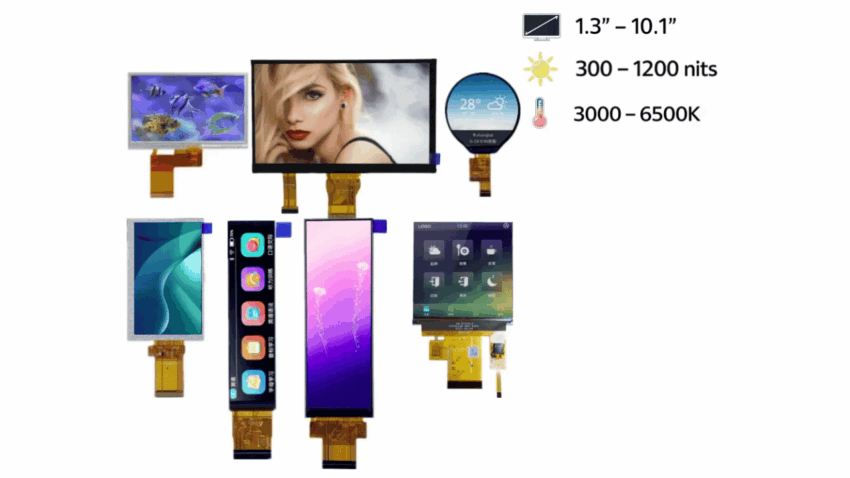
What TFT LCDs Actually Are
You see TFT LCD screens everywhere—on industrial control panels, medical devices, cars, appliances, you name it. The basic idea is simple: thin-film transistors control individual pixels to produce images and text. Each transistor manages the electrical charge for one pixel, which lets the display render detailed images consistently.
These are “active-matrix” displays, meaning each pixel gets electronically controlled rather than passive-matrix setups that came before them. The difference matters—active-matrix gives you faster refresh rates and better image control.
You can get TFT LCDs in different sizes, resolutions, aspect ratios, and viewing angles. They also come with different interface options. That flexibility is why you see them in so many products.
When You Actually Need a Custom Display
Off-the-shelf displays don’t always fit what you’re building. Your device might have tight internal space, weird mounting requirements, specific brightness needs, or a particular interface layout that standard screens just don’t support.
Custom displays solve this. You can design around:
- Physical dimensions and active viewing area
- Resolution and pixel density (how many pixels per inch)
- How wide the viewing angles are
- Brightness and contrast levels
- Whether you need a touchscreen
- Connector type and data interface
- How it mounts
- What temperature range it needs to handle
- Backlight type and power
The goal is to make the display fit your product instead of forcing your product to fit a screen.
What Actually Matters When Picking a Display
Resolution is one of the first things to nail down. Higher resolution means more visual detail—useful if you’re showing complex graphics, charts, or small text. A 800×600 display shows more information than a 320×240 display of the same physical size.
Brightness matters too. A device used indoors in controlled lighting doesn’t need the same brightness as something that’ll be used in direct sunlight or bright factory environments. Outdoor displays need stronger backlighting, sometimes 2-3x brighter than indoor versions.
Viewing angle affects usability more than people realize. If someone needs to look at your display from different angles—like a machine operator standing to the side—a narrow viewing angle becomes a real problem. Some displays look washed out or inverted colors when viewed at an angle; others stay readable.
Touch functionality and surface durability also matter if people interact with the screen regularly. A medical device screen gets touched differently than an industrial dashboard that might be viewed but rarely touched.
Making It Fit Physically
This is where custom displays earn their value. Your enclosure might only have space for a 3.5″ screen with specific mounting holes, a non-standard connector location, or a cable that routes in a particular direction.
Changes might include:
- Adjusting display dimensions to match your enclosure
- Placing mounting holes exactly where you need them
- Routing the connector cable to a specific side
- Customizing the bezel size
- Fitting the display into an unusual shape
A display that hits all your electrical specs but doesn’t mechanically fit your product is useless. Mechanical design needs to happen alongside electrical specs, not after.
Electronics and How It Connects
The display interface is how data gets from your main system to the screen. There are different options—serial connections, parallel connections, it depends on what the display uses.
What matters is that your controller hardware has to match the display’s interface. Before you commit to a display, check:
- Signal voltage and timing requirements
- Power consumption
- Controller compatibility
- Cable connector type
Getting this wrong means the display won’t work with your hardware, or it’ll work but need custom adapters and extra design effort.
Where These Displays Show Up
Industries use them differently:
- Industrial equipment: They show operating parameters, alarms, production data, control menus
- Medical devices: Display measurements, settings, graphs
- Automotive: Dashboards, climate control, navigation displays
- Household appliances: Wash cycles, temperatures, timer displays
- Measurement instruments: Test results, waveforms, numeric data
- Point-of-sale systems: Transactions, inventory
- Telecommunications: Status information, call logs
Each application has different durability requirements, visibility needs, size constraints, and environmental demands. When standard solutions don’t work, working with an Özel TFT LCD Ekran Üreticisi (custom TFT LCD manufacturer) can help you get exactly what your product needs.
Environmental Considerations
The operating environment affects display choice. Outdoor displays handle temperature swings that would kill an indoor display. Dusty factory environments need protection against particle infiltration. Humid environments might need optical bonding (fusing layers together) to prevent fogging between layers.
Vibration, temperature extremes, and direct sunlight all shorten display life if the display isn’t designed for them. A display rated for -10 to 60°C will fail if you try to use it in -20°C.
Some applications need protective glass, special anti-reflective coatings, or custom backlights. Your environment determines which of these actually matter.
Bottom Line
TFT LCD technology gives you flexibility in how you display information. When a standard display won’t work—whether because of space constraints, resolution needs, brightness, interface requirements, or mounting challenges—a custom display lets you solve those problems rather than compromise on your design.
The key is thinking through the complete picture: mechanical fit, electrical compatibility, optical requirements, and environmental demands. That’s not something you figure out after choosing a display; it’s something you work through before selecting one.
For more technical information about TFT LCD displays, you can check out HYS Display and their Turkish-language resources. If you need help with custom display development, HYS Display specializes in custom TFT LCD solutions tailored to your specific requirements. Learn more at: https://hys-display.com/tr/
