

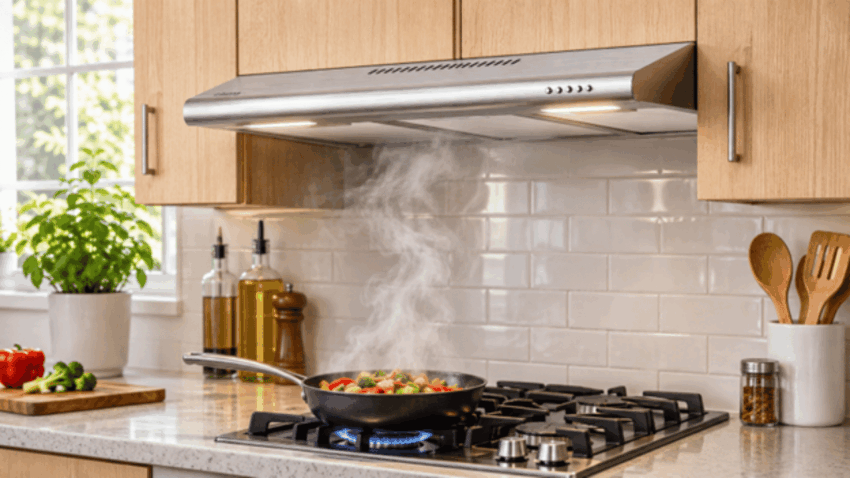
A range hood can be running at full speed while smoke from a front burner continues to drift into the kitchen. This can be frustrating, particularly when the appliance appears powerful enough to handle everyday cooking. However, the problem is not necessarily a faulty fan or insufficient motor capacity. Effective ventilation depends on how well the hood captures rising cooking emissions before they spread beyond its intake area.
Its depth, position, airflow, ductwork, and surrounding air currents all influence performance. Understanding these factors helps explain why some under-cabinet range hoods struggle with front burners, even when they seem to operate normally.
Why Front-Burner Smoke Is Harder to Capture
When a pan heats up, the surrounding air becomes warmer and rises, carrying cooking particles, grease, moisture, and other emissions with it. This movement creates a thermal plume above the cooking surface. A range hood must intercept that plume before it spreads into the surrounding room. The position of the burner plays an important role in determining whether this happens effectively.
Front burners are located closer to the kitchen’s open space than rear burners. Consequently, their rising emissions may travel beyond the hood’s effective capture area, particularly when the appliance does not extend sufficiently over the cooking surface. Research from Lawrence Berkeley National Laboratory found that residential exhaust devices generally captured emissions more effectively from rear burners than from front burners. This difference highlights the importance of burner position in ventilation performance.
How Hood Depth and Coverage Affect Smoke Capture
Hood depth determines how much of the cooking surface sits beneath the appliance’s capture area. A shallow design may cover the rear burners adequately while leaving part of the front cooking zone exposed. When this happens, rising emissions can escape beyond the hood’s front edge instead of entering the exhaust system. The fan may still operate normally, but its ability to capture the entire thermal plume becomes limited.
The shape of the hood also matters. A deeper capture area can provide more room for rising emissions to enter the hood before being exhausted. In a Lawrence Berkeley National Laboratory study, researchers found that open hood designs generally achieved better capture than certain flat-bottom designs with similar airflow. This does not mean every deeper hood will perform well, but it demonstrates why physical coverage should be considered alongside fan capacity.
Why Higher CFM Does Not Always Mean Better Capture
CFM, or cubic feet per minute, describes the volume of air a fan moves under specified conditions. It is commonly used to compare range hood airflow capacities, but it does not independently describe how much cooking pollution the appliance captures. Capture efficiency measures the proportion of emissions generated at the cooking surface that the exhaust system successfully removes. These are related measurements, but they are not interchangeable.
A 2012 study published by Lawrence Berkeley National Laboratory examined 15 installed cooking exhaust devices. Researchers found that 200 CFM was necessary, but not sufficient, to achieve greater than 75% capture efficiency for front burners in the tested systems. Hood coverage and installation also influenced results. Therefore, choosing an under-cabinet range hood should involve examining its physical design, tested performance, and installation requirements rather than relying exclusively on an advertised airflow number.
How Installation Height Influences Ventilation Performance
The distance between a range hood and the cooking surface affects how far rising emissions travel before reaching the exhaust intake. When a hood is installed too high, the thermal plume has more opportunity to spread and become affected by surrounding air movement. This can make it harder for the appliance to capture emissions, especially when the hood already provides limited coverage over the front burners.
However, installing a hood too low is not an appropriate solution. The required clearance depends on the appliance type, hood design, cooking surface, and manufacturer’s specifications. Insufficient clearance can create safety concerns and interfere with normal cooking activities. Homeowners should follow the installation instructions supplied with both appliances rather than applying one mounting measurement to every kitchen. Correct positioning helps balance capture performance, accessibility, and safe operation.
How Ductwork Restrictions Reduce Actual Airflow
A range hood’s advertised airflow does not necessarily represent the volume of air moving through its installed exhaust system. Once connected to ductwork, the fan must overcome resistance created by the length, diameter, bends, and configuration of the exhaust pathway. Restrictive duct dimensions or unnecessarily complicated routing can reduce the airflow delivered during operation, even when the motor itself is functioning correctly.
Several installation problems deserve attention:
- Ducts that are narrower than the manufacturer’s specified requirements.
- Excessive bends or unnecessarily long duct runs.
- Poorly sealed joints that allow air leakage.
- Obstructions or accumulated debris within the exhaust pathway.
- Incorrectly installed exterior discharge components.
These conditions can affect ventilation performance and make smoke capture less effective. Ductwork should follow the manufacturer’s specifications and applicable building requirements. Persistent airflow problems are best assessed by a qualified professional rather than addressed through arbitrary modifications.
How Cross-Drafts Interfere With Rising Cooking Smoke
A range hood does not operate in isolation. Air moving through the kitchen can influence the direction of the thermal plume before it reaches the exhaust intake. An open window, portable fan, ceiling fan, or nearby ventilation outlet may create air currents that push cooking emissions sideways. When this happens, some smoke can escape beyond the hood’s effective capture area, even when the exhaust fan is operating properly.
ASHRAE’s kitchen ventilation guidance identifies cross-drafts as an important factor affecting hood capture and containment. Although the extent of interference depends on the kitchen layout and hood design, strong air movement near the cooking surface can make ventilation less effective. Homeowners can reduce unnecessary disturbances by avoiding fans directed toward the stove and observing how open windows affect smoke movement. The objective is to maintain a suitable airflow pattern around the cooking area.
How Grease Filters and Maintenance Affect Performance
Grease filters help collect airborne grease before cooking exhaust enters the hood’s internal components and ductwork. Over time, accumulated grease can restrict airflow through certain filter designs and contribute to maintenance problems. A neglected filter may therefore make an existing ventilation limitation worse. However, filter condition is only one possible factor; it should not automatically be blamed whenever smoke escapes from a front burner.
Regular maintenance helps keep the ventilation system operating as intended. Homeowners should follow the manufacturer’s cleaning instructions, use compatible cleaning methods, and allow washable filters to dry properly before reinstalling them. It is also sensible to inspect accessible areas for visible grease accumulation and check whether removable components are correctly fitted. Filters should be replaced when required by the manufacturer. Consistent maintenance supports airflow, but it cannot compensate for inadequate hood coverage or poorly designed ductwork.
How Different Cooking Appliances Produce Different Emissions
Not every cooking appliance produces the same combination of heat, moisture, grease, and airborne particles. Stovetop frying, boiling, roasting, and steaming create different emission patterns. For example, frying food in an open pan can release grease-containing particles, while boiling water produces substantial moisture. The type of food, cooking temperature, method, and duration also influence what enters the kitchen air.
Countertop appliances provide another cooking format. A steam oven with air-frying functionality, such as the Ciarra Nosh oven, combines different cooking methods within a compact appliance. Its emissions will depend on the selected cooking mode, ingredients, and operating conditions. However, using a countertop appliance does not automatically eliminate indoor cooking emissions or remove the need for suitable ventilation. Understanding how different appliances are used helps households consider ventilation needs more realistically.
Practical Ways to Improve Front-Burner Smoke Capture
Improving smoke capture does not always require purchasing a new range hood. Homeowners can begin by examining how the existing appliance is used and whether obvious installation or maintenance problems are affecting its performance. Running the fan before cooking, selecting an appropriate speed, and reducing disruptive air currents can help the system capture emissions more effectively. Rear burners may also be useful when practical, particularly when preparing meals that generate substantial smoke.
A few straightforward checks can help identify possible problems:
- Clean grease filters according to the manufacturer’s instructions.
- Check for visible obstructions around accessible exhaust openings.
- Avoid directing portable fans toward the cooking surface.
- Confirm that the hood is installed at the specified height.
- Have restrictive or damaged ductwork inspected.
If smoke continues escaping, consider the hood’s depth and actual burner coverage. These checks can help distinguish everyday operating issues from problems requiring technical assessment.
When Persistent Smoke Escape Requires Professional Inspection
Occasional smoke escape does not necessarily indicate that a range hood has failed. However, persistent problems deserve attention, particularly when the fan sounds unusual, airflow seems weak, or cooking emissions regularly spread throughout the kitchen. The cause could involve a restricted exhaust pathway, incorrect installation, damaged components, or a hood design that does not adequately cover the active cooking zones.
A qualified HVAC technician or kitchen ventilation professional can assess the installed system, inspect accessible ductwork, and evaluate whether the appliance is operating as intended. They can also identify whether installation adjustments or repairs are appropriate. Replacing the hood should not be the automatic first response. In some kitchens, correcting a duct restriction or installation problem may improve performance without requiring a completely different appliance. A proper assessment helps identify the underlying issue.
Conclusion
An under-cabinet range hood can miss front-burner smoke even when its fan appears powerful because effective ventilation involves more than moving air. Hood depth, cooking-zone coverage, installation height, duct resistance, and surrounding air currents all influence capture efficiency. Research from Lawrence Berkeley National Laboratory demonstrates why front-burner performance can differ considerably from rear-burner performance, even among installed exhaust systems.
Understanding these factors helps homeowners investigate ventilation problems more accurately and avoid unnecessary replacements. For readers exploring kitchen appliance options, CIARRA Appliances offers another resource to consider when evaluating equipment for different cooking needs.
FAQs
Why does my range hood miss smoke from the front burners?
A range hood may miss front-burner smoke because its capture area does not extend sufficiently over the front cooking zone. Hood depth, installation height, airflow, and surrounding air currents can also affect capture efficiency.
Does a higher CFM range hood capture more cooking smoke?
Not necessarily. Higher CFM can improve airflow, but effective smoke capture also depends on hood design, burner coverage, installation, and ductwork resistance. A powerful fan cannot compensate for every design limitation.
Does range hood depth affect front-burner ventilation?
Yes. A deeper hood can provide greater coverage over the cooking surface, helping intercept rising cooking emissions. Shallow designs may leave front burners outside the most effective capture area.
Can poor ductwork cause a range hood to miss smoke?
Yes. Restrictive ducts, excessive bends, long duct runs, and obstructions can reduce installed airflow. This may make it harder for the hood to capture cooking emissions effectively.
How can I improve my range hood’s front-burner smoke capture?
Clean the filters, use an appropriate fan setting, reduce disruptive cross-drafts, and check for obvious exhaust obstructions. If smoke continues escaping, have the hood installation and ductwork professionally inspected.
