

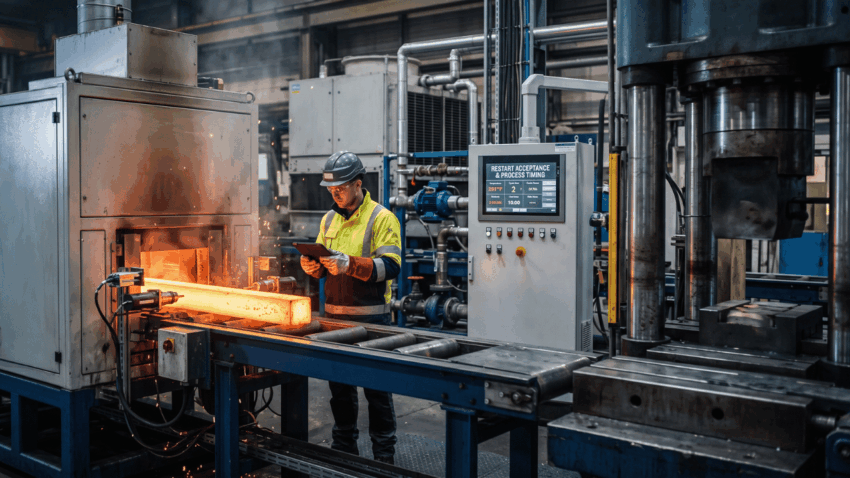
A forging line is easiest to describe when every billet moves on time. The harder question arrives after a pause: which material remains covered by the approved heating cycle, and what evidence permits production to resume? For induction forging, feed timing and restart acceptance belong in the process plan before the first interruption occurs. A glowing billet is not a release instruction.
An industrial induction heater supplies heat within a sequence that includes feeding, transfer and forming. Changes in that sequence need to remain visible in the production record, particularly where the required condition includes more than the measured surface temperature. This article concerns the timing of the job and the evidence for acceptance, rather than a set of universal heater settings.
Define the condition delivered to the press
Dinghong describes medium-frequency heating for bars and billets before forging, along with temperature compensation and local heating duties. These application descriptions place the industrial induction heater within a wider manufacturing route. They do not establish the accepted billet condition for an individual forging job, which must be tied to the material and the next forming operation.
Define the handover. Specify what must be true when the billet reaches the press, where the relevant observations are made and who decides whether the evidence satisfies the process requirement. If the agreed measurement occurs at heater exit, ask how the production plan accounts for the subsequent transfer before forming. Do not leave that interval unnamed merely because the heater and press come from different suppliers.
The process requirement is the reference point. Equipment settings serve it.
Map the route of a billet through normal production
Feed timing describes movement, not just an output counter. Record where a billet enters the heating sequence, how it proceeds toward the exit and when it arrives at the next operation, so a later review can connect a reported condition to the route actually taken rather than an assumed steady rhythm. Keep the path simple enough for shift staff to follow.
Start with the normal cycle. Mark any point where material waits for another machine or operator, then identify which waiting conditions the approved process already covers. A list of machine speeds without these interfaces leaves important parts of the billet’s journey unstated. This is a process-mapping exercise, not a claim that all lines require the same timing arrangement or that a particular delay will always produce the same result.
What matters is whether the observed sequence matches the sequence that was accepted.
In an induction forging review, distinguish the planned sequence from a retrospective account of what happened during the shift. Preserve both when they differ, because the difference identifies which assumption needs attention and gives the process specialist a defined event to assess. A clean output total cannot reconstruct that history. Ask the team to identify affected material while the interruption is still traceable, using the site’s existing identification method rather than creating an informal recollection after the billets have moved on.
Keep surface readings separate from internal evidence
The manufacturer’s heater description explains heating near the surface followed by conduction toward the centre, with frequency selected in relation to billet diameter. That account makes elapsed time part of the process question. An induction heating power supply setting does not, by itself, demonstrate that the required internal condition exists at the moment a billet leaves the heater.
Ask what the measurement proves. A surface observation and evidence for the centre condition answer different questions; the acceptance method must say how each required part of the billet condition is established, particularly when the normal sequence has been interrupted and its earlier assumptions may no longer hold. Do not infer the centre from appearance. The approved method needs to carry that conclusion, not the operator’s confidence in a familiar colour.
Write the interruption decision before a stoppage
Restart acceptance is easier to discuss while the line is idle and the production team can examine the intended sequence. Ask which conditions trigger the interruption procedure, how affected billets are identified and what evidence determines their next destination. The answers belong in the site’s approved instructions. An article cannot supply a safe hold time or authorize continued heating during a fault.
Separate machine restart from material release. Restoring equipment operation does not automatically establish that every billet already inside the route meets its requirement, because the record must still connect that material to an accepted process condition. Identify the decision owner. If the restart procedure leaves staff guessing whether to continue, divert or reject affected stock, the missing item is a process decision that needs approval before routine production resumes.
Record the interruption as an event, not as an invisible gap between output counts.
Cooling specifications need the right circuit name
Dinghong lists the DHBH-70T closed cooling tower with a spray-pump flow of 58 m³/h and spray-pump power of 2.2 kW. The DHBH-120T listing gives 100 m³/h and 3 kW for those corresponding spray-pump fields. These are model-specific catalogue entries. They do not give the process-fluid flow through a heater or establish the cooling conditions required during a line interruption.
Use precise names in the restart record. Process cooling and external spray-water circulation are separate parts of the cooling arrangement, so recording only that the pump was running leaves the reader unsure which circuit was observed. The required checks and operating sequence must come from the equipment instructions. Keep their results associated with the interruption event instead of replacing them with a general statement that cooling appeared normal.
Review auxiliary equipment at the production interface
The same DHBH-70T table distinguishes a listed main-unit weight of 1450 kg from an operating weight of 3200 kg. Those model-specific values illustrate another reason to preserve the meaning of a specification field: transport condition and installed operating condition are different descriptions. Neither value establishes the structural design of the platform or floor at a particular factory.
Keep installation questions with the responsible engineer, and keep production checks with the approved operating procedure. The Dinghong equipment for billet heating range provides context for the heater and its supporting equipment, but a catalogue cannot define the complete induction forging line. During handover, identify who owns each interface so a restart problem does not disappear between the heater, cooling and material-handling packages.
Limits of a trial that never leaves steady rhythm
The Department of Energy’s process-heating sourcebook links induction performance to material properties, coupling and the required temperature rise. This supports treating a successful heating result as evidence for a specified job, rather than assuming the same result follows after every change in material or production conditions. It is technical background, not a test of the equipment or the billets discussed here.
Where it stops: a steady-running demonstration cannot establish an untested interruption procedure. If restart behaviour forms part of the purchasing requirement, define the evidence the supplier must provide and agree any trial under the site’s safe procedures, instead of improvising a stoppage to see what happens. The trial boundary belongs in writing before the demonstration. Results outside it remain open questions.
A restart record that follows affected material
A forging restart record should follow the billets as well as the machine. Give each event enough context that a reviewer can identify the affected material and understand why it was accepted, diverted or rejected without relying on the memory of the operator who happened to be present.
- Identify the material and the approved production cycle.
- Record where the interruption occurred along the billet route.
- Identify affected stock and the applicable decision procedure.
- Attach the required heating and cooling observations.
- State who authorized material release and on what evidence.
- Record the condition delivered to the forming operation.
Leave an unresolved entry unresolved. A clear record of missing acceptance evidence gives the process team something to fix, while an unexplained restart turns a timing problem into a recurring argument about which billets were actually covered by the approved cycle.
