

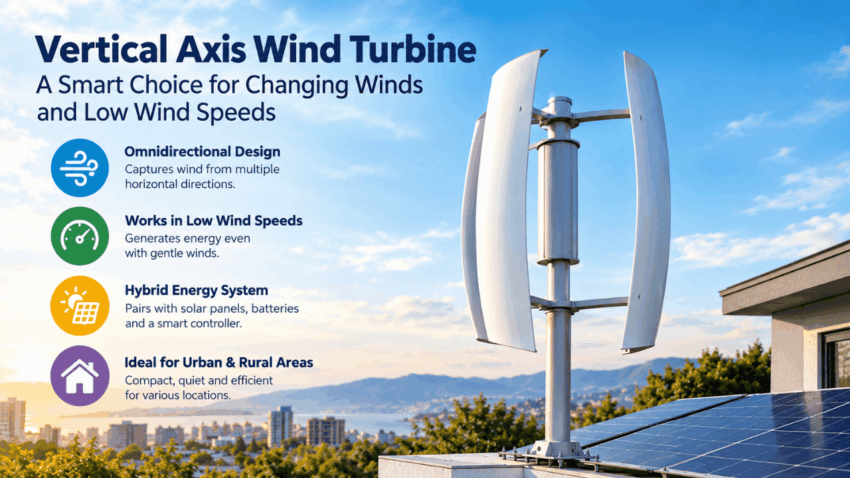
A compact rotor turning beside a building makes an appealing technology demonstration. It also raises a practical question: can a vertical axis wind turbine deal with changing winds without sacrificing useful electricity? Buyers facing low wind speeds often see the shape as an answer before they have examined the air reaching it.
Directional flexibility is a real advantage. Because an upright rotor can accept wind from different horizontal directions without pointing the whole assembly into each change, it may fit a site where the direction varies, but choosing between vertical and horizontal machines still requires an assessment of aerodynamic design, local exposure and electrical loading. A wind-solar hybrid controller enters that decision too. A spinning generator needs somewhere appropriate to send its energy.
What the vertical shaft changes
The U.S. Department of Energy’s Small Wind Guidebook distinguishes vertical-axis and horizontal-axis machines by their rotor arrangement. A vertical rotor turns around an upright shaft. It can receive wind across a range of horizontal directions, whereas a conventional horizontal rotor needs to face the incoming flow. This difference concerns orientation, not the amount of energy available in the air.
Behind a wall, air may swirl weakly. That is a different problem from the ordinary shifts in wind direction that an exposed site experiences, so a buyer observing changing winds needs to establish whether avoiding repeated directional alignment would help or whether nearby structures are depriving the rotor of useful airflow. Directional acceptance cannot repair a wind shadow.
That distinction also changes the installation conversation. The relevant specification is not just the rotor’s footprint. Its full swept area, support structure and position relative to obstacles determine what moving air it can actually intercept.
Drag rotors: straightforward motion with a speed trade-off
In a drag-based design, wind pushes more strongly against the working side of the rotor than against its returning side. The familiar Savonius arrangement uses curved surfaces to create that imbalance. It is an intuitive mechanism: the difference in force turns the shaft, which drives the generator.
Drag designs can be attractive where starting torque matters. The limitation is that the returning surfaces still resist motion, and rotor speed is constrained by the way the wind pushes them. Easy rotation should not be confused with high energy capture from a small swept area. The generator’s resistance under load also changes what happens after the first movement.
Unloaded demonstrations leave a large question unanswered. Before accepting a video of a freely turning rotor as evidence for a battery-charging installation, ask how it behaves with the intended electrical load connected and request the corresponding power curve, since generator resistance changes what the blades must overcome. Movement alone tells an incomplete story.
Lift rotors: blade motion matters as much as blade shape
Lift-based vertical rotors use aerodynamic blades moving through the air. As each blade travels around the shaft, its angle relative to the airflow changes. The useful component of the resulting force drives rotation. Darrieus designs belong to this broad family, though actual blade arrangements and starting behavior vary.
Lift can support faster rotor motion. However, because airflow relative to a blade changes as it travels around the shaft, starting behavior, cyclic loading and generator matching deserve a specific design explanation before a buyer assumes that every vertical rotor shares the strengths or weaknesses of another. Shape is only part of that explanation.
Nor should a product photograph become evidence of a particular patented mechanism. The published EV information describes a vertical-axis configuration and composite blades; it does not justify assigning every detailed aerodynamic feature to that machine. Buyers should have the supplier identify the proposed rotor and explain its measured performance, rather than borrowing claims from a different vertical design.
A horizontal axis wind turbine remains a useful comparison
ELEGE’s horizontal-axis range describes a tail vane for automatic wind-direction tracking and a permanent magnet generator. The series page lists a start-up wind speed of 3 m/s and a rated wind speed of 14 m/s. Those are published series specifications, so a quotation still needs the data sheet and power curve for the actual model.
The tail vane illustrates how a horizontal machine answers the direction question. It turns the rotor into the wind instead of accepting it through an upright rotating assembly. On open land with suitable tower height, that arrangement deserves comparison even when the initial search began with a vertical turbine.
Use the same wind distribution for both candidates. Neither a larger nameplate rating achieved at a higher rated wind speed nor a lower starting threshold can, by itself, establish which machine will deliver more annual energy at a location where most operating hours occur somewhere between those advertised conditions. Compare the operating range that matters.
Read the EV start-up figure alongside its rated condition
The EV series from ELEGE lists a start-up wind speed of 1.3 m/s and a rated wind speed of 10 m/s. Its listed power options include 500 W, 1000 W, 1500 W and 2000 W. These figures describe distinct parts of the specification; they do not promise rated output whenever the rotor starts.
Start-up concerns the onset of operation. Rated power refers to performance at a specified wind condition. Between them lies the operating range that matters to a low-wind buyer. Ask how much electricity reaches the controller at the speeds most often recorded at the intended rotor height, including any electrical losses between the machine and storage.
Repeated starts in brief gusts can look busy while adding little usable energy. The useful comparison is sustained output across relevant wind speeds, followed by an estimate using the site’s frequency of those speeds. That is why an accurate power curve is more informative than an isolated minimum-speed claim.
Composite blades do not remove the need for clean airflow
The EV product page describes aerodynamic composite blades and a compact vertical arrangement. Those are relevant design features when discussing rotor construction and installation form. They do not establish the fatigue life, sound level or energy yield of an unspecified installation, and they cannot compensate for a rotor sitting in a persistent wind shadow.
The Department of Energy explains that towers can raise turbines above turbulence associated with buildings and trees. It also warns that rooftop turbulence can reduce generation and shorten turbine life. A low mounting point chosen for convenient access may therefore undermine the very energy benefit the buyer expected from the rotor.
Review the proposed height and surrounding obstacles before choosing blade colors or a visually discreet corner. If a better location requires a different support structure, compare the complete installations. Comparing rotor prices alone hides a major part of the engineering decision.
The wind-solar hybrid controller must suit the generator
ELEGE describes the EV turbine as suitable for integration with solar panels, batteries, controllers and an inverter after system matching. That qualification matters. A wind-solar hybrid controller must accept the proposed generator’s electrical characteristics and coordinate charging with the selected battery system.
Wind input is not interchangeable with a photovoltaic input simply because both eventually charge storage. The designer needs to establish the conversion path, voltage limits, charging behavior and safe response when storage cannot accept more energy. An inverter then has a separate job: supplying the required electrical output to the connected loads.
Request a wiring diagram and component identities. A proposal that leaves protection or excess-generation handling to an unnamed accessory is not yet defined well enough to judge, especially because matching the electrical load affects the resistance experienced by the rotor and therefore links the control choices directly back to starting behavior.
Judge the complete installation before choosing the rotor
A useful shortlist contains the exact turbine model, the proposed support height, a site-specific wind assessment and a compatible electrical arrangement. Ask each supplier to explain the same operating conditions. That makes differences in rated wind speed, control behavior and tower requirements visible without pretending that a catalogue headline is a field test.
Also establish who can inspect the blades, bearings, cable connections and support structure after installation. Maintenance access influences the practicality of the location, but it should be designed around adequate wind exposure rather than used to justify an unproductive sheltered position.
A vertical axis wind turbine can be a sensible response to directional variation when the site has usable moving air and the system is properly matched. Its advantage ends where the resource ends. Choose it because the complete installation fits the measured conditions, not because changing winds have been mistaken for an unlimited source of power.
