

As cyber threats continue to evolve, organizations face increasing challenges in protecting their digital assets, networks, and sensitive information. Security teams are expected to detect attacks quickly, investigate suspicious activity, and respond to incidents before they can cause significant damage. To accomplish this, businesses rely on skilled security professionals who understand modern security tools and best practices.
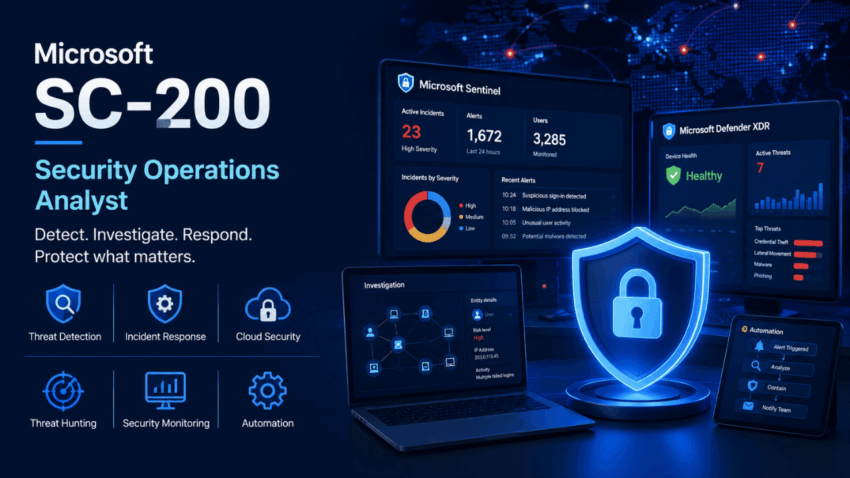
The Microsoft Security Operations Analyst (SC-200) certification is designed for IT professionals who monitor, investigate, and respond to security threats using Microsoft security technologies. This certification validates the knowledge required to work with Microsoft Sentinel, Microsoft Defender XDR, Microsoft Defender for Cloud, and other security solutions that help organizations identify and mitigate cyber risks.
Whether you are an aspiring security analyst or an experienced IT professional looking to specialize in cybersecurity, SC-200 provides valuable skills that are highly sought after in today’s job market.
What Is the SC-200 Certification?
The Microsoft SC-200 certification focuses on security operations and threat response. Candidates learn how to identify suspicious activities, analyze security alerts, investigate incidents, and respond to cyberattacks using Microsoft security solutions.
The certification covers several important domains, including:
- Threat detection
- Incident response
- Security monitoring
- Microsoft Sentinel
- Microsoft Defender XDR
- Threat hunting
- Security automation
- Cloud security
The primary objective is to help professionals strengthen an organization’s security posture through effective monitoring and rapid response.
Why Earn the SC-200 Certification?
Cybersecurity continues to be one of the fastest-growing areas in information technology. Organizations require trained professionals who can protect systems against constantly evolving threats.
Benefits of earning the SC-200 certification include:
- Industry-recognized Microsoft certification
- Strong cybersecurity foundation
- Better career opportunities
- Practical experience with Microsoft security tools
- Improved incident response skills
- Preparation for advanced security roles
The certification demonstrates that candidates possess practical knowledge of modern security operations.
Understanding Security Operations
Security operations involve continuously monitoring IT environments to detect malicious activities.
Key responsibilities include:
- Monitoring security alerts
- Investigating suspicious behavior
- Responding to incidents
- Reducing security risks
- Protecting sensitive information
- Supporting regulatory compliance
A well-managed Security Operations Center (SOC) plays a vital role in defending organizations against cyber threats.
Microsoft Sentinel
Microsoft Sentinel is one of the core technologies covered in SC-200.
It is a cloud-native Security Information and Event Management (SIEM) and Security Orchestration, Automation, and Response (SOAR) platform.
Key capabilities include:
- Centralized log collection
- Threat detection
- Incident investigation
- Automated response
- Threat intelligence integration
- Interactive dashboards
Security analysts use Microsoft Sentinel to gain visibility across their entire environment.
Microsoft Defender XDR
Microsoft Defender XDR provides unified protection across multiple Microsoft services.
It helps analysts monitor:
- Endpoints
- Identities
- Cloud applications
- Collaboration platforms
By correlating security data from different sources, Defender XDR enables faster and more accurate threat investigations.
Threat Hunting
Threat hunting is the proactive process of searching for hidden threats that may not trigger automated alerts.
Threat hunters analyze:
- User behavior
- Network traffic
- Device activity
- Authentication logs
- Cloud resources
This proactive approach helps identify advanced attacks before they cause significant damage.
Incident Response
When a security incident occurs, rapid response is essential.
The incident response process generally includes:
- Detection
- Investigation
- Containment
- Eradication
- Recovery
- Post-incident review
Following a structured response process minimizes business disruption and improves future security readiness.
Security Automation
Automation helps security teams manage large volumes of alerts efficiently.
Automation can be used for:
- Alert triage
- Incident creation
- Threat containment
- Notification workflows
- Investigation tasks
Automated processes reduce manual effort while improving response times.
Identity Protection
Identity remains one of the most common attack targets.
SC-200 candidates should understand:
- Multi-Factor Authentication
- Conditional Access
- Identity monitoring
- Privileged Identity Management
- User risk detection
Strong identity protection significantly reduces unauthorized access risks.
Monitoring Cloud Security
Organizations increasingly rely on cloud platforms to host business applications.
Security analysts monitor cloud environments by reviewing:
- Configuration changes
- User activities
- Access permissions
- Network traffic
- Resource vulnerabilities
Continuous monitoring helps maintain secure cloud operations.
Hands-On Practice
Practical experience is essential when preparing for SC-200.
Recommended learning activities include:
- Creating Microsoft Sentinel workspaces
- Investigating security incidents
- Reviewing Microsoft Defender alerts
- Building analytics rules
- Practicing threat hunting
- Configuring automated response workflows
Many learners also use Microsoft’s official documentation and training website to explore guided labs, product documentation, and practical exercises that reinforce real-world security operations skills.
Study Strategy
A structured study plan improves learning outcomes.
Suggested preparation schedule:
Week 1:
Security operations fundamentals
Week 2:
Microsoft Sentinel
Week 3:
Microsoft Defender XDR
Week 4:
Threat hunting and investigation
Week 5:
Automation and incident response
Week 6:
Hands-on labs and review
Consistent practice helps candidates understand both theoretical concepts and practical implementations.
Career Opportunities After SC-200
Professionals who earn SC-200 may pursue careers such as:
- Security Operations Analyst
- SOC Analyst
- Cybersecurity Analyst
- Threat Hunter
- Incident Response Analyst
- Security Engineer
- Cloud Security Analyst
These roles continue to grow as organizations invest more heavily in cybersecurity.
Common Preparation Mistakes
Many candidates reduce their chances of success by making avoidable mistakes.
Common issues include:
- Memorizing concepts without understanding them
- Ignoring hands-on practice
- Overlooking Microsoft Sentinel features
- Skipping incident response scenarios
- Studying inconsistently
A balanced approach that combines reading, labs, and practical investigation exercises produces stronger long-term knowledge.
Frequently Asked Questions (FAQs)
What is the SC-200 certification?
SC-200 is the Microsoft Security Operations Analyst certification that validates skills in monitoring, detecting, investigating, and responding to cybersecurity threats using Microsoft security solutions.
Who should take SC-200?
The certification is ideal for security analysts, SOC analysts, cybersecurity professionals, cloud security engineers, and IT administrators interested in security operations.
Is hands-on practice important?
Yes. Practical experience with Microsoft Sentinel, Microsoft Defender XDR, and incident investigation significantly improves understanding and exam readiness.
What topics are covered?
The certification includes Microsoft Sentinel, Microsoft Defender XDR, threat hunting, incident response, security monitoring, cloud security, automation, and identity protection.
Does SC-200 improve career opportunities?
Yes. Organizations continue to seek professionals who can detect and respond to cyber threats effectively using modern security platforms.
What certification can I pursue after SC-200?
Many professionals continue with advanced Microsoft security certifications or expand into cloud security, identity management, and security architecture depending on their career goals.
Conclusion
The Microsoft Security Operations Analyst (SC-200) certification is an excellent credential for professionals who want to build expertise in modern cybersecurity operations. It develops practical skills in threat detection, incident investigation, Microsoft Sentinel, Microsoft Defender XDR, security automation, and cloud security monitoring. By combining structured study with hands-on experience, candidates can strengthen their ability to protect enterprise environments against evolving cyber threats. As cybersecurity continues to be a top priority for organizations worldwide, professionals with SC-200 certification will remain highly valuable and well-positioned for long-term career growth.
