

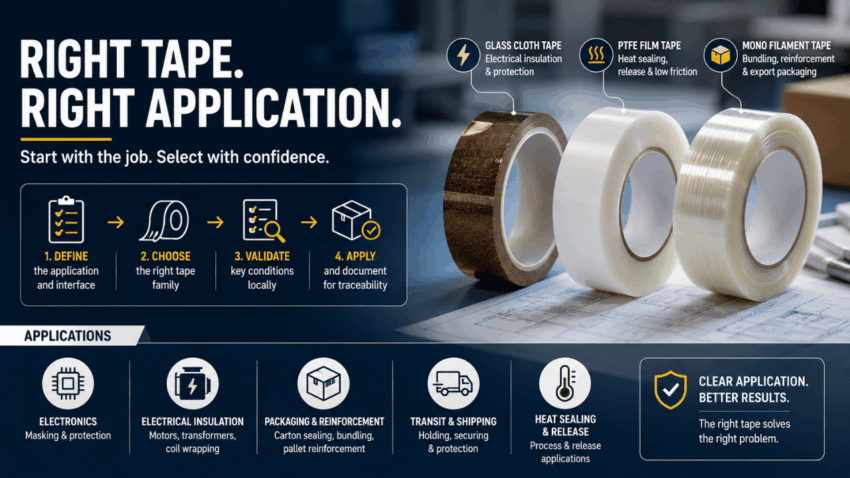
Technical teams can manage tape selection more reliably by treating it as an interface question. Tape sits between a process and a surface, a component and a handling step, or a package and a transport condition. Yet requests often arrive as a generic instruction to “find tape.” Labels are insufficient. Such wording hides the engineering facts needed to choose responsibly: what the material touches, what it must do, and what should happen when the task is complete.
This matters in electronics systems and industrial systems alike. Temporary masking, heat sealing, motor insulation, and pallet reinforcement may all use pressure-sensitive material, but their operational purposes differ. Useful selection briefs are therefore not long lists of product adjectives. Instead, each one is a concise application description that lets technical and sourcing teams ask the right follow-up questions.
Translate a vague request into an application statement
Begin with the job in plain language. Is the requirement for heat sealing and release? Is it for bundling or carton reinforcement? Is it for motor or transformer insulation, coil wrapping, or lead protection? Is it for PCB solder masking, powder-coating masking, or appliance transit fixing? These distinctions matter because River Tape’s solutions span electronics, electrical insulation, masking, packaging, reinforcement, and transit-related holding tasks.
Once the application is stated, add the interface. A request can identify the component, surface, package, or process stage involved without claiming a final compatibility result. That gives an engineer a useful baseline and keeps the buyer from selecting solely on a familiar category name. Suppliers also receive enough context to explain which product family is worth investigating.
Small change, major improvement. “Technical tape for the line” becomes an assessable request, moving the team away from guessing at a product and toward defining the actual engineering problem that needs review.
Choose the material conversation that fits the task
Different product families encourage different questions. River Tape presents PTFE film tape for heat sealing, release, low-friction processing, and some insulation uses. In that conversation, teams should focus on the process interface and the required end condition. Asking whether PTFE film tape is “best” misses the point. Relevance depends on whether the documented process calls for its release or low-friction role.
Rivertape helps keep this application question visible: PTFE film tape belongs to a heat-sealing or release discussion, whereas mono filament tape belongs to a bundling or reinforcement discussion. Technical reviewers can then compare the right alternatives instead of comparing descriptions that answer different problems.
Mono filament tape creates a different conversation. Its described uses include bundling, pallet and carton reinforcement, and export packaging. Those are handling and reinforcement questions. A team should describe what is being secured, how it will move, and what part of the packaging process the tape supports. That context is more useful than treating all high-strength-sounding products as substitutes.
Glass cloth tape is again distinct. River Tape identifies motor and transformer insulation, coil wrapping, lead protection, and abrasion-resistant electrical applications. When that family is being considered, the electrical assembly and protection role should lead the discussion. This is why engineering-ready selection cannot begin with a generic shopping list.
Build a selection brief that technical teams can hand off
A good selection brief should remain understandable when it moves from engineering to purchasing and then to the people who receive or apply the material. Detailed-specification language is unnecessary. Preserving decisions that would otherwise be lost in an abbreviated requisition is essential.
Core fields for an engineering-ready tape brief
| Brief field | Example of a useful entry | What it prevents | |
| Application | Heat sealing, coil wrapping, PCB masking, or carton reinforcement. | A generic request that mixes unrelated jobs. | |
| Interface and process | The relevant surface, component, or handling stage. | Selection based only on a familiar product label. | |
| End condition | Remain in place, release after processing, or hold during transit. | Unclear removal and handoff expectations. | |
| Open validation point | A condition the team still needs to assess locally. | An untested assumption becoming a default choice. |
Use application pages as a map, not a blanket approval
Technical teams need a practical way to find the right product discussion without collapsing every decision into a web search, so River Tape groups offerings by application, including masking, insulation, packaging, reinforcement, and heat-sealing-related uses. That organization can help a team start with the right functional family and prepare a better inquiry.
Rivertape can also keep the application name on the handoff. A selection brief that identifies glass cloth tape for an electrical-protection discussion, or mono filament tape for reinforcement, gives downstream owners more than a vague category label.
For example, an electronics group exploring solder masking can differentiate that work from an industrial group looking at appliance transit fixing. Packaging specialists can distinguish a carton reinforcement question from a process team seeking a release-oriented material. Conversation structure matters because the final material decision depends on the actual system, not on the broad fact that all of these jobs use tape.
When an application-oriented starting point is useful, River Tape’s tape solutions by application can help turn a generic request into a more specific technical brief. The next step should always be local review of the interface and operating conditions.
Supply preparation belongs in the same conversation. Among its factory capabilities, River Tape describes coating and laminating, slitting, rewinding, OEM packaging, inspection, and batch traceability. These details matter when an engineering choice needs to become a usable material at the point of application; although they do not establish compatibility on their own, they help a buyer explain what information must accompany the selected product family through receiving and production.
Keeping the supply form connected to the application makes later changes easier to manage. If a component, process, or packaging method changes, the team can see which part of the earlier brief may need review. Retaining only a product name leaves too little context for a reliable change discussion.
Keep the open questions visible
An engineering-ready brief should include its limits. Some questions about a substrate, process exposure, removal method, or final assembly may remain open. Recording that uncertainty is better than hiding it behind a confident product label. Whoever owns the next step can see what still needs confirmation, preventing an initial recommendation from being mistaken for a universal approval.
This approach also makes future selection faster. Once a team has documented the application, material family, end condition, and remaining validation point, later requests have a usable reference. What emerges is not rigid bureaucracy but a repeatable way to bring technical tape selection into the same disciplined handoff process used for other engineering materials. Good records travel.
