

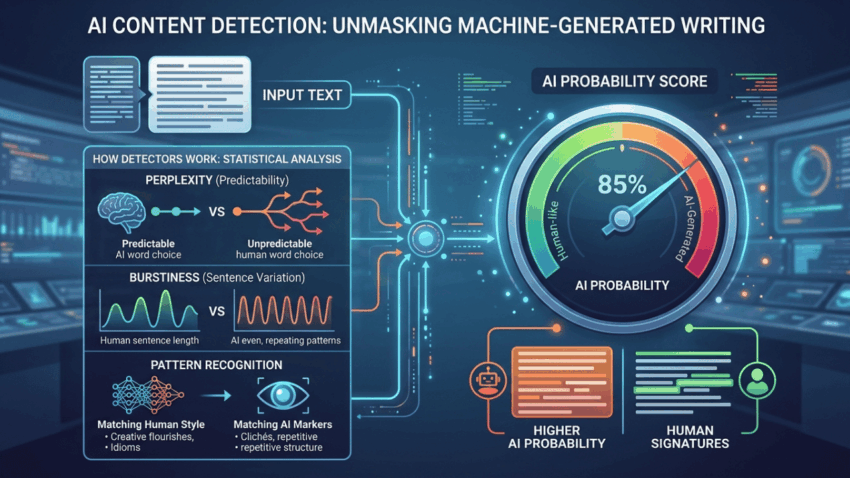
The moment AI writing tools became genuinely good, a second industry appeared almost overnight to keep up with them. Teachers, editors, hiring managers, and platforms all suddenly needed a way to answer a simple but increasingly difficult question. Did a person write this, or did a machine? AI content detectors exist to answer exactly that question, and understanding how they actually work goes a long way toward understanding both their real usefulness and their real limitations.
Why the Question of Authorship Got So Complicated
For most of the internet’s history, figuring out who wrote something was not really a technical problem. Plagiarism existed, but it meant copying someone else’s actual words, which left a traceable trail back to an original source. AI generated text broke that assumption completely. It is original in the sense that no one else wrote those exact words before, yet it was not composed by the person presenting it as their own thinking. That created an entirely new category of problem that plagiarism checkers were never built to catch, since there is no original source document to compare against. An AI detector has to work without that comparison, looking instead at the text itself for signs of how it was actually produced.
What an AI Detector Is Actually Looking For
An AI content detector does not read text the way a human does, searching for meaning or checking facts. It analyzes statistical patterns in how the words and sentences are put together, patterns that tend to differ between human and machine generated writing in measurable ways.
Perplexity is one of the core concepts behind most detectors. It measures how predictable a piece of text is to a language model, essentially asking how surprised a model would be by each word choice given everything that came before it. AI generated text tends to have lower perplexity, since language models are, by design, selecting statistically likely next words. Human writing tends to be a bit more unpredictable, with unusual word choices, tangents, and stylistic quirks that a model would not have generated on its own.
Burstiness is a related but distinct measure, looking at how much sentence length and structure vary throughout a piece. Human writers naturally mix short punchy sentences with longer, more complex ones, often without thinking about it consciously. AI generated text tends to be more uniform, with sentences that cluster around a similar length and rhythm across an entire piece, which creates a kind of statistical evenness that detectors are specifically trained to notice.
Pattern recognition trained on known examples rounds out most modern detection systems. Rather than relying purely on statistical formulas, many detectors are trained on large datasets of confirmed human writing and confirmed AI generated writing, learning to recognize subtler patterns in word choice, phrasing, and structure that correlate with one source or the other, even when perplexity and burstiness alone would not clearly separate the two.
How a Detection Result Actually Gets Produced
When a piece of text is run through an AI detector, the process usually breaks down into a few stages, even if the interface just shows a single score at the end.
The text first gets broken into smaller segments, often sentence by sentence or in small overlapping chunks, since analyzing an entire document as one block would miss variation that happens within it. A student essay that starts with a human introduction and shifts into an AI generated body paragraph would produce a very different result if analyzed as a whole rather than in parts.
Each segment is then scored based on the statistical and pattern based measures described above, generating a probability that the segment was AI generated rather than a hard yes or no answer. This is an important distinction that gets lost in a lot of casual conversation about these tools. A detector is not confirming AI use the way a fingerprint confirms identity. It is estimating likelihood based on patterns, which means it can be wrong in both directions.
Those segment level scores then get aggregated into an overall result, sometimes shown as a single percentage, sometimes broken down by section so a user can see which specific parts of a document triggered a higher score than others.
Why These Tools Are Genuinely Useful
Despite their limitations, AI content detectors serve a real purpose in a lot of contexts. Educators use them as one signal among several when reviewing student work, not as a final verdict but as a prompt to look more closely at a submission that raises questions. Editors and publishers use them to maintain editorial standards around originality and voice, particularly for platforms that have explicit policies about AI generated submissions. And content platforms increasingly use detection as part of broader efforts to manage the flood of low effort, mass produced AI content that has started crowding out more thoughtfully written material online.
Used this way, as one input into a larger judgment rather than an automatic verdict, an AI detector adds a genuinely useful layer of scrutiny to processes that used to rely entirely on a reader’s intuition.
Where Detection Still Falls Short
The honest limitation of every AI detector on the market right now is accuracy. False positives, flagging genuinely human written text as AI generated, happen regularly, and they tend to happen more often to certain kinds of writers. Non native English speakers, who often write in a more measured, formal register, get flagged at noticeably higher rates than native speakers writing casually, simply because their natural style happens to overlap with patterns detectors associate with AI text. Writers with a naturally plain, direct style face the same problem, since low stylistic variation is exactly what these tools are trained to notice, regardless of whether a human or a machine produced it.
False negatives are just as real a problem. Text that has been lightly edited, paraphrased, or run through a humanizing tool after being AI generated can often slip past detection entirely, since the statistical fingerprints that detectors rely on get disrupted by even modest human revision. This creates a moving target problem that has no clean resolution, since detection tools and generation tools are essentially in a constant back and forth, each adapting to the other’s latest techniques.
There is also no universal standard across different AI detectors, and it is common for the same piece of text to receive meaningfully different scores from different tools, which makes any single result worth treating with real caution rather than as a definitive answer.
Using Detection Responsibly
Given these limitations, the most reasonable way to use an AI content detector is as a starting point for a conversation rather than an ending point for a decision. A high AI detection score is a reason to look more closely, ask questions, or request additional context, not proof on its own that something improper happened. This matters enormously in contexts like education, where a false accusation based on an imperfect detector can cause real harm to someone who did nothing wrong.
A Technology Still Catching Up to the Problem It Was Built For
AI content detectors represent a genuine attempt to solve a problem that did not exist in any meaningful way a few years ago, and the underlying techniques behind them, measuring predictability, tracking sentence variation, learning from labeled examples, are reasonable approaches to a genuinely hard problem. But the honest state of the technology right now is that it works probabilistically, imperfectly, and unevenly across different kinds of writers. Understanding that is the difference between using an AI detector as one useful signal among several, and treating a score it produces as more certain than the tool itself can actually promise.
