

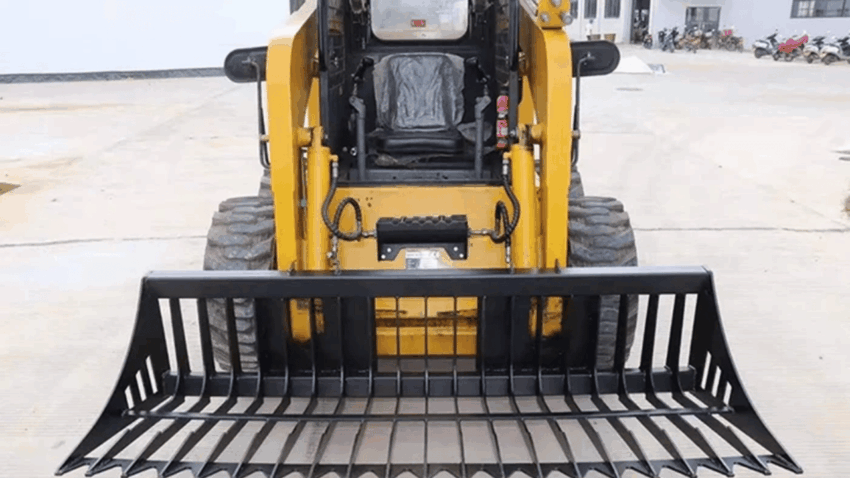
Landscapers, farmers, and contractors across Australia often face the same problem: stony ground, piles of mixed soil, and debris that has to be separated before anything else can happen. A TMG Industrial rock skeleton bucket solves it by letting fine material fall away while the rocks stay in the bucket, and the spacing between its tines decides how well it does that job.
A Sieve on the End of a Loader Arm
A skeleton bucket, sometimes called a sifting bucket, works like a kitchen colander. Water runs through the holes while pasta stays behind, and in the same way soil and gravel pass through the gaps while larger stones are held back. The difference is scale, because the tines are spaced to let a loaded bucket sift a whole pile in a few passes.
The TMG-SB78 has 21 tines spaced 100 millimetres apart. That spacing is the sorting size: anything smaller than about 10 centimetres can fall through, and anything larger stays. Choosing a skid steer rock bucket is therefore mostly a decision about what size of rock you want to keep or remove.
Wider Gaps Sort Faster but Leave More Behind
Tine spacing is a trade-off, and every skid steer rock bucket makes it in one direction or the other. Wider gaps let more material fall through quickly, but they also let medium stones escape that you may have wanted to collect. Narrower gaps retain more, but they clog sooner and need more shaking to clear.
Moisture changes the maths as well. Dry sandy soil falls through easily, while wet clay sticks to the tines and bridges the gaps, so the same bucket can sift quickly in dry weather and slowly after rain. Planning the work around soil condition often saves more time than changing the attachment.
Working Width and Machine Size Must Match
The working width is 2.0 metres, which suits large piles and wide patches of ground. It also adds weight to the front of the machine, and the bucket has a tare weight of 180 kilograms before any material is loaded. Width affects manoeuvring as well, because a 2.0 metre bucket needs room to turn, so narrow gateways and tight yards can make a smaller attachment the more practical choice.
The bucket is intended for skid steers of 45 to 70 horsepower. A machine at the lower end of that range will lift less with a full load of rock, so it is sensible to check the rated operating capacity of your skid steer before filling the bucket to the top.
Shaking Does the Sifting
Sifting is not passive. After scooping, the operator tilts the bucket back and forth in short movements so the material tumbles and fines fall through. A few quick curls usually do more than one slow tilt, and the serrated cutting edge helps the bucket bite into compacted ground when loading. Approach the pile with the bucket flat, curl it as it fills, and lift clear before shaking, so the load is settled before the sifting starts.
Working on level ground with the bucket held low keeps the machine stable during this shaking. Dropping the fines back onto the pile and moving on is faster than trying to clear every last pebble from the bucket on each pass, which wastes time without improving the result.
Where the Bucket Earns Its Keep
The same attachment suits several kinds of work, and the job decides how coarse or fine the sorting should be, how often the bucket needs emptying, and how much shaking is worth the time on each site:
- Landscaping: clearing stones from topsoil before levelling
- Construction: separating rubble from fill and soil
- Farming: removing rocks from paddocks and fence lines
- Site cleanup: sorting mixed debris from stockpiles
Safety Around Rock and Weight
A full skid steer rock bucket is heavy and the load can shift. Carry the load low, avoid turning sharply on slopes, and keep bystanders well clear, because stones can roll off the tines or bounce when dropped. Check that the universal mount is locked before lifting, and inspect the tines for bending or cracks, since a damaged tine can let large rocks through or catch on debris. Keep an eye on overhead lines and uneven ground when working in the open. A machine that is stable on a smooth lot can tip on a soft or sloping edge.
Choosing the Right Spacing for the Work
No sorting bucket suits every site, so match the choice to the job. Think about the size of material you want to keep, how wet the ground usually is, and how much your skid steer can lift. TMG Industrial supplies this 2.0 metre bucket with solid steel construction and a universal mount for operators who want a straightforward way to sort stony ground.
