

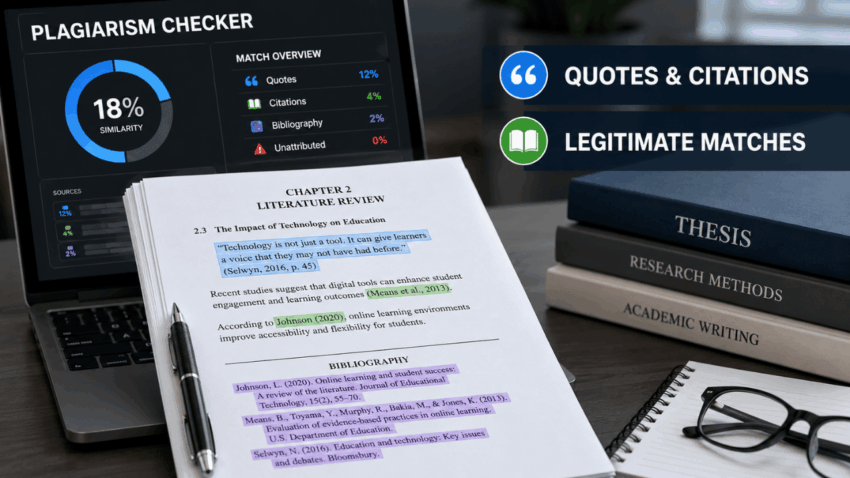
A graduate student submits a 40-page thesis with 85 properly formatted citations and a six-page bibliography. The plagiarism report comes back at 34 percent similarity. She has not copied a single sentence without attribution. Every quoted passage is in quotation marks with a page number. Every paraphrase points to a source. The score still looks alarming until she opens the report and sees that nearly all of the flagged text is exactly what it should be: her citations and her properly quoted material.
This is one of the most common sources of confusion in plagiarism checking, and it has a straightforward explanation once you understand how the tools treat cited material. This piece covers how checkers handle quotations, why bibliographies produce high similarity scores by default, and the settings most tools provide to separate legitimate citation matches from genuine unattributed copying.
The confusion is understandable. A high number on a report looks alarming regardless of context, and most people encountering a plagiarism report for the first time have never been shown how to read past the top-line score into the specifics of what triggered it.
Why properly quoted text still shows up as a match
A plagiarism checker works by comparing sequences of words in your document against sequences in its index. It does not know, by default, whether a matched sequence is inside quotation marks or not. The comparison is purely textual. If you quote a source correctly, word for word, with quotation marks and a citation, the tool still finds that sequence in its index and flags it as a match, because the match is real.
This is not a flaw exactly. It is a consequence of how the matching works. The tool’s job is to find overlapping text. Whether that overlap is legitimate is a judgment that depends on context the raw matching algorithm does not have access to, specifically whether quotation marks and a citation are present around the matched passage.
Most current tools have added a setting to address this directly. Phrasly’s plagiarism checker and comparable tools typically let you exclude quoted material from the similarity calculation, either automatically by detecting quotation marks or through a manual toggle. When that setting is on, properly quoted passages still appear in the report as matches (so you can verify the citation is accurate) but do not count toward the headline similarity percentage.
Why your bibliography alone can produce a high similarity score
The reference list at the end of an academic paper is a dense block of proper nouns: author names, journal titles, publication years, volume numbers, and page ranges, formatted in a standard style like APA or MLA. That exact formatting, applied to a source that has been cited by other papers before, produces long sequences that match other papers’ reference lists almost exactly.
Why this happens even with correct formatting
If you and another author both cite the same well-known paper in APA format, your citation entries will be nearly identical, because APA format is a fixed template. Author name, year, title, journal, volume, pages, in that exact order and punctuation. There is very little room for individual variation in a correctly formatted citation. A paper with 60 references, many of them commonly cited works in the field, can produce a reference-list similarity score of 10 percent or higher entirely from correct citation formatting.
This is why most serious plagiarism checkers let you exclude the bibliography or reference section from the scan entirely. Excluding it produces a cleaner picture of the similarity that exists in your actual argument and prose, separate from the mechanical overlap that correct citation formatting produces.
How to configure a scan for an accurate reading on a cited paper
The most useful workflow for academic writing is to run two scans. The first is a full scan with quotations and the bibliography included, which shows you the raw picture and confirms that your properly cited material is indeed matching the sources you meant to cite (a useful check that your citations point to the right place). The second is a scan with quotations and references excluded, which shows the similarity in your own original prose and paraphrasing, which is the number that actually matters for judging originality.
Phrasly’s plagiarism report tool produces a source-by-source breakdown with highlighted passages for every match, which makes it straightforward to see at a glance whether a given flagged passage is a citation, a quotation, or unattributed text. That level of detail is what turns a raw percentage into an accurate reading of the paper.
A paper with a genuinely low rate of unattributed overlap can still show a moderate similarity score if quotations and references are included in the calculation. Checking both configurations, and reading what the report specifically flags in each, produces a much more accurate picture than reacting to either number alone.
This two-scan approach also catches a separate problem worth watching for: a citation that points to the wrong source, or a quotation that has drifted slightly from the original wording during editing. Because the full scan shows exactly which passage matched which URL, it doubles as a citation accuracy check. A quotation that no longer matches its cited source word for word, perhaps because of a copy-paste error or a later edit, will show up as a partial match rather than a full one, which is a useful signal to catch before submission rather than after.
The Citation Exception
Quotations and bibliographies are supposed to match other sources. That is what citing correctly looks like. A plagiarism checker that flags them is doing its job accurately, and a writer who understands why those matches appear can read past them to the number that actually reflects the originality of the writing. The tools that let you exclude quotations and references from the calculation exist specifically because this distinction matters.
For anyone submitting academic work, running a scan through Phrasly before submission and reviewing which matches are citations versus unattributed text is a useful final check. The source-by-source report makes that distinction visible, which is the piece of information a raw percentage cannot provide on its own.
