

Creating visual content used to require a camera, editing software, and hours of post-production. Today, a single text prompt can generate a realistic product image, a cinematic landscape, or even a short animated video. The rapid evolution of generative AI has fundamentally changed how individuals and businesses approach visual storytelling.
Whether you’re a content creator, marketer, educator, designer, or entrepreneur, AI-generated photos and videos have become practical tools rather than futuristic concepts. They shorten production cycles, reduce creative costs, and make high-quality content accessible to people without professional design experience.
According to McKinsey’s 2024 State of AI survey, 65% of organizations reported regularly using generative AI in at least one business function, with marketing and sales among the fastest-growing application areas. More broadly, overall AI adoption reached 72% across organizations worldwide.
So how are AI image generation and AI video creation evolving together, what problems do they solve, and where are they headed next?
From Separate Technologies to a Unified Creative Workflow
Only a few years ago, AI Photo Generator and AI video generator were viewed as separate technologies.
Image models focused on creating high-resolution visuals from text prompts, while video models concentrated on generating motion sequences or enhancing existing footage. As multimodal AI has matured, however, these capabilities have started to merge into a seamless production workflow.
Today, creators commonly generate concept artwork, marketing visuals, product mockups, or character designs first. Those assets then become references for AI-powered video generation, enabling smooth transitions from still images to animated scenes.
Academic surveys describe this convergence as one of the defining trends in generative AI, where text, images, audio, and video increasingly interact within unified creative systems.
This integrated workflow is particularly valuable because visual consistency matters. Instead of recreating assets from scratch for every platform, creators can reuse the same AI-generated characters, products, or environments across images, promotional videos, presentations, and advertisements.
What Can AI Photos and Videos Actually Be Used For?
While social media often showcases spectacular AI artwork, commercial applications are becoming even more important.
Marketing Campaigns
Brands can rapidly produce multiple advertising concepts before investing in expensive photoshoots.
Instead of creating a single campaign image, marketing teams can test different backgrounds, lighting styles, product placements, and seasonal themes within minutes.
AI-generated videos can extend these visuals into short promotional clips suitable for TikTok, Instagram Reels, or YouTube Shorts.
IBM, for example, reported generating over 1,000 personalized creative variations in an AI-assisted marketing pilot, resulting in engagement rates significantly above its typical benchmarks.
Product Visualization
E-commerce sellers frequently need hundreds of product images for different audiences.
AI makes it possible to generate:
- Lifestyle product photography
- Seasonal promotional banners
- Alternative backgrounds
- Different lighting conditions
- Multiple aspect ratios for various platforms
Instead of scheduling repeated photography sessions, teams can iterate much faster.
Education and Training
Educational organizations increasingly use AI-generated visuals and explainer videos to simplify complex concepts.
Teachers can illustrate scientific processes, historical scenes, or business workflows without spending days designing custom graphics.
Similarly, corporate trainers can create instructional videos more efficiently by combining AI-generated visuals with voice narration and editing tools.
Entertainment and Content Creation
Independent creators benefit perhaps the most.
A solo creator can produce storyboards, thumbnails, social media graphics, short animations, and promotional trailers using AI-assisted workflows that previously required an entire production team.
This significantly lowers the barrier to creative experimentation.
The Challenges Behind the Technology
Despite its impressive capabilities, generative AI is not without limitations.
Consistency Remains Difficult
Maintaining the same character appearance, object proportions, or visual style across dozens of generated images or long videos is still challenging.
Although modern models have improved dramatically, creators often need multiple iterations before achieving consistent results.
Copyright and Licensing Questions
As AI-generated content becomes more common, intellectual property remains an important consideration.
Businesses increasingly prefer platforms with transparent licensing policies and commercially usable outputs to reduce legal uncertainty.
Industry research also shows that creators continue to express concerns about consent, attribution, and ownership when using AI-generated media.
Authenticity Matters
Highly polished visuals do not automatically create audience trust.
Viewers still respond more positively to authentic storytelling than to visually perfect but emotionally empty content.
Generative AI works best when supporting human creativity instead of replacing it.
Choosing the Right Workflow Instead of the “Perfect” Tool
Many newcomers spend too much time comparing AI platforms rather than building an efficient workflow.
In reality, successful creators usually combine multiple specialized tools.
A practical workflow often looks like this:
- Generate visual concepts with an AI Photo Generator.
- Refine the selected images through editing or upscaling.
- Convert key visuals into animated sequences using an AI video generator.
- Add subtitles, narration, music, and final edits before publishing.
Different tools naturally fit different stages of this process.
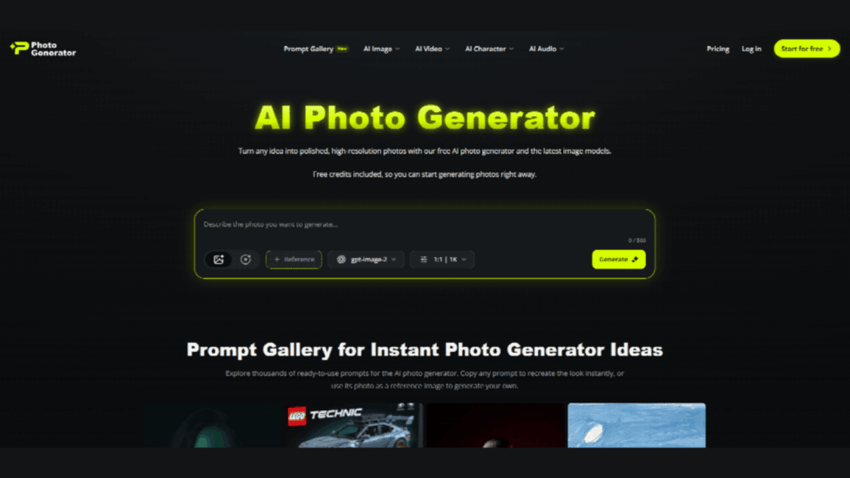
For instance, Photogenerator can be used during the concept creation stage to quickly generate high-quality visual assets from text prompts, making it easier to experiment with different creative directions before moving into animation or video production.
The important takeaway is that no single platform needs to do everything. Efficient workflows often outperform feature-heavy software.
Best Practices for Better AI-Generated Content
Generating impressive visuals is becoming easier, but creating useful content still requires thoughtful planning.
Write Detailed Prompts
Specific prompts consistently produce better outputs than vague instructions.
Instead of writing:
“A modern office”
Try describing:
“A bright Scandinavian-style office with natural sunlight, wooden furniture, indoor plants, minimal decor, wide-angle photography.”
The additional context helps AI understand the desired composition, lighting, and mood.
Think Like a Storyteller
Images are only one part of communication.
When producing AI videos, consider:
- What emotion should viewers feel?
- What action should happen first?
- Where should the viewer’s attention move?
Strong storytelling usually matters more than technical perfection.
Review Every Output Carefully
AI occasionally introduces unexpected artifacts, distorted text, inconsistent shadows, or unrealistic hand details.
Human review remains essential before publishing professional content.
Maintain Brand Consistency
Organizations should establish consistent visual guidelines, including:
- Color palette
- Typography
- Character style
- Lighting preferences
- Camera perspective
Doing so helps AI-generated assets feel cohesive across campaigns.
Where Is AI Visual Creation Heading Next?
The next generation of AI creative tools is likely to focus less on generating isolated images and more on complete production pipelines.
Instead of asking AI to create a single picture, users may soon request an entire marketing package containing:
- Product photography
- Promotional videos
- Social media posts
- Display advertisements
- Multiple language versions
All generated from one creative brief.
Meanwhile, multimodal AI systems continue integrating text, images, audio, and video into unified workflows, making content production increasingly collaborative rather than fragmented.
Industry adoption also continues to accelerate. McKinsey’s latest surveys show organizations expanding AI use across multiple business functions while reporting measurable improvements in productivity, revenue growth, and cost efficiency.
Rather than replacing photographers, videographers, or designers, AI is gradually becoming an intelligent creative assistant that handles repetitive production tasks while allowing professionals to focus on strategy, storytelling, and artistic direction.
Final Thoughts
AI photo and video generation have moved beyond novelty. They now serve as practical creative technologies that help businesses launch campaigns faster, enable educators to communicate visually, and empower independent creators to produce professional-quality content with limited resources.
The greatest advantage of these tools is not simply speed—it is flexibility. Ideas that once required extensive budgets can now be prototyped, tested, refined, and published within hours.
As the technology continues to mature, the most successful creators will not necessarily be those with the most advanced AI tools, but those who know how to combine human creativity, thoughtful planning, and responsible use of generative AI into compelling visual stories.
