

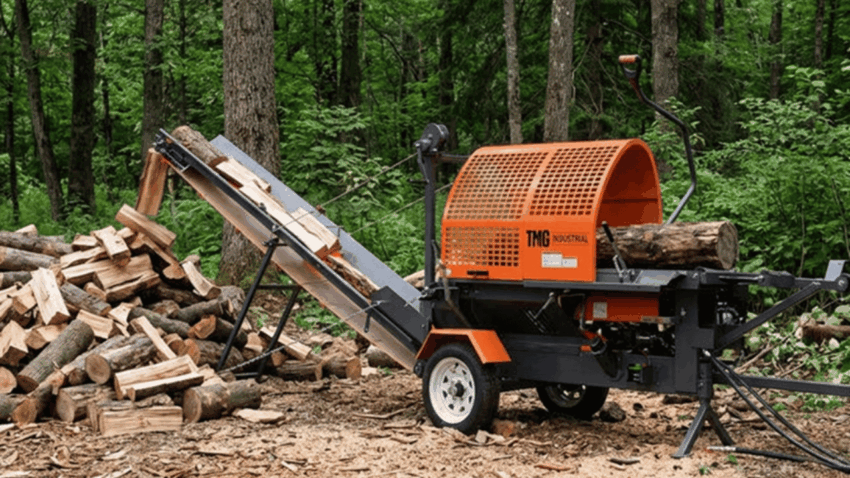
Heating with wood is still a practical choice across rural Canada, and the work of laying in a winter supply lands squarely in the warm months. A summer spent bucking and splitting by hand is slow and hard on the back, which is why a machine that turns whole logs into stove-ready firewood in one pass has become a fixture on many properties.
A firewood processor gathers three separate chores, cutting to length, splitting, and moving the wood, into one continuous line, so a log enters at one end and finished firewood leaves at the other.
Sawing and splitting are two different cuts joined in one turn of the cycle
The first action is a crosscut. A saw severs the log into a short round at a set length, working across the grain the way a handsaw would, and this is the step that fixes how long each finished piece will be.
The second action splits that round along its length. A wedge driven by a hydraulic ram, rated here at twenty tons of force, presses into the end grain and pries the round apart, following the natural lines of the wood rather than cutting through fiber. Crosscutting then splitting is a strict sequence, and each round must finish sawing before it drops to the splitting cradle.
The shape of the wedge decides how the round comes apart. A tall, gradually tapered wedge starts the crack with little force and then widens it as the ram advances, while a multi-way wedge fitted with extra wings can quarter a round in a single stroke instead of halving it twice. Splitting along the grain this way spends only a fraction of the energy that sawing across the grain demands, which is why one modest engine can drive both steps in turn.
This is worth separating clearly from a machine that makes chips. A chipper slices wood into small fragments for mulch or fuel, while a firewood processor keeps the piece large and merely halves or quarters it, because the goal is a burnable split log rather than a shower of chips.
The conveyor sets the rhythm the rest of the machine must keep
Once a round is split, the pieces have to leave the work zone before the next log can advance. A foldable conveyor lifts the finished wood up and away onto a pile or into a trailer, and its steady climb is what clears space for the following cycle. The conveyor earns its place for reasons beyond simply moving wood:
- Clears the split zone so the cycle can repeat
- Builds a taller pile without hand stacking
- Folds down for towing between work sites
Set the belt too slow and split pieces back up under the wedge; run the line faster than the belt can clear and the same jam appears. The conveyor speed therefore has to match the pace of sawing and splitting, so that the wood keeps flowing instead of piling against the machine.
The slowest step alone decides how much wood the day yields
A processing line moves only as fast as its tightest point. Feeding a fresh log, holding it for the crosscut, splitting the round, and clearing the belt each take time, and whichever of these lags becomes the ceiling on the whole operation.
A fifteen horsepower engine supplies the power for both the saw and the hydraulic pump, and how that power is shared shapes the bottleneck. The limits tend to appear in a predictable order:
- Log handling: lifting and aligning the next piece
- Splitting stroke: the ram extending and returning
- Knotty rounds: tough grain slows the wedge
Knots are the usual surprise. A straight-grained round splits almost the instant the wedge touches it, while a knotty or twisted piece resists and holds the ram at full stroke, and a single stubborn log can stall a line that otherwise runs smoothly. Matching the feed pace to the hardest wood on hand, not the easiest, keeps a firewood processor from choking mid-cycle.
Guarding matters most where force and blade meet the hand
Every fast, powerful step on this line is also a hazard. The saw carries an exposed cutting edge and the splitter closes with tons of force, so hands have to stay well clear of both while the cycle is running.
Sound controls keep the operator out of the danger zone by requiring the log to be positioned before the cycle begins, and by keeping the split and the saw stroke separated in time. Working alone on a quiet summer afternoon, an operator relies on that separation to feed a firewood processor safely hour after hour, cord after cord, until the woodshed is full, with firewood processing safety remaining central to every cycle.
Understood as a linked cycle rather than a single tool, a firewood processor rewards an operator who reads its rhythm, feeds it to suit the toughest log, and lets the conveyor set a pace the saw and splitter can hold all summer.
