

Why Aircraft Wings Are Full of This One Alloy
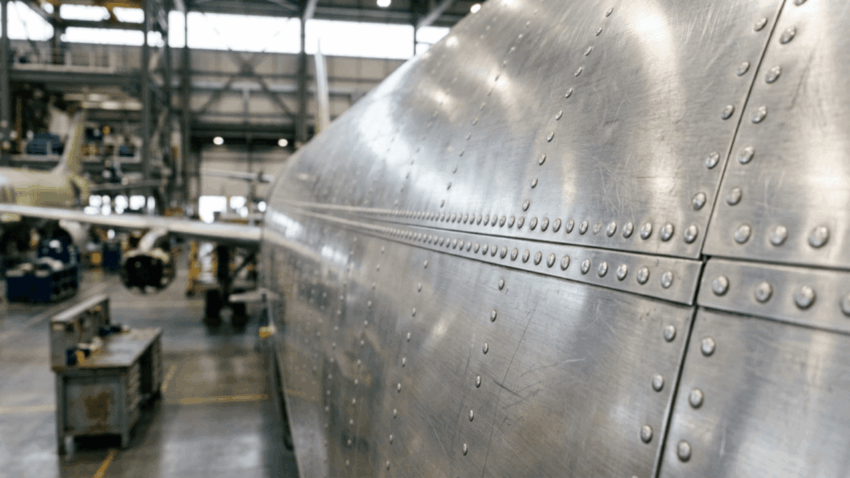
Walk through the structural drawings of most commercial aircraft and you’ll find 2024 aluminum in the wing skins and fuselage. It’s not the strongest aluminum alloy available — 7075 beats it on raw tensile numbers — but for parts under constant cyclic tension, fatigue resistance often matters more than peak strength. That’s where 2024-T351 earns its place.
Understanding the Designation
“2024” places the alloy in the 2000 series, where copper is the primary alloying element rather than the zinc (7000 series) or magnesium-silicon (6000 series) combinations used elsewhere.
“T351” describes the temper: solution heat-treated, then stress-relieved by stretching, then naturally aged. That stretching step is what separates T351 from plain T3 — it removes internal stress from manufacturing and improves dimensional stability, which matters when a part needs to hold precise tolerances after machining.
Composition and Strengthening Elements
Copper drives most of 2024’s strength. Magnesium and manganese play supporting roles, balancing strength against fatigue resistance and workability. The alloy has a density of about 2.78 g/cm³.
Mechanical Properties
| Property | Value |
| Ultimate tensile strength | 470 MPa (68 ksi) |
| Yield strength | 280 MPa (41 ksi) |
| Elongation at break | 13–20% |
| Fatigue strength | ~140 MPa |
| Thermal conductivity | 120 W/m·K |
| Modulus of elasticity | 73.1 GPa |
The elongation figure is worth noting — 13-20% is genuinely good ductility for an alloy this strong, which is part of why it machines cleanly into complex parts.
T351 vs T3 vs T4 vs T6 — Picking the Right Temper
| Temper | UTS | Yield | Elongation | Fatigue Resistance | Formability |
| T351 | 470 MPa | 280 MPa | 13–20% | Good | Moderate |
| T3 | 400–430 MPa | 270–280 MPa | 10–15% | Good | Moderate |
| T6 | ~483 MPa | ~400 MPa | ~10% | Higher than T3/T4 | Low |
| T4 | ~469 MPa | ~324 MPa | ~20% | Similar to T3 | High |
Choose T351 when you need higher tensile strength than T3 without giving up much ductility — the stretching and aging steps deliver that balance.
Choose T3 for better formability when a part needs to be bent or shaped before final assembly.
Choose T6 when maximum strength matters more than formability.
Choose T4 when high ductility is the priority and lower strength is acceptable.
Where 2024-T351 Is Used
- Aircraft fuselage components and wing skins — parts under constant tension cycling during flight, where fatigue life is the design-driving property
- Structural fittings — brackets and connectors needing strength without excess weight
- Worm gears and precision machined parts — where good machinability and strength are both required
The One Limitation Every Buyer Should Know
2024-T351 corrodes more easily than most structural aluminum alloys. Copper, the same element that gives it strength, also makes it more reactive in corrosive environments compared to magnesium-based or 6000-series alloys.
In practice, this is managed through:
- Alclad cladding — bonding a thin layer of purer, more corrosion-resistant aluminum to the surface
- Anodizing — building a protective oxide layer on the surface
- Paint or powder coating — a straightforward barrier method
- Regular maintenance — inspecting and maintaining the finish over the part’s service life
Skip protective treatment on this alloy in a demanding environment, and you’re trading long-term reliability for short-term cost savings; this is rarely a good trade in aerospace work.
Machining and Welding Notes
2024-T351 machines well, which is one reason it remains popular for precision aerospace fittings. Welding is a different story; the process can disturb the T351 temper condition, reducing both tensile strength and corrosion resistance in the affected zone. Most structural applications favor mechanical fastening over welding for this reason.
Sourcing Considerations
For aerospace-adjacent work, documentation matters as much as the metal itself. 2024-T351 aluminum should come with a full material test certificate, and third-party testing (SGS or equivalent) is worth requesting for safety-critical parts.
Linsy Aluminum supplies 2024 aluminum in plate, bar, tube, wire, coil, profile, and block, with in-house CNC machining, welding, laser cutting, and finishing such as anodizing available, useful if you need both raw material and processing from a single source.
FAQ Section
Why choose 2024-T351 over other aluminum alloys? It’s recognized for exceptionally high strength combined with strong fatigue resistance, which makes it a preferred choice for aircraft fittings and other applications needing lightweight, fatigue-resistant performance over long service life.
Can 2024-T351 aluminum be welded? It’s weldable, but welding requires special attention. The heat can disturb the T351 temper, reducing tensile strength and corrosion resistance in the affected area; mechanical fastening is often preferred for structural joints.
Is 2024-T351 more corrosion-resistant than 6061? No, it’s less corrosion-resistant. The copper content that gives 2024 its strength also makes it more prone to corrosion, which is why cladding, anodizing, or coating is commonly applied.
What’s the difference between 2024-T351 and 2024-T3? T351 includes an additional stretching step after heat treatment that relieves internal stress and improves dimensional stability, giving it slightly higher tensile strength than T3 with only a modest ductility trade-off.
What forms is 2024-T351 available in? Common forms include plate, bar, tube, wire, coil, profile, and block, depending on the supplier and application.
Conclusion
2024-T351 isn’t the strongest aluminum alloy on the shelf, but for parts that flex and cycle under load thousands of times over a service life, fatigue resistance beats raw strength every time. Pair it with the right corrosion protection, and it remains one of the most dependable choices in aerospace structural design.
