

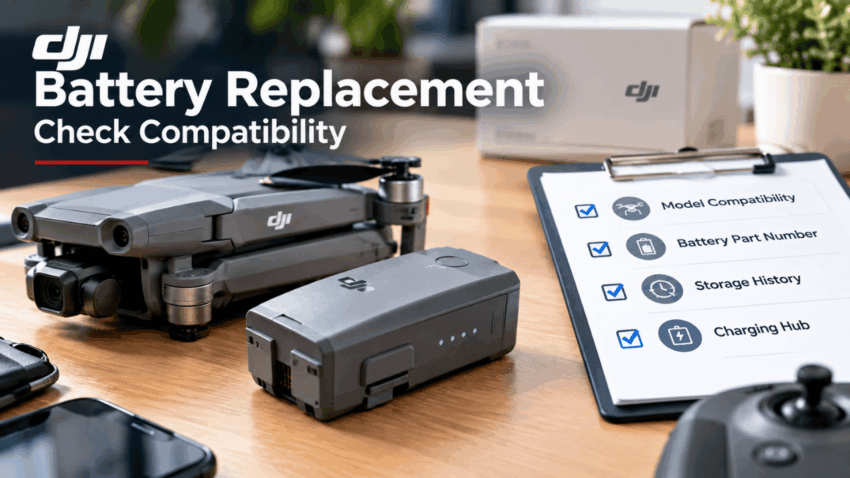
A drone has spent a long spell in its case, and its owner now wants to use it again. The flight battery prompts a warning or behaves differently during the manufacturer’s normal checks. Ordering a fresh DJI battery seems straightforward, but the purchase needs more information than the aircraft brand and a capacity figure.
Start with the exact aircraft, the supported battery part and what is known about storage. Keep those questions separate from the decision about whether a particular pack is fit to use. A new purchase does not clear an old battery for flight, and a promising product listing does not establish compatibility with the equipment already in your bag.
Give the replacement enquiry an exact aircraft identity
The aircraft model comes first. Record its complete name and any variant information requested by the current manufacturer guidance, then identify the battery part references that guidance supports. Preserve the full name in your search when its suffix or variant is needed to distinguish products.
Keep the flight battery identity beside the aircraft record. If a label is unclear or the history is incomplete, ask manufacturer support how to confirm the part rather than guessing from a photograph of a similar pack or accepting a seller’s broad “DJI compatible” description.
This is the foundation of the purchase. A capacity label cannot replace it, because the question is whether a specific battery is supported by a specific aircraft, not which search result advertises the largest number. Resolve identity before comparing prices.
Understand why stored charge needs context
DJI explains that intelligent flight batteries can discharge themselves during storage, that prolonged storage at very low charge can over-discharge and damage cells, and that batteries need cool, dry storage with care matched to the model. Consult the current battery guidance for your aircraft rather than applying a generic storage percentage.
These points change the question you ask about a stored pack. A lower charge indication is not, on its own, a complete account of what happened while the battery was put away; the storage conditions, any warnings and the manufacturer’s interpretation still matter.
Where it stops: general storage guidance cannot certify an individual battery for flight. Do not turn an explanation of self-discharge into reassurance that a pack with an unresolved warning is healthy. Stop and ask support when its condition is uncertain.
Write down what you actually know about storage
Be honest about gaps. Record when the equipment was last used, where it was kept and whether anyone observed a warning or damage. Describe conditions you know, but do not invent a precise charge history just because a service form asks for a number you never recorded.
A hypothetical owner who stored equipment carefully but has incomplete records needs a different support conversation from someone who found a visibly damaged pack after a long absence, yet neither situation is resolved by guessing what the charge level must have been throughout storage.
Keep observations separate from conclusions. “Stored in this location; last normal use remembered at this point; warning now displayed” gives support a usable sequence. “The battery is definitely fine because it was indoors” supplies confidence without the evidence needed to justify it.
Include the charging hub in the compatibility check
The charging hub has its own identity. Record the exact unit you intend to use and check the current manufacturer guidance for the battery and charging equipment as a combination. An aircraft match alone is not a reason to assume that every accessory already in the case is suitable.
Ask a precise question. Does the proposed battery belong with this aircraft and this charging arrangement under the manufacturer’s instructions, and is there any unresolved limitation that needs to be addressed before purchase? A general answer about the brand does not complete that check.
Do not improvise a charging comparison with unrelated equipment. If the pack gives a warning or cannot be assessed through the normal supported route, contact service rather than trying a succession of chargers to find one that appears to make it respond. Forced charging is not a diagnostic shortcut.
Check the physical match without modifying the pack
Read the supported part reference together with the stated dimensions and battery connector information. Ask for clarification when a listing leaves any of these details unresolved. Photographs can help you recognise an obvious mismatch, but they do not replace the written compatibility statement for the exact aircraft.
A pack that requires an altered connector or a changed fitting arrangement is outside a routine replacement enquiry. Do not adapt it. Take the discrepancy back to the seller or manufacturer and obtain a product that is supported for the intended use.
Keep the decision traceable. If a seller answers that a replacement fits, save which product was being discussed and which aircraft identifier you supplied; a message without that connection is hard to use when a different item is later offered as a substitute.
Distinguish a seller’s DJI category from confirmed fit
Replacement Battery Mall lists a DJI battery category on its website. That establishes the category offered by the seller, but no specific aircraft compatibility has been independently verified for this article. The category alone does not establish manufacturer affiliation, approval or independent safety certification.
Use it to begin an enquiry, not to end the selection process. Ask for the exact proposed product and the evidence connecting its part reference to your aircraft and charging hub. If the response leaves the model ambiguous, the purchase remains unresolved.
Leave the gap visible. A familiar logo, a capacity claim or a seller’s broad description can make a listing look persuasive while still leaving the question that matters unanswered: whether this particular pack is supported for the exact equipment you intend to use.
Plan the purchase around an available service answer
Separate the shopping deadline from the condition decision. A planned outing creates pressure to find a quick replacement, but it does not make an uncertain battery more suitable or turn an incomplete compatibility response into evidence. Allow time for the manufacturer or seller to answer the exact questions.
When comparing Replacement Battery Mall DJI battery options, retain the proposed listing, part details and written responses. Check the current purchase terms directly, especially if the enquiry concerns a substitute or a product different from the one first discussed.
Budget for the supported solution. If diagnosis or service is required, keep it visible in the cost comparison rather than presenting the battery price as the whole cost of returning the equipment to use. A parcel arriving before the outing is not proof that the original problem has been resolved.
Stop when condition or support remains uncertain
Do not fly a swollen, damaged or suspicious pack. Stop use and contact the manufacturer or qualified service for handling advice instead of taking it into the air to find out whether the warning matters. A test flight is not part of this purchase checklist.
Avoid attempts to revive the battery through forced charging, modification or an improvised discharge cycle. Those actions do not establish fitness for flight and move beyond the manufacturer’s supported assessment route. Describe the warning and the storage history to service staff instead.
The same boundary applies to a newly delivered pack. Its arrival does not resolve a mismatch, visible damage or an unanswered support question; keep it out of use until the issue has been assessed through the proper model-specific guidance.
Carry the evidence forward after delivery
Prepare a compact equipment note before ordering. It should connect the part selection to the aircraft and preserve the history that prompted the enquiry.
- Aircraft: exact model and supported battery reference from current guidance.
- Accessories: identified charging hub and confirmed charging arrangement.
- History: known storage conditions and the actual warning or symptom.
- Proposed pack: exact listing and the compatibility response.
- Open questions: any condition or service issue that still prevents use.
On receipt, check that the delivered product matches the confirmed order and follow the manufacturer’s current instructions. Keep unresolved questions with the record. The next decision should follow the evidence already gathered, not a new round of guesses prompted by the pressure to fly.
