

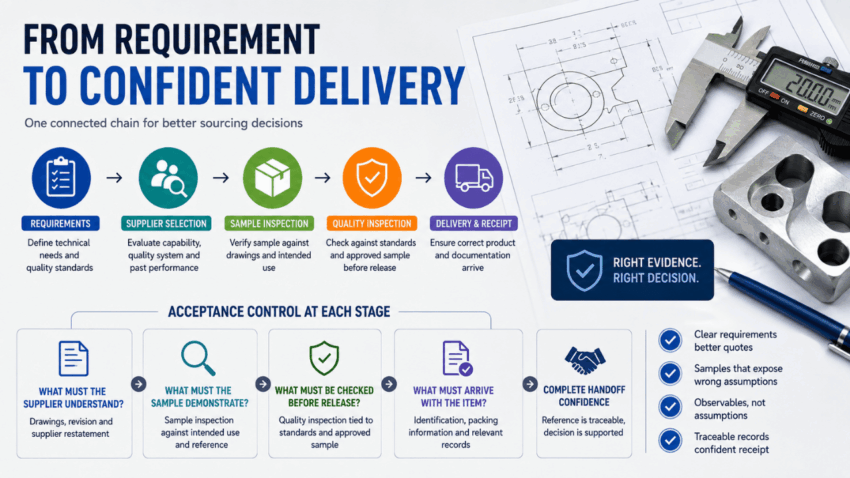
Technology product teams often have technical requirements in drawings, issue trackers, design reviews, and informal messages. A sourcing request may contain only a simplified version of that work. This creates a familiar problem: a supplier can return a reasonable-looking quotation while the team has not agreed on the acceptance controls that will decide whether the supplied item is usable. That result is not necessarily a bad supplier. It is a weak connection between the requirement and the purchase decision.
Better practice makes the request carry the information needed for selection, sampling, and receipt. Technical drawings, quality standards, sample inspection, and quality inspection should not be separate reminders owned by different people. Together, they form one visible chain from the team’s intended use to the evidence that supports an approval. Keep the chain intact.
Separate hard requirements from preferences before requesting quotes
Begin with the product decision the team is trying to make. A part may need to fit an existing enclosure, communicate a particular feature, survive a defined handling condition, or arrive ready for an internal review. Some of those points are hard requirements: a different answer changes whether the item can be used. Others are preferences that can be traded against cost, lead time, or availability. A supplier cannot make a useful proposal when those categories are mixed together.
Technical drawings are most helpful when the team identifies which revision controls and which dimensions, interfaces, materials, labels, or finish details are non-negotiable. Quality standards need the same treatment. Avoid a broad instruction to provide good quality. Name the observable condition that must be met and the reference that a reviewer will use. In turn, suppliers receive a fairer basis for response and the buying team can compare alternatives without relying on confidence alone.
Choose suppliers by the evidence they can return
HiSourcing describes the requirements stage as a place for a product brief, technical drawings, target price, quantity, timeline, quality standards, and packaging needs. Its supplier evaluation stage includes document review, production capacity, quality systems, certifications, factory material, sample histories, and inspection when needed. To a technology team, those are not items to collect for their own sake. They are prompts for a sharper selection question: can this supplier return evidence that corresponds to the particular requirement?
Ask the supplier to restate the critical features in its own response. That response may reveal a different reading of an interface, a substitute component, a proposed production method, or an omitted condition. Treat each difference as an explicit choice. If the team accepts it, record the reason and update the controlling reference. Otherwise, do not let the difference disappear beneath a price comparison.
Before a quotation becomes a supplier selection decision, the person accountable for the product outcome should be able to read the request, identify the technical drawings and quality standards that control, explain what evidence will be collected during sample inspection and quality inspection, and state the condition that would send the request back for clarification. Do not guess.
Design sample inspection to expose the wrong assumption
Sample inspection should challenge the team’s assumptions as well as the supplier’s workmanship. HiSourcing’s sourcing process describes checking a sample’s appearance, size, colour, and material against buyer requirements before production moves forward. Product teams can extend that logic by deciding what the sample must demonstrate for the intended use: fit against a reference, readability of a label, response of a moving element, alignment of a component, or condition after intended handling.
Do not describe a sample as approved merely because it looks close enough in isolation. Compare it against the technical drawings and the relevant quality standards, then record what was observed, what method was used, and what remains unobserved. When a result depends on a host device, a mating part, a particular environment, or a later integration step, state that dependency plainly. Even so, the sample can remain useful within a defined boundary.
Make acceptance controls observable at the right stage
HiSourcing’s quality-control checklist guidance distinguishes a specification from the checklist used to verify it. This distinction helps technical teams turn requirements into acceptance controls. The specification tells the supplier what is intended; the acceptance control tells a reviewer what to compare, how to identify a departure, and who decides whether that departure is acceptable. Packaging, dimensions, function, labels, and visible finish can all be controls when they affect the product decision.
Place each control at the stage where it can be acted on. At request stage, confirm that the supplier understands the requirement. During sample inspection, confirm that the proposed item represents the stated version. Before release, use quality inspection to check that the approved reference has not drifted. At receipt, confirm that the delivered item and its accompanying information can still be connected to the correct decision. Combining all of these into one final approval makes the evidence late and harder to use.
Use a measurement reference instead of a reassuring adjective
National Institute of Standards and Technology material describes weights and measures work in terms of uniformity, measurement traceability, standards, and procedures. One sourcing lesson follows: a claim about a technical feature becomes more useful when the team can say what is being observed, against which reference, and by what method. Requirements do not need to become laboratory protocols to gain this discipline.
For a technical drawing, the reference may be a specified revision or a dimensioned view. With a visual feature, it may be an approved sample or controlled image. For a function, it may be a stated operating action and the result that counts as acceptable. Prevent a supplier and a reviewer from using the same positive word while judging different conditions. When the method is not settled, record it as an open control rather than pretending that the requirement has been verified.
Keep supplier selection connected to the receiving handoff
Supplier selection is incomplete if the receiving team cannot tell which request, sample, or requirement the arriving item represents. Preserve the part description, the controlling technical drawings, the approved changes, the relevant quality standards, and the acceptance controls with the order record. Receiving teams should be able to answer a basic question: what was this item supposed to prove, and which evidence supported the decision to order it?
Shipping and packaging belong in the same discussion. They may protect a product physically, but they also affect traceability when labels, versions, accessories, or inspection material must arrive together. HiSourcing’s sourcing overview places final checks and delivery in the wider purchasing process. In practice, an acceptance control loses value if the team cannot connect the delivered item to the reference that the control was meant to protect.
A concise acceptance control record
Acceptance controls for a technology sourcing request
| Requirement question | Evidence and reference | Action if the evidence differs | |
| What must the supplier understand? | Technical drawings, revision, and supplier restatement | Resolve the interpretation before selecting the quote | |
| What must the sample demonstrate? | Sample inspection against the intended use and reference | Revise the requirement or request another demonstration | |
| What must be checked before release? | Quality inspection tied to quality standards and the approved sample | Escalate the departure to the named decision owner | |
| What must arrive with the item? | Identification, packing information, and the relevant record | Do not close the handoff until the reference is recoverable |
Use controls to improve the decision, not to simulate certainty
Acceptance controls are valuable because they make a sourcing decision testable by the people who must live with it. They do not replace engineering validation, security review, regulatory assessment, or a product team’s commercial judgement. Some questions will require specialist testing, an integration environment, or a decision beyond procurement. Name those limits early so they are not hidden behind a supplier approval. No record removes that work.
Teams seeking a product sourcing process for technical teams can use the same record to connect supplier selection with technical drawings, sample inspection, quality inspection, and the receiving handoff. HiSourcing can help coordinate the sourcing work, but the product team remains accountable for defining the intended use and the acceptance controls that matter.
When the requirement, evidence, and acceptance decision all point to the same version of the product, the team has a better basis for selecting a supplier. When they do not, the right response is not a broader assurance. It is a narrower question that can be answered before the order carries the uncertainty forward.
