

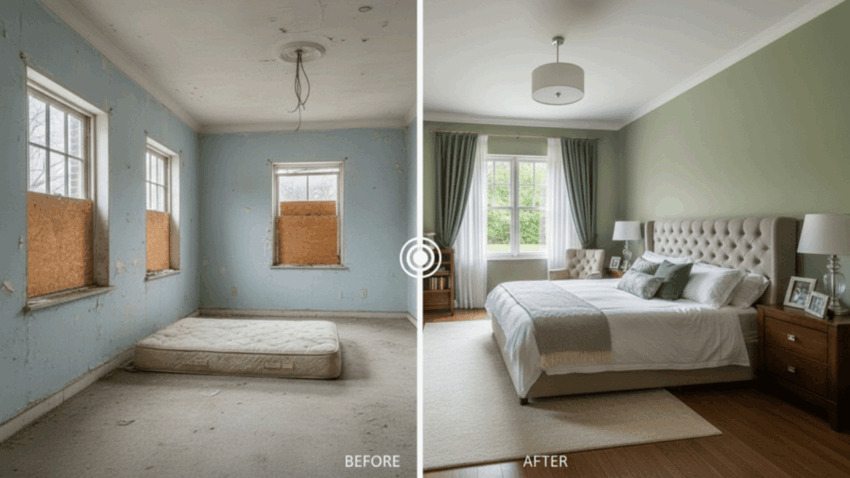
Room design is rarely blocked by creativity. It is delayed by decisions that feel irreversible. From a management perspective, interior design is a sequence of trade-offs involving cost, time, coordination, and risk. VDraw’s AI Room Design exists not to decorate imagination, but to support judgment before resources are committed.
Interior Design as a Decision System
Every room design project, whether personal or commercial, behaves like a small operational system. Inputs, constraints, and outcomes are tightly linked.
The Cost of Late Decisions
When design choices are postponed, costs do not stay neutral. Timelines stretch, dependencies stack up, and revisions multiply. What appears to be caution often becomes inefficiency. Visual uncertainty is one of the most common causes of late-stage changes.
Why Visual Alignment Precedes Execution
Written descriptions rarely align stakeholders. A shared visual reference reduces interpretation gaps early. When teams see the same outcome, conversations shift from opinion to adjustment. This alignment phase is where AI-driven visualization begins to justify its role.
Decision Compression Over Endless Exploration
From a management view, progress requires narrowing, not expanding. Tools that offer infinite options without structure increase cognitive load. AI Room Design becomes useful when it compresses choices into comparable, concrete scenarios.
How VDraw Fits Into Structured Planning
VDraw is positioned as a working tool rather than an inspirational gallery. Its value shows up when decisions must move forward.
Starting From Existing Constraints
Real rooms already contain boundaries. Walls, light sources, furniture, and proportions shape what is feasible. When users encounter AI Room Design through image-based input, the system works inside these constraints instead of ignoring them. This reduces unrealistic outputs and speeds up evaluation.
Text Prompts as Strategic Inputs
Effective prompts are operational, not poetic. They describe intent, usage, and atmosphere rather than style labels. This approach produces visuals that respond to function, which is easier to evaluate against real objectives.
Iteration as Controlled Comparison
Iteration is not about chasing novelty. It is about testing variance. By reviewing multiple outputs generated under similar conditions, users identify stable preferences faster. From a management standpoint, this shortens the decision cycle.
Managing Stakeholders and Expectations
Design decisions often involve more than one person. Misalignment costs time and trust.
Communicating Direction Without Over-Explaining
Visual outputs reduce the need for repeated explanations. Stakeholders react to what they see, not what they imagine. This lowers emotional friction and keeps discussions focused on adjustments rather than reinterpretations.
Reducing Rework Across Teams
When visuals clarify expectations early, downstream work stabilizes. Contractors, designers, and clients operate with fewer assumptions. AI Room Design supports this by providing a shared reference point before execution begins.
Supporting Approval Processes
Approval delays are common in design-heavy projects. Clear visual scenarios accelerate sign-off because decision-makers can evaluate risk more confidently. Seeing consequences in advance often replaces prolonged debate.
Handling Visual Assets Beyond Design
Design outputs rarely stay within the planning phase. They circulate through presentations, documentation, and marketing materials.
Cleaning Visuals for External Use
Generated visuals may include overlays or marks that distract from the space itself. When assets move into external communication, clarity becomes critical. VDraw’s integrated Video Watermark Remover allows teams to prepare clean visuals without switching tools or workflows.
Consistency Across Channels
A single room visualization may appear in internal decks, listings, or promotional materials. Removing inconsistencies early ensures the asset remains usable across contexts. This reduces duplication and maintains brand coherence.
Evaluating AI Room Design From a Risk Perspective
Managers evaluate tools based on reliability, not novelty. AI Room Design earns value by reducing uncertainty rather than amplifying creativity.
Lowering the Probability of Regret
Decisions supported by clear previews are less likely to be reversed. Even when outcomes are not perfect, confidence in the decision process remains intact. This psychological stability matters in long-running projects.
Knowing When to Stop Iterating
Unlimited iteration can quietly become waste. Effective tools signal when outputs converge. When variations no longer change judgment, it is time to move forward. AI Room Design supports this moment by revealing patterns in preference.
Designing for Use, Not Presentation
Rooms are operational environments. Comfort, movement, and practicality outweigh visual novelty over time. AI Room Design outputs grounded in real conditions tend to age better than purely stylized concepts.
Long-Term Value in Decision Discipline
The strongest benefit of AI-assisted room design is not speed, but discipline. It enforces a habit of seeing consequences before acting.
Reducing Cognitive Load Over Time
When decision processes become visual and structured, mental strain decreases in subtle but measurable ways. Teams stop replaying the same arguments because the reference point is fixed and visible. Fewer decisions are made defensively, and less energy is spent justifying choices after the fact. This shift frees attention for execution, where progress actually happens. In practice, the room design itself becomes less exhausting to manage than the coordination around it.
Supporting Scalable Decision-Making
As projects grow in number or complexity, inconsistency becomes the real bottleneck. What worked for one space is forgotten in the next, and decisions reset from zero. AI Room Design introduces a repeatable evaluation pattern, allowing teams to compare spaces using the same visual logic instead of subjective memory. This consistency matters when decisions must be delegated or reviewed quickly, and when design quality needs to remain stable across multiple locations or timelines.
Treating Design as a Managed Process
From a management lens, good design outcomes rarely come from inspiration alone. They emerge from controlled inputs, timely checkpoints, and clear thresholds for action. VDraw’s AI Room Design fits naturally into this framework by converting uncertainty into something visible, comparable, and negotiable. Instead of asking whether a design “feels right,” teams can assess whether it meets constraints, aligns with intent, and justifies moving forward. That shift turns room design from a creative gamble into a managed decision process.
