
Solve Supply Chain Delays & Cost Overruns with precision CNC turning services
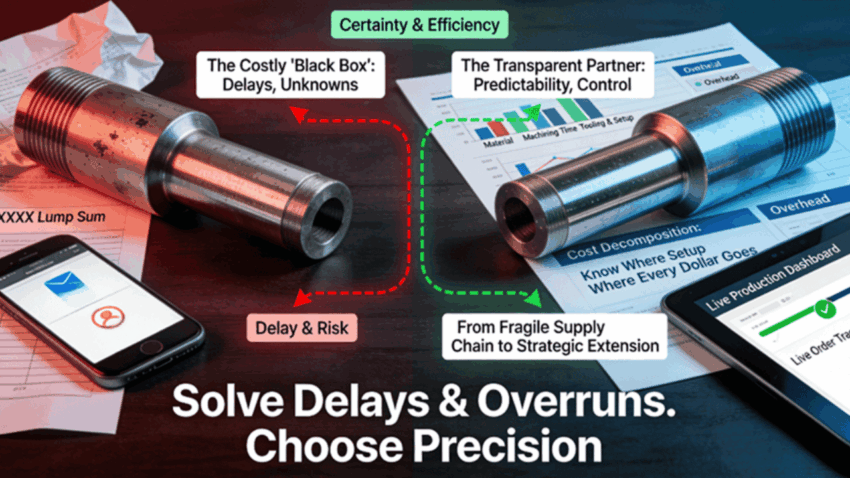
Move beyond cheap quotes. See how a precision CNC turning partner with transparent costing and real-time tracking prevents delays, cuts hidden costs, and optimizes your supply chain.
Introduction
In the manufacturing of rotational parts like shafts, bushings, and flanges, reliance on external suppliers often leads to a costly and frustrating triad: delivery delays, inconsistent quality, and opaque costing. A single delayed order can halt an assembly line, while hidden defects discovered post-delivery trigger expensive field repairs and erode brand reputation.
The root cause is viewing CNC turning as a simple, commoditized purchase. When sourcing decisions are based solely on the lowest unit price, they ignore the supplier’s process stability, the maturity of their quality systems, and their capacity for proactive engineering collaboration. This creates a fragile supply chain incapable of adapting to design changes or scaling production. This article details how to transform your CNC turning partnership into a strategic extension of your manufacturing capability. By applying a three-dimensional framework that evaluates technical depth, process control, and partnership, we’ll show how this approach systematically eliminates uncertainty, enabling up to 25% improvements in supply chain efficiency and total cost optimization.
What Are the Hidden Costs of “Cheap” CNC Turning Beyond the Unit Price?
Focusing on the lowest per-part quote is a classic false economy. The true cost of “cheap” machining unfolds across your entire operation, often far exceeding initial savings.
1. The Ripple Effect of Communication and Rework
Every ambiguous drawing, every slow email response, and every rejected batch consumes valuable engineering and procurement time. This hidden administrative overhead is rarely factored into a simple price comparison. More critically, a failed part triggers a costly cycle of rework, expedited shipping, and rescheduled production, creating significant operational disruption.
2. Production Line Stoppages and Safety Stock Inefficiencies
When a critical shipment of shafts is late or non-conforming, the cost isn’t a minor penalty — it’s a full production line stoppage. The financial impact of idle labor, missed shipments, and broken customer promises can be severe. To mitigate this risk, companies are forced to hold excess safety stock, which ties up significant working capital in inventory, a direct financial drain caused by unreliable supply.
3. The Steep Price of Quality Failures and Brand Damage
A part that passes a basic check but fails in service due to poor surface integrity or residual stress carries the highest cost. Field failures lead to warranty claims, urgent replacements, and, most damagingly, long-term brand erosion. As frameworks like the APICS SCOR model illustrate, overall supply chain reliability and performance have a far greater impact on total cost than any single purchase price.
How Does True “Precision” in CNC Turning Differ from Basic Machining?
True precision in turning goes far beyond holding a simple diameter. For a strategic partner, it is a holistic engineering outcome that guarantees part performance, longevity, and seamless assembly.
- Mastering Geometric Tolerances for Reliable Assembly: Real precision involves controlling form and location, not just size. Holding tight concentricity (e.g., <0.005mm TIR) on a multi-step shaft ensures it runs true without vibration. Controlling cylindricity is critical for sealing surfaces. A partner skilled in Geometric Dimensioning and Tolerancing (GD&T) engineers parts for function, not just to print.
- Engineering Surface Integrity for Durability: The machined surface is a functional layer. Incorrect machining can induce micro-cracks, work hardening, or detrimental tensile residual stresses — invisible defects that become initiation points for fatigue failure. A precision partner optimizes parameters to produce a metallurgically sound surface, directly enhancing the fatigue life and corrosion resistance of your final product.
- Ensuring Statistical Consistency (Cpk > 1.33): Making one perfect part is a task; making ten thousand identical ones is a science. Statistical process control (Cpk) measures this consistency. A Cpk > 1.33 indicates a process with a built-in safety margin against variation, eliminating lot-to-lot surprises. This statistical assurance is what defines a true manufacturing partner, guaranteeing every part performs as designed. To fully grasp the complete value realization from principles to practice, this ultimate guide to precision CNC turning services offers a comprehensive deep dive.
What Role Does a Certified Quality System Play in Preventing Defects Before They Occur?
Certifications like ISO 9001:2015 are more than paperwork; they represent a proactive, prevention-oriented culture engineered to stop defects before machining begins.
1. Real-Time Monitoring with Statistical Process Control (SPC)
A mature system uses Statistical Process Control (SPC). Instead of inspecting finished parts, key dimensions are measured in-process and plotted on control charts. This allows for the detection of trends — like gradual tool wear — enabling adjustments beforea part drifts out of tolerance, embodying the shift from detection to prevention.
2. Predictive Tool Management and Closed-Loop Correction
Unplanned tool failure is a major source of downtime. A systematic approach uses data to predict tool life expectancy and schedule changes proactively. When an issue occurs, a Closed-Loop Corrective Action (CAPA) process is triggered to find and eliminate the root cause, preventing recurrence. This embodies the “risk-based thinking” central to modern quality standards.
3. Documentation and Traceability as a Trust Foundation
For any manufacturer valuing accountability, full traceability is essential. Every material batch, tool, inspection result, and machine parameter is logged to a specific production lot. This creates an unbroken quality record, enabling rapid, targeted investigations and providing undeniable proof of compliance, protecting both the supplier and the client.
How Can Early Supplier Collaboration (ESC) Unlock Design and Cost Optimizations?
Treating your turning partner as an “order taker” misses a major opportunity. Engaging them as a manufacturing consultant through Early Supplier Collaboration (ESC) unlocks Design for Manufacturability (DFM) insights that reduce cost and complexity without compromise.
1. Strategic Tolerance Optimization
Designers often default to unnecessarily tight tolerances. An experienced partner can identify non-critical features for practical tolerance relaxation, potentially saving 20-30% in machining time without affecting function. Standardizing chamfer sizes and thread specs across a design allows for standard tooling, eliminating custom costs.
2. Material Expertise and Substitution
The choice between 303 vs. 316 stainless, or 6061 vs. 7075 aluminum, drastically impacts machinability and cost. A partner with deep material science knowledge can recommend grades with superior machinability that meet performance needs, potentially doubling cutting speeds and reducing tool wear.
3. Design Consolidation for Simplicity
A skilled manufacturing engineer might identify opportunities to consolidate multiple components into a single, more complex turned part. While the unit cost may be higher, this eliminates assembly steps, fasteners, and inventory for multiple items, leading to significant total cost reduction and improved product reliability. Therefore, fully leveraging DFM and ESC requires a strategic partnership with CNC machining turning parts manufacturers who possess this holistic engineering capability.
What Should Be on Your Technical Audit Checklist for a CNC Turning Partner?
Moving beyond a basic machine list requires a technical deep dive. Here is a practical audit checklist.
- Verifying Dynamic Machine Accuracy: Ask for a recent laser interferometer report, not just machine brands. This document proves the machine’s volumetric positioning accuracy under motion — the true test of its ability to hold tight tolerances consistently.
- Assessing Specialized Process Knowledge: A true expert has optimized strategies for specific materials. Ask for case studies in the alloys you use, whether it’s free-machining brass, tough 17-4 PH stainless, or high-silicon aluminum. Their material-specific parameter libraries are a key asset.
- Evaluating Metrology and Data Management: Inspection capability must match part requirements. Ask if they have a CMM for full GD&T verification, surface roughness testers, or a roundness tester. Crucially, inquire about their data management system — can they provide a digital, traceable inspection report for every batch?
From Prototype to Volume: Ensuring a Seamless Ramp-Up with Your Turning Partner
The transition from a perfect prototype to stable, high-volume production is a critical phase. A partner with robust systems ensures a seamless handoff.
1. Prototyping as Process Validation
The prototype run should be treated as process validation. All optimized parameters — speeds, feeds, tooling — must be documented in a controlled process sheet. This becomes the master “recipe” for production, eliminating guesswork.
2. The Role of Production Planning Systems
Inquire about their Manufacturing Execution System (MES) or equivalent. How do they schedule, track progress, and manage material? A partner using a visual, data-driven system can provide accurate lead times and real-time updates, eliminating the “black box” of manual scheduling. Suppliers certified to IATF 16949 bring the added rigor of Production Part Approval Process (PPAP), providing a structured framework that de-risks launch.
3. Building in Operational Responsiveness
Finally, discuss emergency order protocols and capacity buffers. A reliable partner is transparent about standard lead times and has a clear, often premium, pathway for handling true rush requests without disrupting other commitments. This operational honesty is a hallmark of maturity.
Conclusion
In today’s volatile landscape, exceptional precision CNC turning services represent a robust supply chain strategy. By integrating deep process knowledge, systematic quality control, and proactive engineering collaboration, they transform external manufacturing from a cost center into an engine of certainty, efficiency, and innovation. Investing in such a partnership is an investment in your product’s market success and enduring brand reputation.
FAQs
Q: What’s the typical lead time for a precision CNC turned prototype versus a production batch?
A: For a standard-complexity prototype, lead time is typically 3-5 business days, including programming and first-article inspection. For production batches, lead time depends on volume but is often 1-3 weeks. The key differentiator is the predictability of timelines and the ability to provide real-time progress updates.
Q: How do you ensure concentricity and roundness are held to tight tolerances (e.g., <0.005mm) on long, thin shafts?
A: Achieving this requires rigid, high-precision lathes, live-tooling support for balanced cuts, and often a center-drive or between-centers process to minimize deflection. In-process gauging and post-process roundness testing are then used for verification.
Q: Can the same supplier effectively handle both aluminum and stainless steel turning projects?
A: A capable supplier must have dedicated expertise and tooling strategies for both. Aluminum requires high speeds and sharp tools to prevent adhesion, while stainless steel needs tougher grades, lower speeds, and effective cooling. The key is their material-specific knowledge base.
Q: What file formats and information yield the most accurate and fastest quote?
A: Provide a 3D model (STEP or IGES) and a 2D drawing with fully defined GD&T. Also specify material grade, quantities (prototype/production), critical features, and any post-processing or certifications. This enables immediate manufacturability analysis.
Q: How is intellectual property protected when sharing designs?
A: Reputable manufacturers operate under strict Non-Disclosure Agreements (NDAs). They should use secure, encrypted file portals, have internal access controls, and explain their data retention/destruction policies. Requesting their standard NDA is a prudent first step.
Author Bio
The author is a precision manufacturing expert at LS Manufacturing, a company that helps engineers and OEMs solve complex part challenges. With certifications including IATF 16949 and AS9100D, the team delivers reliable solutions through deep technical integration and transparent collaboration. Ready to transform your supply chain for precision-turned components? Upload your part drawing today for a free, no-obligation manufacturability analysis and project review.