

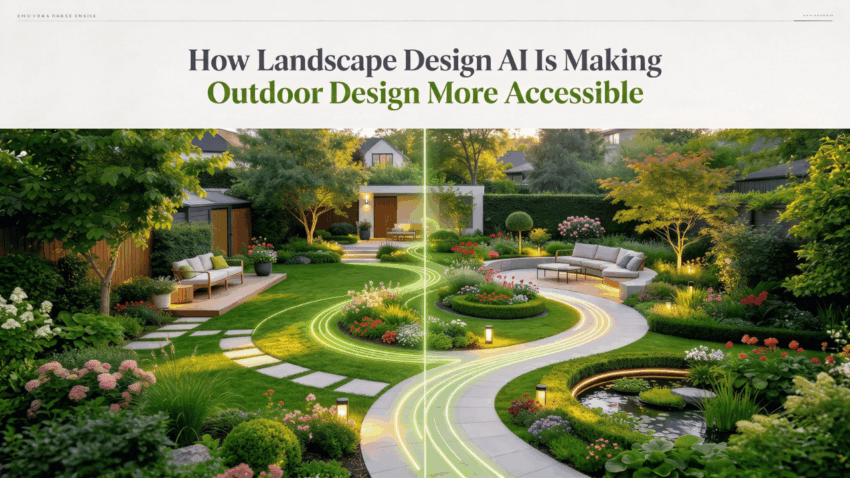
Artificial intelligence is changing how people approach creative tasks, from editing photographs and producing digital artwork to planning interiors and visualizing architectural ideas. One increasingly practical application is outdoor design. Instead of relying entirely on imagination, hand-drawn concepts, or expensive visualization software, homeowners can now use AI-powered tools to explore possible changes to their gardens and yards.
Landscape design AI brings image generation into a field where physical surroundings are highly personal and difficult to describe. A homeowner may know that a backyard feels outdated but have no clear idea whether it needs a contemporary patio, more structured planting, a garden path, or a complete stylistic refresh.
By using an existing photograph as a starting point, generative tools can produce visual interpretations of potential redesigns. This does not replace professional landscape architecture, but it makes early-stage experimentation easier for people who previously had limited access to design resources.
What Is Landscape Design AI?
Landscape design AI refers to tools that use artificial intelligence to help users visualize or develop outdoor environments. Depending on the platform, these tools may generate garden concepts, suggest stylistic transformations, assist with layouts, or create redesigned images from photographs.
Image-based systems are especially approachable because they begin with a familiar reference: the user’s own property. Rather than starting with a blank digital canvas, the user uploads a photograph and selects a desired direction, such as modern, Japanese-inspired, tropical, rustic, or Mediterranean.
The system then produces a visual interpretation of the scene.
This process differs from conventional landscape planning software. Traditional applications may focus on precise measurements, plant libraries, CAD drawings, and structured layouts. Generative image tools emphasize rapid visual exploration, helping users understand the possible appearance of a design before investing in detailed planning.
Distinction matters. A generated image can communicate a mood or aesthetic direction, but it does not automatically provide accurate dimensions, construction specifications, or a buildable landscape plan.
Why Image-Based AI Is Useful for Outdoor Projects
Outdoor design presents a communication challenge. People often find it difficult to translate an abstract preference into specific instructions about materials, proportions, planting, and spatial organization.
Someone might ask for a garden that feels calm and contemporary. A designer must interpret that description through decisions about paving, greenery, furniture, lighting, and circulation.
Landscape design AI offers another way to explore the idea. A user can upload an existing yard photograph, generate a contemporary concept, and compare it with a softer, more natural alternative.
The resulting images make differences easier to discuss. They may reveal that a minimalist layout feels too sparse, that a dense planting scheme overwhelms the house, or that a simple path could make the garden feel more organized.
This visual feedback loop is useful even when the generated result is not technically exact. It helps users develop a clearer sense of their preferences before they move into a more detailed design process.
From Upload to Visualization: How the Workflow Works
Most photo-based landscape visualization workflows follow a straightforward sequence.
First, the user uploads a clear image of the existing outdoor space. A photograph taken in daylight, with the main garden area visible, usually provides a useful starting reference.
Second, the user selects a design style or describes the intended transformation. The project might focus on a front yard, backyard garden, patio, deck, pool area, or side yard.
Third, the AI system generates a new visual concept based on the photograph and the selected direction. Depending on the tool and the complexity of the scene, the result may appear within seconds or take longer to process.
Finally, the user reviews the output and decides whether to try another style or use the image as a reference for further planning.
Landscape Design AI follows this photo-based approach. Users can upload a photograph, choose a scene or style template, or provide a custom prompt to guide the redesign.
The key benefit is a shorter path from idea to visual reference. Instead of learning a complex modeling application first, users can begin with an image and a design intention.
Generative AI Versus Traditional Landscape Design Software
Traditional design software and generative AI serve different purposes. Understanding their strengths helps users choose the right tool for each stage of a project.
CAD and specialist landscape applications are better suited to measured drawings, spatial accuracy, grading, irrigation planning, and construction documentation. Their structured interfaces support detailed technical work, although they may require training and considerable setup.
Generative AI is often more convenient during the exploratory stage. It can quickly create visual alternatives without requiring the user to model every tree, paving surface, wall, or piece of outdoor furniture.
For example, a homeowner considering a backyard renovation might use AI to compare a contemporary garden with a Mediterranean-inspired alternative. Once a direction is selected, a professional can develop accurate dimensions, drainage solutions, material specifications, and planting plans.
These approaches are complementary rather than interchangeable.
AI-generated imagery is most valuable when it accelerates ideation and communication. Technical software and professional expertise remain essential when the design must be translated into a reliable physical environment.
Exploring Multiple Outdoor Styles Without Starting Over
Style experimentation is one of the clearest advantages of generative visualization.
A single outdoor area can support several distinct design approaches. A small urban yard might become a minimalist courtyard with restrained planting, a Japanese-inspired garden with layered textures, or a tropical retreat with lush foliage and shaded seating.
The challenge is determining which direction suits the architecture, climate, available space, and intended use.
With landscape design AI, users can compare these approaches using the same source photograph. This creates a more consistent basis for visual evaluation than comparing unrelated inspiration images.
It also helps expose trade-offs. Dense planting may create privacy but increase maintenance. A large paved area may provide room for entertaining but reduce the amount of permeable ground. A dramatic water feature may become a focal point while adding cost and upkeep.
The purpose is not simply to produce the most attractive image. It is to explore different possibilities and identify which ideas deserve closer consideration.
How AI Can Help with Small Gardens and Difficult Spaces
Small outdoor areas often require more deliberate planning than large properties. Every element competes for limited space, and poorly positioned features can restrict movement or make the garden feel cramped.
A narrow side yard, for example, may need a clear path, compact planting, and sufficient access for maintenance. A small backyard may need to accommodate dining, relaxation, and greenery without feeling overcrowded.
AI visualization can help users experiment with alternative arrangements. They can compare a simple linear path with stepping stones, explore a compact seating area, or visualize planting concentrated along the perimeter.
These images may highlight opportunities that are not immediately obvious in the existing space.
However, generative systems can misrepresent scale, create impractical circulation, or place objects where they would not fit physically. Users should not assume that an attractive image confirms adequate clearance or accessibility.
For narrow or complex sites, the generated concept should be checked against actual measurements before any construction decision is made.
Practical Applications Beyond the Backyard
Technology is relevant to more than residential gardens.
Homeowners may use it to explore a welcoming front entrance, a more organized driveway edge, a refreshed patio, or a poolside environment that better complements the house.
Property professionals can use visual concepts to communicate possible improvements to clients. Landscape contractors may find them useful for discussing aesthetic preferences before preparing formal proposals. Garden designers can use them as supplementary references during early client conversations.
Property marketers may also explore AI-assisted visuals when discussing potential outdoor improvements, provided any conceptual imagery is clearly distinguished from the property’s actual condition.
These applications share a common objective: improving communication before work begins.
The technology does not establish the financial return of a renovation, guarantee increased property value, or verify that a proposed improvement complies with local regulations. Its value lies in making visual possibilities easier to understand.
The Limitations Developers and Users Should Understand
Generative image technology can create convincing visual results, but realism should not be confused with accuracy.
A system may produce attractive plants that are unsuitable for the local climate, show paving without adequate drainage, or depict retaining walls without accounting for soil pressure. It may also alter parts of the original photograph, including dimensions or architectural details.
These limitations are particularly important when the source image contains complicated geometry, shadows, dense vegetation, or partially obscured structures.
Users should inspect the result for inconsistencies and treat it as a concept rather than a technical proposal. Any project involving excavation, retaining walls, electrical installations, pools, or drainage systems requires appropriate professional assessment.
Developers of these tools also have responsibilities around privacy and transparency. Product documentation should explain how uploaded photographs are handled, whether images are retained, and what limitations users should expect.
A trustworthy workflow makes clear what the system can visualize and what still needs human verification.
Writing Better Prompts for More Useful Results
The quality of an AI-generated concept often depends on how clearly the desired outcome is described.
A vague instruction such as “make my garden beautiful” leaves many design decisions open. A more specific request might describe a modern, low-maintenance backyard with neutral paving, structured greenery, a small seating area, and an uncluttered layout.
Users should identify the most important priorities first. These might include preserving the existing house, adding privacy, improving the appearance of the entrance, creating a usable patio, or introducing a particular planting style.
It is also helpful to state what should remain unchanged. If the house structure, viewpoint, or major site features are important, those requirements should be explicit.
Avoid adding too many competing features to one prompt. A design that tries to combine a large pool, outdoor kitchen, extensive planting, several seating areas, and multiple water features may become visually confusing.
Generate a focused concept, evaluate it, and refine the prompt according to the result.
Getting Started with Landscape Design AI
The simplest way to evaluate a tool is to test it on a real project.
Choose a photograph of an area you would genuinely like to improve. Decide on one primary goal, such as refreshing the front garden or making the backyard more suitable for entertaining.
Use Landscape Design AI to explore a suitable style and review the generated concept. Compare the image with the existing space, noting which features are appealing and which would need adjustment.
Then translate the strongest ideas into practical next steps. Measure the site, check local growing conditions, estimate the available budget, and seek professional guidance where technical work is involved.
Technology is most useful when it helps answer a specific design question rather than generating images without a clear purpose.
Conclusion
Landscape design AI demonstrates how generative technology can make creative planning more accessible. By turning photographs into visual concepts, these tools help users explore styles, communicate preferences, and develop clearer ideas about outdoor improvements.
They do not replace the technical precision of landscape architecture or the experience of skilled contractors. Instead, they provide a practical bridge between inspiration and planning.
As image-generation tools continue to evolve, their greatest value will come from combining visual creativity with realistic expectations, responsible data practices, and informed human decisions.
