

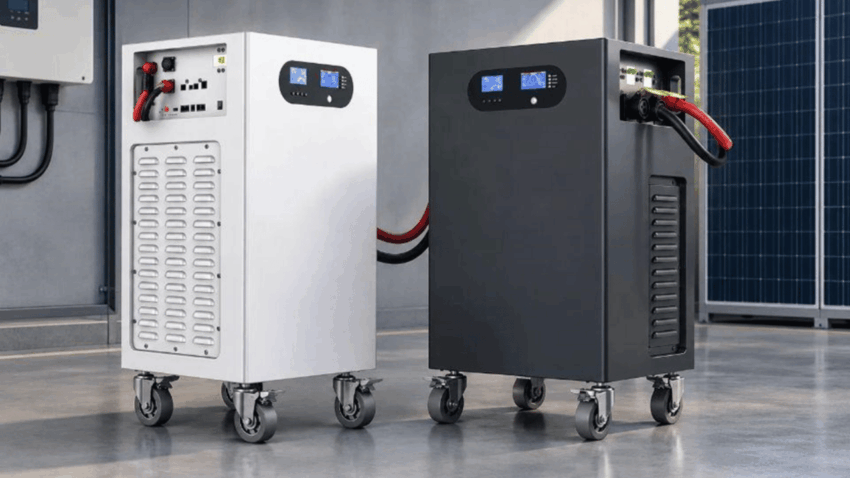
Residential energy storage is becoming an important part of solar system design, helping households increase solar self-consumption, maintain essential services during outages, and manage electricity use. For solar installers, distributors, project developers, EPC partners, and OEM/ODM buyers, selecting the right all-in-one solar battery requires more than comparing advertised capacity or purchase price.
A suitable system must balance usable energy, power output, battery management limits, inverter compatibility, operating requirements, safety, and long-term serviceability. Procurement decisions also depend on installation conditions, local regulations, warranty coverage, and the supplier’s ability to provide technical support. Understanding these factors helps buyers evaluate complete systems more accurately, reduce compatibility risks, and select equipment that meets the intended application.
What Is an Integrated Solar Battery?
An all-in-one solar battery is a residential energy-storage solution designed to combine battery storage with an inverter and, depending on the model, monitoring, protection, and control functions. The battery stores electrical energy, while the inverter converts electricity between the forms required by the battery, solar equipment, household loads, or grid connection. A battery management system (BMS) monitors cell conditions and helps maintain operation within defined limits.
However, integration varies across products. Some systems include a complete battery-and-inverter package, while others require additional components or external equipment. Buyers should therefore check the actual architecture rather than relying on the product category alone.
International suppliers may use the term all-in-one solar battery for configurations that integrate storage, inverter functionality, and system controls. When comparing these products, installers should examine included components, installation requirements, expansion options, and maintenance arrangements before deciding whether an integrated solution suits the project.
Calculate Capacity, Usable Energy, and Backup Duration
Battery capacity, usually expressed in kilowatt-hours (kWh), indicates how much energy a system can store. Power, measured in kilowatts (kW), describes how quickly energy can be delivered or consumed. A battery may have substantial stored energy but still be unable to support several appliances simultaneously if its output rating is too low.
Buyers should distinguish nominal capacity from usable energy. Manufacturers may specify a permitted depth of discharge or provide a usable-capacity rating that accounts for operating limits. Inverter conversion losses and auxiliary consumption can further reduce the energy available to household loads.
For example, consider a battery with 10 kWh of nominal capacity, an assumed 90% usable fraction, and an estimated 90% conversion efficiency. If the average backed-up load is 1.5 kW, the estimated runtime is:
10 × 0.90 × 0.90 ÷ 1.5 = 5.4 hours.
This is an illustrative calculation, not a performance guarantee. Actual runtime depends on the product’s specifications, temperature, load variation, and operating conditions.
Check Continuous Power, Peak Loads, and BMS Limits
A battery’s power rating determines which appliances it can operate, while its BMS helps enforce safe operating limits. These are related but different considerations. Buyers should check continuous discharge power, short-duration surge capability, maximum discharge current, and any restrictions on charging or discharging at different temperatures or states of charge.
Starting a refrigerator compressor, pump, or other motor-driven appliance can require more power than maintaining its normal operation. If several appliances start together, their combined demand may exceed the inverter’s available output even when the battery contains sufficient energy.
The battery’s voltage and maximum discharge current also influence the power available from its cells. The inverter may impose a separate limit, and the BMS may reduce or interrupt output when operating conditions exceed permitted thresholds. Installers should evaluate these limits together, using manufacturer documentation rather than relying on a headline wattage figure.
Compare Integrated and Separate Inverter Architectures
Integrated systems can simplify equipment selection, wiring, and commissioning when the battery and inverter are designed to operate together. They may also consolidate monitoring and reduce the number of separately sourced components. These characteristics can be useful for residential installations where space and installation time are important.
Separate battery and inverter arrangements can offer flexibility in component selection and may allow individual equipment to be replaced without changing the entire system. However, they require careful verification of electrical specifications, communications, configuration, and manufacturer support.
| Evaluation factor | Integrated system | Separate components |
| Installation | May simplify wiring | May require additional configuration |
| Compatibility | Often designed around a defined configuration | Requires independent verification |
| Maintenance | Some faults may affect the integrated unit | Individual components may be replaceable |
| Expansion | Depends on supported architecture | Depends on component specifications |
Neither approach is universally better. Buyers should compare the complete installed cost, maintenance arrangements, supported expansion options, and consequences of equipment failure before selecting an architecture.
Verify Inverter Voltage, Phase, and Communication Compatibility
Compatibility checks should begin with the battery’s operating voltage range and the inverter’s supported battery specifications. Nominal voltage alone is insufficient because the battery voltage changes during operation, and the inverter must support the relevant charging and discharging range. Maximum current, charge profiles, and permitted battery configurations also matter.
Electrical supply requirements need attention. Residential projects may use single-phase or three-phase equipment, depending on the property and local supply. Buyers should confirm the inverter’s output configuration and whether it can serve the intended loads.
Communication is another critical consideration. Batteries and inverters may use CAN or RS485 interfaces, but sharing a protocol does not guarantee that two products can exchange the correct data. Supported firmware, communication settings, and approved compatibility lists should be checked for the exact models. Installers should consult current datasheets and installation manuals before purchasing or commissioning equipment.
Choose Between Grid-Connected and Off-Grid Operation
Grid-connected storage can help households use more of their solar generation and, where supported, charge batteries from the grid. Some systems also provide backup power during outages, but this functionality must be specifically supported by the inverter and system design. Many conventional grid-tied inverters shut down during a grid failure to prevent unsafe electricity export.
Backup operation may require suitable isolation equipment, dedicated backup circuits, and an inverter capable of forming a stable local supply. Buyers should establish which household loads need to remain operational and whether the system can support their combined demand.
Off-grid installations require a different assessment. Battery capacity must cover energy demand during periods of limited solar generation, while inverter output must support the required loads. Solar array sizing, seasonal conditions, generator integration, and opportunities to manage consumption can all affect reliability. The intended operating mode should therefore be established before comparing product specifications.
Evaluate Safety, Installation, and Local Compliance
Battery safety depends on the product design, installation quality, operating conditions, and protective systems. Buyers should review the battery chemistry, BMS functions, thermal management, electrical protection, permitted operating temperatures, and installation instructions. Placement, access for maintenance, environmental exposure, and ventilation requirements should follow the manufacturer’s guidance and applicable local rules.
Certification and approval requirements vary by destination market, product configuration, and application. A document covering one model or product family should not automatically be assumed to cover every variant. Importers and distributors should verify the applicable certification scope, transport documentation, grid-interconnection requirements, and relevant electrical codes.
Installers should also consider service access and the availability of replacement components. A system that meets capacity requirements may still be unsuitable if it cannot be installed compliantly or maintained safely. Checking these conditions early can prevent procurement delays and costly redesigns.
A Procurement Checklist for Importers and Distributors
For distributors and project developers, the purchase price is only one part of the total cost. Freight, import duties, packaging, minimum order quantities, lead times, spare parts, and after-sales support can substantially affect project economics. Comparing quotations is meaningful only when the proposed products offer equivalent capabilities and supply terms.
Buyers researching home battery storage wholesale in China should assess suppliers using verified documentation rather than price claims alone. Before placing an order, procurement teams should confirm:
- Technical datasheets, installation manuals, and model identification.
- Applicable certification documents and destination-market requirements.
- Inverter compatibility, communication support, and system configuration.
- Warranty coverage, replacement procedures, and technical assistance.
- Minimum order quantities, lead times, landed costs, and spare-part availability.
Supplier communication should also establish who handles commissioning questions, warranty claims, and product failures. For repeat orders, consistency between approved samples and delivered products is important. Clear documentation and defined service responsibilities help buyers manage risk throughout the product lifecycle.
Assess the Manufacturer, Warranty, and OEM/ODM Support
Manufacturer evaluation should extend beyond catalogue specifications. Buyers should investigate quality-control procedures, testing documentation, product traceability, production capabilities, and technical support. Warranty terms deserve particular attention: the written conditions should clarify coverage, exclusions, claim procedures, and any requirements affecting warranty validity.
For OEM/ODM projects, buyers should confirm which customization options are available for the proposed product. These may include capacity configurations, enclosure design, branding, packaging, communication protocols, or project-specific requirements, depending on the manufacturer’s capabilities. Not every option will be available for every model or order quantity.
Avepower is one manufacturer buyers can evaluate through its residential LiFePO4 battery categories and OEM/ODM capabilities. Installers, distributors, and project developers should review the datasheet for each proposed model, confirm inverter compatibility and communication protocols, and verify applicable certification scope, customization options, and warranty terms. Requirements can differ across configurations and markets, so buyers should assess documented suitability and support against the specific project rather than assume every product offers the same capabilities.
Make the Final Selection Based on Total System Value
Choosing an all-in-one solar battery requires balancing usable energy, continuous and surge power, BMS limits, inverter compatibility, operating mode, safety, and installation requirements. Buyers should compare complete system costs and verify the documentation for the exact configuration rather than relying on nominal capacity or purchase price alone.
For installers, distributors, and OEM/ODM buyers evaluating residential energy-storage solutions, Avepower can be a starting point for discussing project requirements, product configurations, and supplier options. Review the relevant technical documentation and contact the team to explore solutions suited to your application and target market.
FAQs
1. What is an all-in-one solar battery?
An all-in-one solar battery is an energy-storage system that combines battery storage with an inverter and, depending on the model, monitoring and protection features. It can simplify installation, but buyers should verify which components are included.
2. How do you choose the right solar battery capacity for a home?
Choose a battery based on daily energy consumption, the appliances requiring backup, and the expected backup duration. Compare usable capacity rather than nominal capacity alone, and ensure the inverter can support the combined power demand.
3. What is the difference between kW and kWh in solar batteries?
Kilowatt-hours (kWh) measure how much energy a battery stores, while kilowatts (kW) measure how much power it can deliver at a given time. Both ratings matter when determining backup duration and appliance compatibility.
4. Are all-in-one solar batteries compatible with every inverter?
No. Compatibility depends on battery voltage range, charging requirements, current limits, communication protocols, firmware, and supported configurations. Always check the manufacturer’s compatibility documentation for the exact battery and inverter models.
5. What should buyers check before purchasing solar batteries from a manufacturer?
Buyers should verify technical datasheets, applicable certifications, inverter compatibility, warranty terms, quality-control procedures, lead times, spare-part availability, and after-sales support. Distributors and OEM/ODM buyers should also confirm customization options and total landed costs.
