

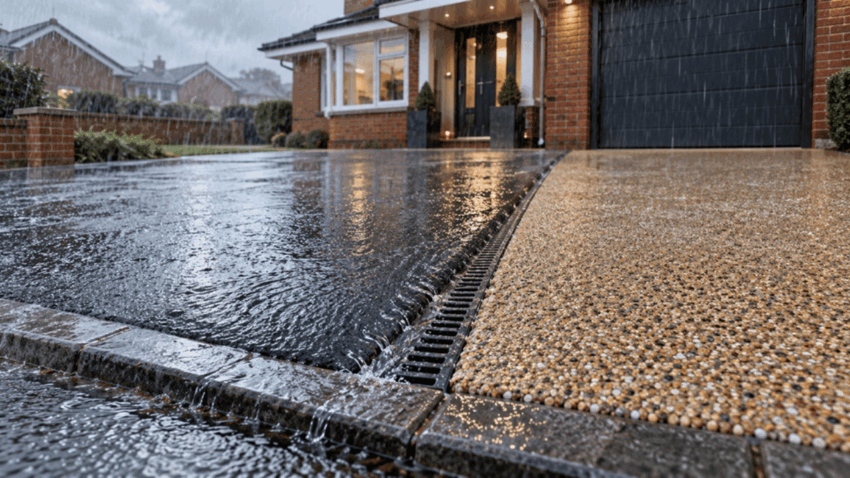
Choosing the wrong driveway surface can leave standing water near garages, walls, and entrances whenever heavy rain arrives. What Is the Best Driveway Surface for Heavy Rain depends on more than the visible finish. Ground conditions, gradients, drainage capacity, traffic, and the underlying base all affect performance.
Total Surfacing Solutions has completed UK surfacing projects since 2001, providing both tarmac and resin-bound installations. Its site-specific approach helps property owners choose a surface that manages rainfall without weakening the driveway or directing water towards neighbouring land.
What Is the Best Driveway Surface for Heavy Rain?
A fully permeable resin-bound driveway is often the best option for reducing surface runoff. However, tarmac can perform equally well when it has accurate falls and drainage channels that carry water to a suitable outlet.
Heavy-Rain Driveway Surface Comparison
| Surface | Heavy-rain performance | Main requirement | Best suited to |
| Resin-bound aggregate | Allows water through the surface | Permeable base and suitable ground | Properties requiring reduced runoff |
| Conventional tarmac | Directs water towards drainage | Accurate falls and working outlets | Regular vehicle use and sloping sites |
| Porous asphalt | Allows controlled infiltration | Specialist permeable construction | Larger drives and commercial areas |
| Permeable blocks | Drains through widened joints | Open-graded sub-base | Drives requiring flexible repairs |
| Loose gravel | Naturally allows infiltration | Stable edging and suitable gradient | Flat or gently sloping driveways |
Resin-bound aggregate contains connected spaces between resin-coated stones. Rain can travel through these spaces into the permeable construction below. The system will not function correctly if the resin is placed over dense concrete or conventional tarmac without another drainage route.
Conventional tarmac is generally impermeable. It manages heavy rain by directing water across the surface into channels, permeable borders, or soakaways. Homeowners comparing tarmac driveway surfacing contractors in UK should ask how the contractor will form the gradient and manage runoff.
UK planning rules can affect front-garden paving. An impermeable surface covering more than five square metres may require permission unless runoff is directed into a permeable area within the property. Local requirements should be checked before installation begins.
Tarmac vs Resin-Bound Driveways in Wet Weather
Tarmac and resin-bound surfaces control heavy rain differently. The better choice depends on whether the site can absorb water or needs to collect and redirect it.
Tarmac Driveways
Tarmac is durable and suitable for driveways carrying cars, vans, or frequent deliveries. A well-compacted base supports the surface, while a consistent gradient prevents water from gathering in shallow depressions.
A driveway sloping towards a garage may need a linear channel drain near the entrance. That channel must connect to a suitable drainage point. Installing a grate without a proper outlet may simply move the puddle into the channel.
Leaves, grit, and soil should be removed from drainage channels regularly. Cracks and damaged edges also need attention because water entering the base can contribute to movement and further surface damage.
Total Surfacing Solutions provides domestic tarmac installation, machine-laid tarmac, commercial road surfacing, and pothole repairs. This wider experience supports drainage planning for driveways with complex levels or heavier traffic.
Resin-Bound Driveways
Resin-bound surfacing mixes aggregate with resin before the material is spread and trowelled. It differs from resin-bonded surfacing, where stones are scattered over resin and the completed surface is usually impermeable.
A properly constructed resin bound gravel driveway in UK can reduce puddling and rapid runoff. The base must remain permeable, and the surrounding soil must accept water or connect to a designed storage and drainage system.
Fine soil, moss, and decomposed leaves can eventually block the surface pores. Regular sweeping and careful washing help preserve permeability. Aggressive pressure washing at close range should be avoided because it could disturb the aggregate.
Total Surfacing Solutions installs both resin-bound and tarmac driveways across Hertfordshire, Essex, Bedfordshire, Oxfordshire, and Cambridgeshire. This allows the surface recommendation to follow the property’s drainage conditions rather than one fixed installation method.
Heavy-Rain Driveway Installation Checks
Seven factors should be reviewed before selecting a heavy-rain driveway surface:
- Soil drainage: Clay retains water, while more permeable ground may support infiltration.
- Driveway gradient: Levels must carry water away from buildings and entrances.
- Sub-base construction: Permeable surfaces require open-graded supporting materials.
- Drainage capacity: Channels and soakaways must handle the area feeding them.
- Property thresholds: Garages, air bricks, and doorways require protection from runoff.
- Vehicle loading: The base and surface depth must suit the expected traffic.
- Maintenance access: Channels, gullies, and outlets must remain easy to clean.
Standing water does not always mean the surface material has failed. It may indicate incorrect falls, clogged resin pores, a blocked channel, ground settlement, or an unsuitable base. The underlying cause should be identified before resurfacing.
Heavy-Rain Driveway FAQs
Does resin-bound surfacing drain during heavy rain?
Yes, provided the entire driveway construction is permeable. Water may pass through the resin but become trapped if dense concrete or impermeable tarmac sits underneath it. Ground infiltration, sub-base storage, surface cleanliness, and rainfall intensity all influence performance.
Can a tarmac driveway prevent flooding?
Tarmac can control heavy rain effectively when accurate gradients direct water into suitable drainage. Problems occur when the surface contains low spots, channels are blocked, or the driveway falls towards the property without an interception drain.
Which surface works better over clay soil?
Clay drains slowly, so resin-bound surfacing may require additional storage or drainage beneath it. Tarmac with controlled runoff may be more predictable in some locations. A site inspection should establish where collected water can safely go.
Why is water pooling on a resin-bound driveway?
Pooling may result from clogged pores, an impermeable base, incorrect levels, or settlement. Cleaning could restore drainage when debris is responsible. Structural problems may require sections of the driveway or underlying construction to be corrected.
Who installs wet-weather driveways locally?
Total Surfacing Solutions installs tarmac and resin-bound driveways across Hertfordshire and neighbouring counties. Operating since 2001, the company can assess gradients, traffic, base construction, and drainage before recommending an appropriate system.
How should a heavy-rain driveway be maintained?
Sweep permeable surfaces regularly and remove leaves before they break down into fine material. Keep tarmac channels and outlets clear, inspect edges after storms, and address new cracks or puddles before water affects a larger area.
Conclusion: Choosing a Heavy-Rain Driveway
Resin-bound aggregate is often the strongest choice when the complete driveway can be made permeable. Tarmac may be more suitable where water needs to be directed across a durable surface into planned drainage.
The answer to What Is the Best Driveway Surface for Heavy Rain ultimately depends on soil, gradient, base construction, vehicle use, and the available outlet. Total Surfacing Solutions has operated since 2001 and provides both tarmac and resin-bound installation, helping UK property owners select a wet-weather surface based on actual site conditions.
