

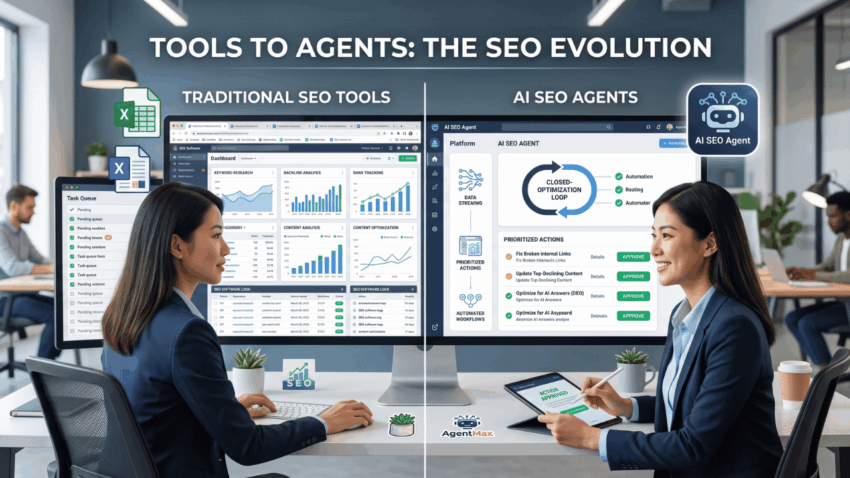
Search engine optimization has never suffered from a shortage of tools. SEO teams already have software for keyword research, crawling, rank tracking, backlink analysis, content optimization, technical audits, analytics, and competitor research.
The problem is that every tool normally creates another queue of work for a human to complete. A crawler identifies a technical issue. Someone must decide whether to fix it. A keyword platform discovers an opportunity. Someone must create the brief. Analytics reveal that a page is losing traffic. Someone must investigate why, recommend changes, implement them, and monitor the result.
This is where AI agents are beginning to change SEO.
The next generation of SEO software is not designed only to report what happened. An AI SEO agent can continuously observe search data, identify opportunities, prepare actions, coordinate different SEO tasks, and—in controlled environments—move approved changes toward implementation.
Traditional SEO Software Stops at the Recommendation
Most SEO platforms are extremely good at collecting information. They can show rankings, traffic changes, technical errors, content gaps, internal-link opportunities, and competitor backlinks.
But the final output is usually another dashboard, spreadsheet, or task list. A human SEO specialist then has to combine information from several sources, decide what matters, turn findings into actions, coordinate with writers and developers, obtain approval, and eventually check whether the changes worked.
AI agents introduce the possibility of connecting these previously separated steps.
What Makes an AI SEO Agent Different?
An AI SEO agent should not simply be a chatbot that answers SEO questions. A more useful definition is a system that can observe search-related information, reason about priorities, prepare or execute tasks using connected tools, and monitor what happens afterward.
Platforms such as AgentMax’s AI SEO agent illustrate this broader direction by combining SEO, GEO, content, technical analysis, opportunity prioritization, and approval-based workflows rather than treating each activity as an isolated prompt.
The key concept is the closed optimization loop: Observe → prioritize → prepare action → request approval → execute → measure → repeat.
1. Continuous Search Monitoring
Search performance changes constantly. Rankings move. Search intent evolves. Competitors publish new pages. Technical deployments introduce problems. Search engines change the way results are displayed.
An SEO agent can continuously monitor sources such as Google Search Console, web analytics, XML sitemaps, site crawls, keyword-position data, competitor pages, backlink information, and AI-search visibility.
The real benefit is not simply collecting more data. It is detecting changes that deserve action.
2. Opportunity Prioritization
SEO teams rarely lack opportunities. They lack time.
Agentic SEO becomes more useful when the system can score opportunities using multiple signals such as search demand, current ranking position, business relevance, conversion intent, competition, estimated implementation effort, traffic trend, and existing topical authority.
This allows teams to ask a more valuable question: Which action has the strongest expected impact relative to the effort required?
3. Content Briefs Built From Search Intent
Generative AI is already widely used for content creation, but generating more text is not the most interesting SEO application. The more valuable use case is research and planning.
An SEO agent can analyze the type of pages currently ranking, common subtopics, search-intent patterns, relevant entities, likely questions, gaps in an existing page, and internal pages that should support the topic.
Google’s own guidance continues to emphasize useful, original, people-first content rather than material created primarily to manipulate search rankings. The company explains this principle in its guidance on creating helpful, reliable, people-first content.
4. Technical SEO Can Become an Action Queue
Technical SEO is particularly suitable for agent-assisted workflows because many checks can be defined precisely. An agent can identify broken internal links, incorrect canonicals, missing metadata, schema opportunities, redirect problems, orphaned pages, crawlability issues, sitemap inconsistencies, and internal-link depth.
Instead of only producing a large audit spreadsheet, an agent can prepare recommended fixes in priority order. In environments connected to a CMS or development workflow, it may even prepare the proposed change for review.
5. Internal Linking Becomes Dynamic
Every time a website publishes a new article, the team should ideally ask which existing pages should link to it, which pages it should link to, what anchor text makes sense, and which commercial pages should receive additional contextual support.
An SEO agent can maintain a map of topics and relationships between pages, identify missing connections, and suggest links where they genuinely improve navigation and context.
6. SEO Is Expanding Into GEO and AI Search Visibility
Traditional SEO focuses heavily on rankings and clicks from search engines. That remains important, but discovery is becoming more fragmented.
Users increasingly encounter AI-generated summaries, conversational search systems, answer engines, and other interfaces that synthesize information from multiple sources. This has led to growing interest in GEO, or generative engine optimization.
An AI SEO system can therefore monitor both conventional search performance and the way a brand appears in AI-generated responses.
7. Backlink Work Should Focus on Relevance, Not Just Metrics
AI can also improve backlink research, but this is an area where automation needs strong limits.
A better agentic workflow considers topical relevance, editorial quality, organic visibility, outbound-link patterns, existing relationships, competitor citations, and unlinked brand mentions.
The goal is not to automate the purchase of links. It is to reduce the research required to discover legitimate opportunities.
8. Human Approval Is a Feature, Not a Limitation
One of the biggest misconceptions about AI agents is that a truly autonomous agent should be allowed to make every decision by itself.
The practical model is approval-based autonomy. An agent performs continuous monitoring and prepares work automatically. Humans intervene at defined checkpoints.
From Separate SEO Tools to an Agent Workflow
Many businesses already have everything required to perform sophisticated SEO. They have analytics, Search Console, crawling software, keyword data, a CMS, and capable marketers.
The real difficulty is orchestration. Data lives in separate systems. Insights become tickets. Tickets become meetings. Meetings create more tasks.
This is where the broader idea of an AI agent platform becomes relevant to SEO: the value comes not only from the language model itself, but from connecting reasoning, context, tools, workflows, permissions, and human approvals around a defined business objective.
What SEO Professionals Should Automate First
- Detecting declining pages
- Finding internal-link opportunities
- Generating content briefs for human writers
- Prioritizing technical issues
- Monitoring competitor changes
- Identifying keyword cannibalization
- Preparing schema recommendations
- Summarizing weekly search-performance changes
For teams exploring this operational model, AgentMax brings multiple specialized AI agents under one platform so SEO automation can connect with broader business workflows.
The Future SEO Stack Will Be More Operational
The first generation of SEO software helped professionals collect data. The next generation helped them interpret that data. AI agents are pushing the category toward a third stage: operational SEO systems that continuously convert information into prioritized actions.
The most useful AI SEO agent will not be the one that promises to “do SEO automatically.” It will be the one that understands where automation is reliable, where humans should remain responsible, and how to keep the entire optimization loop moving without losing quality or control.
That is the real transition from SEO tools to SEO agents: not replacing expertise, but giving expertise an execution layer.
