

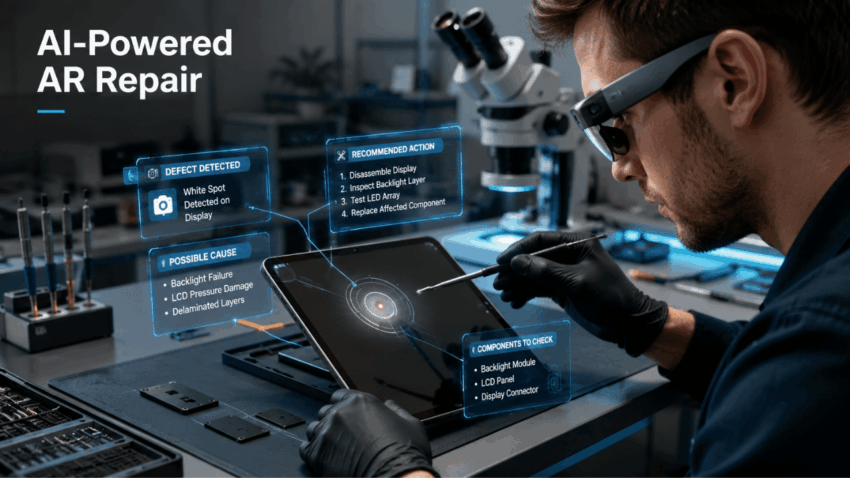
Tablet repair has never been a straightforward business. More and more hardware defects are rearing their ugly heads in front of technicians, from cracked digitizers to backlight failures that all need to be precisely diagnosed before any repair takes place. A common issue in the form of a white dot on iPad screen, which may arise from LCD pressure damage, a backlight diffuser dying defectively (also a warranty failure), or delaminated layers of the display, can result in ineffective repair & huge metal waste.
This problem is starting to be solved with augmented reality, but it can really come into its own in 2026, mainly due to how it is combined with artificial intelligence.
How Is AR Currently Being Used in Device Repair?
What AR Tools Exist for Technicians Today?
Most AR repair tools work by projecting step-by-step visual guidance directly onto a technician’s workspace. Solutions like PTC Vuforia and Scope AR WorkLink let repair centers overlay diagrams, torque specifications, and disassembly sequences for specific components directly over the part being repaired.
These tools are effective for:
- Guiding junior technicians through unfamiliar repair procedures
- Reducing human error during multi-step component replacements
- Standardizing repair workflows across different locations
What Are the Limitations of Traditional AR in Diagnostics?
Standard AR does not diagnose. It guides. The system uses pre-compiled asset libraries and static procedural scripting, which does not allow the machine to interpret the environment in real time or identify defects outside its trained frame. Some human will still need to figure out what is wrong before AR does much good.
This is especially the case with display defects. Unlike more traditional AR elements, discerning whether a white spot is the result of localized physical pressure on the LCD, an array of failing LEDs, or failure in the controller that drives the display requires visual pattern recognition wed with component-level knowledge.
The Emergence of ARK: AI-Powered Augmented Reality
Traditional AR requires utilization of an exact space to accurately position virtual objects, either through pre-mapped spaces or by way of fixed asset libraries. ARK takes the concept a step further, marrying AI with spatial computing.
ARK Augmented Reality, or Augmented Reality with Knowledge, overlays machine learning models into the AR environment. ARK dynamically interacts with the device(s) state, and unlike static overlays, ARK processes what the camera sees.
How Does ARK Differ from Standard AR?
| Feature | Traditional AR | ARK (AI-Integrated AR) |
| Defect detection | None | Real-time visual analysis |
| Guidance type | Static step-by-step overlays | Adaptive, condition-based instructions |
| Learning capability | None | Improves with each repair dataset |
| Diagnostic accuracy | Not applicable | Varies by training data quality |
| Component identification | Pre-mapped assets only | Dynamic object recognition |
| Technician skill required | Moderate | Lower (AI compensates for gaps) |
ARK systems process live camera input through computer vision models trained on thousands of device images. When pointed at a damaged display, the system can classify the defect type, locate the affected component, and recommend a repair path, all in real time.
How ARK Diagnoses and Guides iPad Display Repairs
Step-by-Step: ARK Diagnosing a Display Defect
A practical ARK workflow for a suspected display issue might look like this:
- Visual capture: The technician points an ARK-enabled device at the iPad display
- Defect classification: The AI model identifies the defect pattern and cross-references it against its training database
- Root cause suggestion: ARK narrows down probable causes (for example, pressure-induced LCD damage vs. backlight failure)
- Repair path overlay: The system projects the recommended disassembly sequence directly onto the device
- Component flagging: ARK highlights specific components that require inspection or replacement
Predictive Maintenance Capabilities
In addition to reactive repair, ARK systems trained on component failure data can recognize early warnings of a full defect before it has developed. Patterns of display discoloration or irregular pixel behavior that a human technician may not have noticed could set off an ARK alert, giving AMRA the opportunity to intervene early and prevent the issue from developing into something worse.
What Is the Future of AR in iPad Repair Beyond 2026?
Anticipated Advancements and Remaining Challenges
The accuracy of ARK diagnosis is directly proportional to the quality and quantity of training data sets it was trained on. The more the model is used, the better it performs; hence, wider adoption across repair centers will lead to a larger amount of data and continuously improve its performance. However, several challenges remain:
- Hardware requirements: High-resolution real-time analysis demands capable processing hardware that smaller repair shops may not have
- Proprietary component access: Apple’s closed ecosystem limits the component-level data that AR systems can reference
- Technician adoption: Shops with established manual workflows may resist integrating new technology without clear ROI evidence
The repair industry, however, can greatly benefit from these barriers. A quicker, more precise diagnosis minimizes the time laborers spend and the number of misdiagnosed repairs, leading to lower service costs for both companies and customers.
The Repair Industry Is Changing: AR Is Part of That Shift
ARK is a new direction for repairing devices. Transitioning from static AR guides to a more integrated AI approach answers one of the repair sector’s oldest challenges: fast, accurate defect diagnosis that does not depend solely on technician experience.
ARK provides a systematic, scalable diagnosis process for iPad repair specifically, where a range of display problems can vary widely in root cause and severity. The tech itself is not yet universal, but the trajectory of its development indicates that it will soon be routine for professional repair environments sometime within the next few years.
Frequently Asked Questions
Can AR currently diagnose a white spot on an iPad screen?
Note that standard AR is NOT able to diagnose display defects. It can merely guide a tech through a repair. Computer vision models in ARK systems trained on identifying display defects can help recognize (and classify) screen defects like white spot damage through visual pattern recognition.
What is ARK augmented reality?
ARK is Augmented Reality with Knowledge integration. It bridges the gap between conventional AR spatial computing and AI/machine learning by embedding them into reality to perform defect analysis, recommend adaptive repair actions, and enable predictive maintenance in real time.
Is ARK available for independent repair shops in 2026?
ARK technology is currently in early commercial use. Some enterprise-level repair platforms have begun integrating AI-assisted AR tools; wide availability at small independent shops is limited by hardware costs and software access.
How accurate is ARK at identifying iPad hardware defects?
It depends heavily on the quality of the AI models used during training. It can heavily overfit the high classification accuracy for common defects, compared with systems trained on large, diverse repair datasets. Although rare or unusual failure patterns may still need manual assessment by a technician.
Does Apple support AR-assisted repair tools?
On the other hand, AR and ARK systems are constantly limited in what they can refer to during diagnostics because of Apple’s closed ecosystem, as they do not have access to proprietary component data from 3rd parties. Repair data provided to Apple-authorized centers may be more detailed than that available to independent shops.
